


Why Extreme Summer Heat and Cool Winter Nights Stress Your System More Than You Realize
How extreme summer heat and cool winter nights stress your system is something every St. George homeowner feels — but few fully understand until a health scare or a broken AC unit forces the question.
Here is a quick summary of the key ways temperature extremes affect your body and home:
How Extreme Summer Heat and Cool Winter Nights Stress Your System at a Glance
| Stressor | What Happens to Your Body | What Happens to Your Home |
|---|---|---|
| Extreme summer heat | Core temperature rises, heart works harder, kidneys strain, sleep is disrupted | AC runs continuously, compressor wears faster, energy bills spike |
| Cool winter nights | Blood pressure rises, blood thickens, cardiovascular risk increases | Furnace cycles more, heat exchangers expand and contract, pipes risk freezing |
| Day-to-night temperature swings | Autonomic nervous system is forced to constantly readjust, immunity is taxed | HVAC switches between heating and cooling, causing short-cycling and component wear |
| Seasonal transitions (autumn/spring) | Re-acclimatization strains the respiratory and cardiovascular systems | Systems that sat idle face their first demanding run of the season, increasing failure risk |
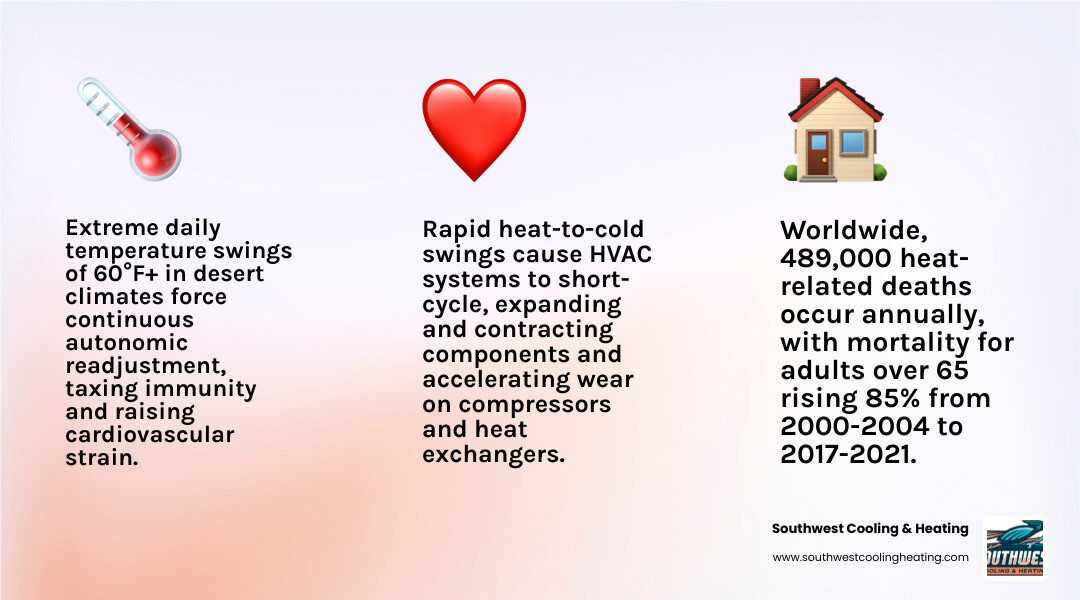
St. George, Utah sits in one of the most thermally demanding climates in the country. Summer days regularly push past 100°F, while winter nights can drop below freezing — a swing of well over 60 degrees that repeats year after year. That is not just uncomfortable. Research consistently shows that extended periods of high daytime temperatures combined with warm nights prevent the body from recovering its normal core temperature, creating cumulative physiological stress that can become genuinely dangerous. Meanwhile, rapid swings between heat and cold force your HVAC system through repeated cycles of expansion, contraction, and mode changes that accelerate wear on every major component.
The global data makes the stakes clear. Approximately 489,000 heat-related deaths occur worldwide every year, and heat-related mortality for people over 65 increased by roughly 85% between 2000–2004 and 2017–2021. In the United States, extreme heat has become the leading cause of weather-related deaths, and the average number of extreme heat events in U.S. cities has jumped from about two per year in the 1960s to ten per year between 2010 and 2020. The problem is not staying still — it is accelerating.
I’m Bruce Hymas, owner of Southwest Cooling and Heating, and after decades of serving families across the St. George area I’ve seen how extreme summer heat and cool winter nights stress your system — from heat-exhausted homeowners with failed AC units to furnaces that couldn’t keep up with a sudden cold snap. In the sections below, I’ll walk you through exactly what is happening inside your body and your home, and what you can do about it.
Quick look at how extreme summer heat and cool winter nights stress your system:
- best hvac setup for high desert weather
- how desert temperature swings create unique comfort challenges
- how southern utah climate affects your hvac system
How Extreme Summer Heat and Cool Winter Nights Stress Your System: The Physiological Toll
To understand how extreme summer heat and cool winter nights stress your system, we have to look at the human body’s built-in thermostat. Your body works tirelessly to maintain a stable core temperature of about 98.6°F (37°C). This process, known as thermoregulation, is managed by your autonomic nervous system.
When you are exposed to extreme summer heat, your body’s primary defense is to dump heat. It does this by dilating blood vessels near the skin (vasodilation) and producing sweat. For sweat to cool you down, it must evaporate. However, when the heat index is high, evaporation slows down. This forces your heart to pump significantly harder and faster to move warm blood to your skin.
On the flip side, during cool winter nights in high-desert areas like Diamond Valley or Winchester Hills, the biological response reverses. Your body tries to conserve heat through vasoconstriction—narrowing blood vessels to keep warmth centered around your vital organs.
This constant back-and-forth is highly taxing. In locations with dramatic diurnal variations, your autonomic nervous system never gets a break. During the day, you are dealing with dehydration and kidney stress as your body uses up water to sweat. At night, your system must suddenly pivot to keep you warm. This rapid cycling drains your energy reserves, taxes your kidneys, and leaves you feeling physically exhausted. To explore this dynamic further, check out our guide on All About Desert Temperature Swings.
The Cardiovascular and Respiratory Impact: How Extreme Summer Heat and Cool Winter Nights Stress Your System
The cardiovascular system bears the heaviest burden when dealing with extreme temperatures. During extreme summer heat, the sheer volume of blood redirected to the skin surface increases myocardial oxygen demand. If you are dehydrated, your blood volume drops, making your heart pump even faster to maintain blood pressure.
Conversely, when the sun sets over Ivins or Santa Clara and those cool winter nights set in, the sudden temperature drop triggers acute hemodynamic stress. Vasoconstriction instantly drives up your blood pressure. Simultaneously, cold exposure increases plasma viscosity and fibrinogen levels, essentially making your blood thicker and more prone to clotting. This “winter milieu” explains why cardiovascular events, such as heart attacks and strokes, rise during cold snaps. Each 1°C decrease in ambient temperature is associated with a 1.6% increase in cardiovascular mortality risk.
Your respiratory system faces its own battle. Cold, dry night air acts as a rapid irritant to sensitive airways. It cools the nasal tissues, which reduces your local immune response and can trigger severe bronchospasms. For residents living with asthma or Chronic Obstructive Pulmonary Disease (COPD), these rapid daily shifts between hot and cold air can lead to sudden hospitalizations.
Your home’s comfort systems experience a parallel mechanical strain. To learn more about how local atmospheric conditions impact mechanical equipment, read about Why Washington County Weather Is Hard on Your AC.
Sleep Disruption and Melatonin: How Extreme Summer Heat and Cool Winter Nights Stress Your System
A major reason why extreme summer heat and cool winter nights stress your system is the cumulative impact of sleep disruption. Your circadian rhythm relies heavily on temperature cues. To fall asleep and reach deep, restorative REM stages, your core body temperature must naturally drop by about 1 to 2 degrees Fahrenheit.
When nighttime temperatures remain elevated during summer heatwaves, your body cannot dump its internal heat. This delays the onset of melatonin—the hormone responsible for sleep regulation—which is already pushed back by the longer daylight hours of summer. The result is a highly fragmented sleep cycle, characterized by difficulty falling asleep, frequent waking, and a higher probability of getting less than seven hours of sleep.
Without nighttime cooling, your core temperature remains high, leaving you with a elevated thermal baseline the next morning. When this happens night after night, it creates a state of cumulative fatigue. This chronic exhaustion damages your immune system, impairs cognitive function, and heightens emotional irritability.
The Science of Seasonal Transitions: Why Autumn and Spring Strain the Body
While extreme summer heat and freezing winter nights are obvious challenges, the transition seasons of autumn and spring introduce a more subtle, molecular strain. The human body does not instantly adapt to a new climate; seasonal acclimatization is a complex biological process that takes up to two weeks of steady exposure.
During these transition periods, your body is caught off guard. In late spring, sudden heat spells catch your system before it has expanded its plasma volume or adjusted its sweat rate. This lag triggers an immediate inflammatory response. Researchers tracking biomarkers have found that the spring transition is associated with sharp spikes in inflammatory molecules, rheumatoid arthritis markers, and even HbA1c levels (a marker of blood sugar regulation).
In autumn, the transition from warm to cold weather causes a sudden shift in your gut microbiome, immune pathways, and blood pressure regulation. Because the weather in places like Hurricane, Toquerville, and La Verkin can swing wildly from day to day, your body is forced into a state of constant re-acclimatization. This continuous biological shifting back and forth leaves you highly vulnerable to seasonal illnesses.
Your HVAC system faces a very similar struggle during these shoulder seasons, switching rapidly between heating and cooling modes. To understand this mechanical battle, see Why the Southern Utah Desert Is Your HVAC System’s Toughest Opponent.
Warm-to-Cold vs. Cold-to-Warm: The Autumn Mortality Peak
Interestingly, the human body does not handle all seasonal transitions equally. Bioclimatic mortality data reveals a fascinating paradox: the transition from warm to cold weather in autumn produces significantly more thermophysiological strain than the transition from cold to warm in spring.
In continental climates with wide temperature variations, mortality data shows a distinct secondary peak in October (autumn), whereas the spring transition in May shows a much smaller jump. Even though October is objectively warmer than the freezing winter months, the sudden drop from late-summer warmth to autumn chill catches the body before it has developed cold-acclimatization defenses.
During the warm-to-cold transition, your body must rapidly adapt to increased respiratory heat exchange. Breathing cold air strips moisture and heat directly from your lungs, putting immediate stress on your pulmonary and cardiovascular systems.
| Transition Type | Biological Adaptations Required | Primary Physiological Risks | Impact on Mortality |
|---|---|---|---|
| Warm-to-Cold (Autumn) | Vasoconstriction, increased thyroid activity, metabolic remodeling of brown adipose tissue | Sudden blood pressure spikes, increased blood viscosity, respiratory airway irritation | Significant secondary mortality peak (e.g., October spike) |
| Cold-to-Warm (Spring) | Vasodilation, expanded plasma volume, increased sweat rate, lower electrolyte loss | Dehydration, heat lethargy, sudden electrolyte imbalances | Minor, smaller mortality jump (e.g., May transition) |
The Acclimatization Thermal Strain Index (ATSI) Explained
To accurately measure this seasonal transition strain, scientists developed the Acclimatization Thermal Strain Index (ATSI). Traditional weather metrics rely solely on air temperature or humidity, but these figures do not account for how well the human body is currently adapted to its environment.
The ATSI is a advanced bioclimatic indicator that quantifies the additional physiological strain experienced during periods of rapid temperature change. It calculates respiratory heat exchange and autonomic stress by comparing the current day’s thermal conditions against the average conditions of the preceding weeks.
If St. George experiences a sudden 55°F day in early October after weeks of 90°F weather, the ATSI will show a high strain value. However, that same 55°F day in January—when your body is fully cold-acclimatized—will register a very low strain value. The ATSI proves that health risks are not just about how hot or cold it is; they are about how fast the weather is changing relative to your body’s current state of acclimatization.
Identifying Vulnerable Populations and High-Risk Groups
While extreme temperature swings affect everyone, certain groups are far more vulnerable to the dual stress of hot days and cold nights. These high-risk populations include older adults, infants, individuals with chronic illnesses, outdoor workers, and low-income households.
Low-income households in older residential areas of Bloomington or Bloomington Hills often face heightened risks. They may live in poorly insulated homes with aging, inefficient HVAC systems. When faced with high energy demands, these families may delay running their heating or cooling, exposing themselves to dangerous indoor temperature extremes.
Risk Factors for Seniors and Chronic Disease Patients
For seniors over the age of 65, thermoregulation is naturally compromised. Aging bodies produce sweat less efficiently and have a diminished thirst drive, which rapidly accelerates the risk of dehydration and heatstroke.
Furthermore, many older adults take prescription medications that interfere with the body’s ability to regulate temperature. For example:
- Diuretics (often prescribed for high blood pressure) can severely worsen dehydration in extreme heat.
- Beta-blockers limit the heart’s ability to increase its rate, preventing proper heat dissipation via blood flow to the skin.
- Antihistamines and antidepressants can suppress sweating, leaving the body unable to cool itself.
When you combine these medication side effects with pre-existing cardiovascular or respiratory diseases, a sudden heatwave or a freezing desert night can quickly escalate into a medical emergency.
Practical Interventions: Protecting Your Health and Your Home
Minimizing the physiological strain of extreme temperature swings requires a combination of smart lifestyle habits and reliable home climate control.
To protect your body, start with these evidence-based strategies:
- Hydrate proactively: Drink water consistently throughout the day. Do not wait until you are thirsty, as thirst is an early sign of mild dehydration.
- Utilize hand and foot immersion: If you are overheating, submerge your hands and feet in cool (not freezing) water. These areas contain specialized blood vessel networks that act as highly efficient heat exchangers, rapidly lowering your core temperature.
- Prioritize bedroom cooling: If you have limited cooling options, focus your resources on keeping your bedroom below 70°F at night to ensure deep, restorative sleep.
- Leverage smart thermostats: Program your thermostat to transition temperatures gradually rather than making large, sudden jumps.
Maintaining a reliable home HVAC system is your primary line of defense against high desert extremes. To learn why regular system checkups are essential in our region, see Is Annual HVAC Maintenance Worth It in St. George?.
Preparing Your Home’s Climate Control for Volatile Weather
Your HVAC system is the unsung hero of your health, but high desert conditions put immense mechanical stress on its components. When St. George temperatures swing wildly, your system is forced to cycle rapidly between heating and cooling. This can lead to premature component failure, particularly in capacitors, compressors, and reversing valves.
To protect your home and keep your system running efficiently, focus on these key maintenance steps:
- Seal your building envelope: Add weatherstripping around doors and seal gaps around windows to prevent drafts and keep conditioned air inside.
- Manage indoor humidity: Keep your indoor humidity levels strictly between 30% and 50%. This range protects your respiratory tract from drying out while preventing mold growth.
- Replace air filters regularly: In dusty desert environments like Coral Canyon and Hidden Valley, fine sand particles quickly clog filters, restricting airflow and placing extra strain on your system.
For a complete guide to protecting your equipment, review our Ultimate Checklist for Benefits of Regular HVAC Maintenance in High Desert Arid.
Recognizing HVAC and Health Emergencies
When temperature extremes peak, you must be able to recognize the early warning signs of both physical and mechanical failure.
Health Emergencies: Know the difference between heat exhaustion and heatstroke. Heat exhaustion presents with heavy sweating, a rapid pulse, dizziness, nausea, and muscle cramps. If these symptoms occur, move to a cool place, apply cool wet cloths, and sip water.
Heatstroke is a life-threatening medical emergency. Symptoms include hot, dry skin (or heavy sweating in some cases), confusion, slurred speech, a core body temperature of 104°F or higher, and loss of consciousness. Call 911 immediately if you suspect heatstroke.
HVAC Emergencies: Your cooling and heating system can also experience sudden failure under extreme stress. Watch for warning signs like weak airflow, strange grinding noises, constant short-cycling, or a system that simply cannot reach your thermostat’s setpoint.
If your system breaks down during a peak summer day or a freezing winter night, you need to act quickly. Learn what to look for by reading Signs You Need Emergency HVAC Service Immediately and Red Alerts and Cold Comforts: Signs Your HVAC Needs Help ASAP.
Frequently Asked Questions About Temperature Stress
How long does it take for the human body to adapt to sudden temperature changes?
The human body requires a dedicated acclimatization period of approximately 10 to 14 days to fully adapt to a new temperature range. During this time, your body undergoes significant physiological adjustments, including expanding its blood plasma volume, increasing its sweat rate, reducing the salt content of your sweat, and stabilizing your heart rate under thermal stress. Sudden weather shifts that occur faster than this two-week window place a much higher strain on your cardiovascular and respiratory systems.
Why are nighttime temperatures rising faster than daytime temperatures?
Nighttime temperatures are rising twice as fast as daytime temperatures primarily due to the greenhouse effect and increased cloud cover. During the day, greenhouse gases allow solar radiation to warm the earth. At night, the earth attempts to radiate that heat back out into space. However, increased cloud cover and greenhouse gases trap this outgoing thermal radiation, sending it back down to the ground. This prevents nighttime cooling, trapping heat in urban areas and denying your body a chance to recover.
Is it safe to switch my HVAC system between heating and cooling on the same day?
Yes, modern HVAC systems are designed to handle mode changes, but doing so frequently can cause significant wear if not managed correctly. The main risk is short-cycling, which occurs when a system is forced to switch back and forth without enough time for refrigerant pressures to balance.
To prevent unnecessary wear and tear on your compressor and reversing valve, use a smart thermostat with a built-in “deadband” setting of at least 5 degrees. This ensures your system won’t fight against itself as temperatures fluctuate. For practical advice on managing system disruptions, see The Ultimate Survival Guide for When Your HVAC Quits.
Conclusion
Understanding how extreme summer heat and cool winter nights stress your system is key to protecting both your family’s health and your home’s mechanical equipment. High desert climates demand a proactive approach to wellness and home maintenance.
At Southwest Cooling & Heating, we have spent over four decades helping our neighbors across St. George, Santa Clara, Bloomington, Hurricane, Ivins, and the surrounding communities stay safe and comfortable year-round. We combine modern technology with honest, old-school values to ensure your home remains a reliable sanctuary, no matter what the weather is doing outside.
Don’t wait for the next extreme temperature swing to test your system’s limits. Schedule professional HVAC services in St. George today and let our expert team ensure your home is ready for any season.