


Why Washington County Weather Is Hard on Your AC (And Your Whole HVAC System)
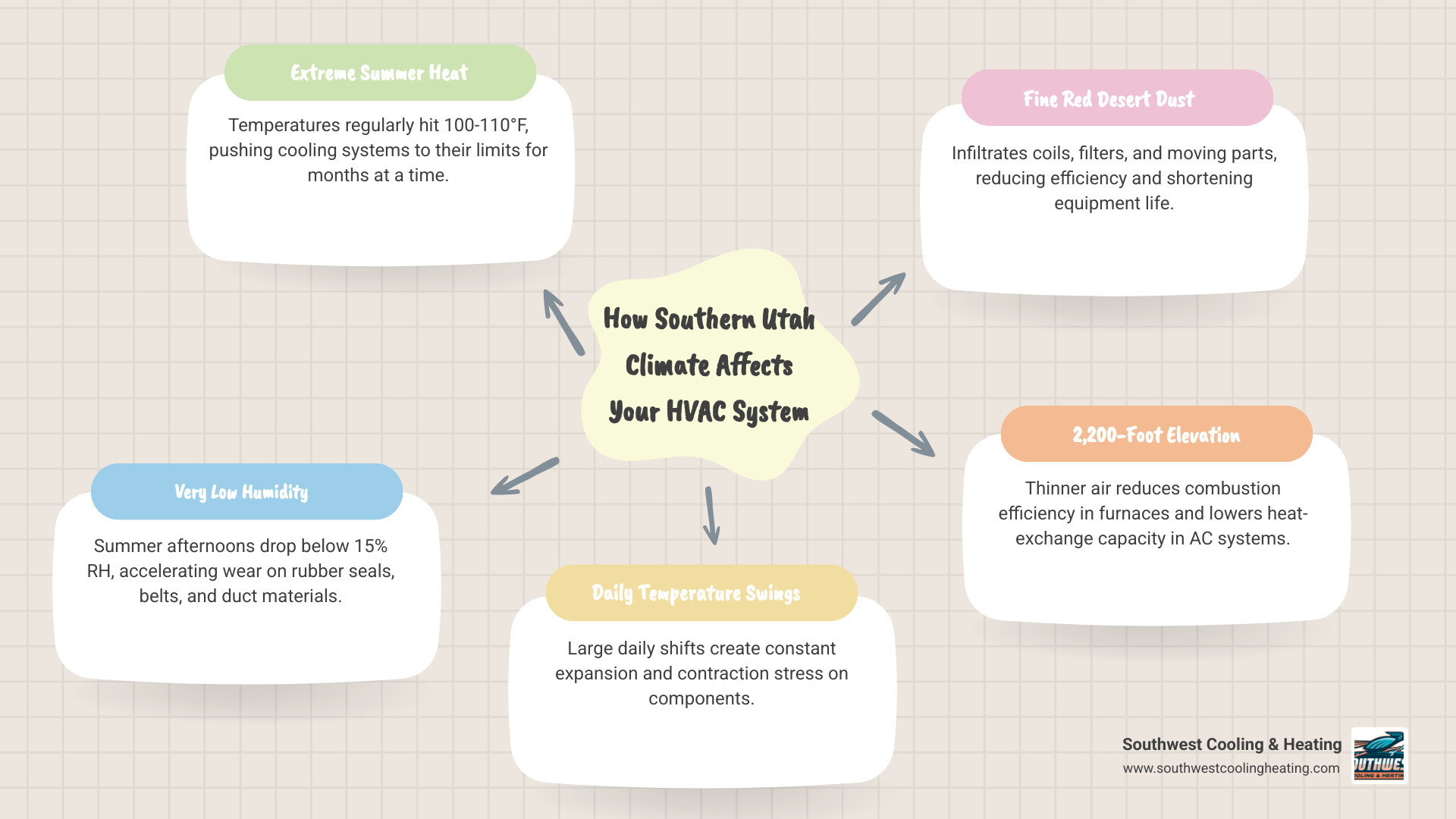
How southern utah climate affects your hvac system comes down to a few key forces working against your equipment year-round:
- Extreme summer heat – Temperatures regularly hit 100-110°F, pushing cooling systems to their limits for months at a time
- Very low humidity – Summer afternoons drop below 15% relative humidity, accelerating wear on rubber seals, belts, and duct materials
- Daily temperature swings – Days in the 55-65°F range followed by nights near 30°F create constant expansion and contraction stress on components
- Fine red desert dust – Infiltrates coils, filters, and moving parts, reducing efficiency and shortening equipment life
- 2,200-foot elevation – Thinner air reduces combustion efficiency in gas furnaces and lowers heat-exchange capacity in refrigerant systems
- Monsoon humidity spikes – Brief but intense summer moisture events strain evaporator coils and drainage systems not sized for sudden latent load increases
The result is an HVAC system that works harder, wears faster, and needs more targeted care than systems in milder parts of the country.
Washington County sits in Climate Zone 3B – a classification where cooling loads dominate system design. With roughly 2,800 Cooling Degree Days versus 2,500 Heating Degree Days annually, your air conditioner is the workhorse of your home. But the desert environment attacks both heating and cooling equipment in ways most homeowners don’t expect until something breaks.
I’m Bruce Hymas, owner of Southwest Cooling and Heating, and understanding how southern utah climate affects your hvac system has been central to my family’s work serving St. George-area homeowners since 1980. In the sections below, I’ll walk you through exactly what our desert environment does to your equipment – and what you can do about it.
How Southern Utah Climate Affects Your HVAC System Performance
Living in the high desert means our equipment faces “thermal stress” that homeowners in Salt Lake City or the Midwest simply don’t experience. When we talk about how southern utah climate affects your hvac system, we have to look at the sheer intensity of our 3B climate zone. In places like Hurricane and Ivins, your outdoor condenser unit sits in direct, punishing sunlight while trying to shed heat into 105°F air.
The biggest silent killer of HVAC components here is material fatigue. Because we experience massive daily temperature swings—often 30 degrees or more between high noon and midnight—the metals and plastics in your system are constantly expanding and contracting. This puts immense pressure on refrigerant lines and electrical connections.
When it comes to equipment choice, the variable speed vs single stage ac installation st george debate is particularly relevant. In our climate, a single-stage unit is like a car that only goes 0 or 100 mph. It blasts on, hits the target temperature, and shuts off. In the desert heat, this leads to frequent “short-cycling,” which wears out the compressor. Variable-speed systems, however, can throttle down to maintain a steady, gentle flow of cool air, which is far better at managing the dominant cooling loads we face in Washington County.
Managing Extreme Summer Heat and Low Humidity
In the peak of a St. George summer, we aren’t just fighting the heat; we are fighting the dryness. With relative humidity levels frequently dropping below 15% on summer afternoons, the air is “thirsty.” While this makes evaporative cooling a viable, energy-saving option for some, it also means that standard air conditioners have to work overtime to keep indoor air comfortable without over-drying your home.
As of April 2026, all new residential central air systems installed in our region must meet a minimum SEER2 rating of 15.0. This Department of Energy standard is specifically designed for Southwest regions (Climate Zones 3B and 4B) because our cooling seasons are so long and intense. If your system was installed before 2023, it likely operates at a much lower efficiency, meaning you’re paying more to achieve the same cooling effect as your neighbors with modern units.
How Southern Utah Climate Affects Your HVAC System in Winter
While we are famous for our heat, our winters shouldn’t be overlooked. In Toquerville and La Verkin, winter nights regularly dip into the 20s. This is where many homeowners consider a heat pump conversion. Modern heat pumps are incredibly efficient in our “mild” winters, but they do have to deal with defrost cycles when temperatures hover near freezing.
Because our Heating Degree Days (HDD) are roughly 2,500, we don’t need the massive heating capacity required in Northern Utah, but we do need versatility. Dual-fuel systems—which combine an electric heat pump with a gas furnace backup—are becoming the gold standard here. They allow the heat pump to do the heavy lifting during 50-degree days and let the gas furnace take over during those rare, bone-chilling January nights.
Critical Factors for HVAC Efficiency in the High Desert
Efficiency in the desert isn’t just about the machine; it’s about the environment it lives in. We have to account for solar heat gain—the way the sun bakes your roof and walls—which can account for up to 20% of your cooling load.
| Metric | Washington County (3B) | Typical Northern Utah (5B/6B) |
|---|---|---|
| Cooling Degree Days (CDD) | ~2,800 | ~1,100 |
| Heating Degree Days (HDD) | ~2,500 | ~6,000+ |
| Primary Design Focus | Cooling / Dehumidification | Heating / Snow Load |
| Min. Duct Insulation | R-6 | R-8 |
One of the most common issues we see is an oversized AC in St. George. Many people think “bigger is better” for the desert, but an oversized unit cools the air so fast that it doesn’t run long enough to remove any lingering moisture or provide even filtration. This leads to hot spots and high utility bills.
Proper duct insulation is also non-negotiable. In Climate Zone 3B, supply ducts in unconditioned spaces (like your attic) must have a minimum insulation value of R-6. Without this, the air your AC worked so hard to cool will be lukewarm by the time it reaches your bedroom.
Impact of Elevation on How Southern Utah Climate Affects Your HVAC System
St. George sits at about 2,200 feet, but as you move toward Diamond Valley or Winchester Hills, that elevation climbs. Why does this matter? For every 1,000-foot increase in elevation, air density reduces. This thinner air has two major impacts:
- Combustion Efficiency: Gas furnaces need oxygen to burn fuel. Thinner air means less oxygen, which can lead to “incomplete combustion” if the system isn’t properly derated for altitude.
- Heat Exchange: Refrigerant systems rely on air moving across coils to transfer heat. Thinner air is less efficient at carrying that heat away, meaning your outdoor unit has to run longer to achieve the same cooling effect.
Specialized Maintenance for St. George HVAC Systems
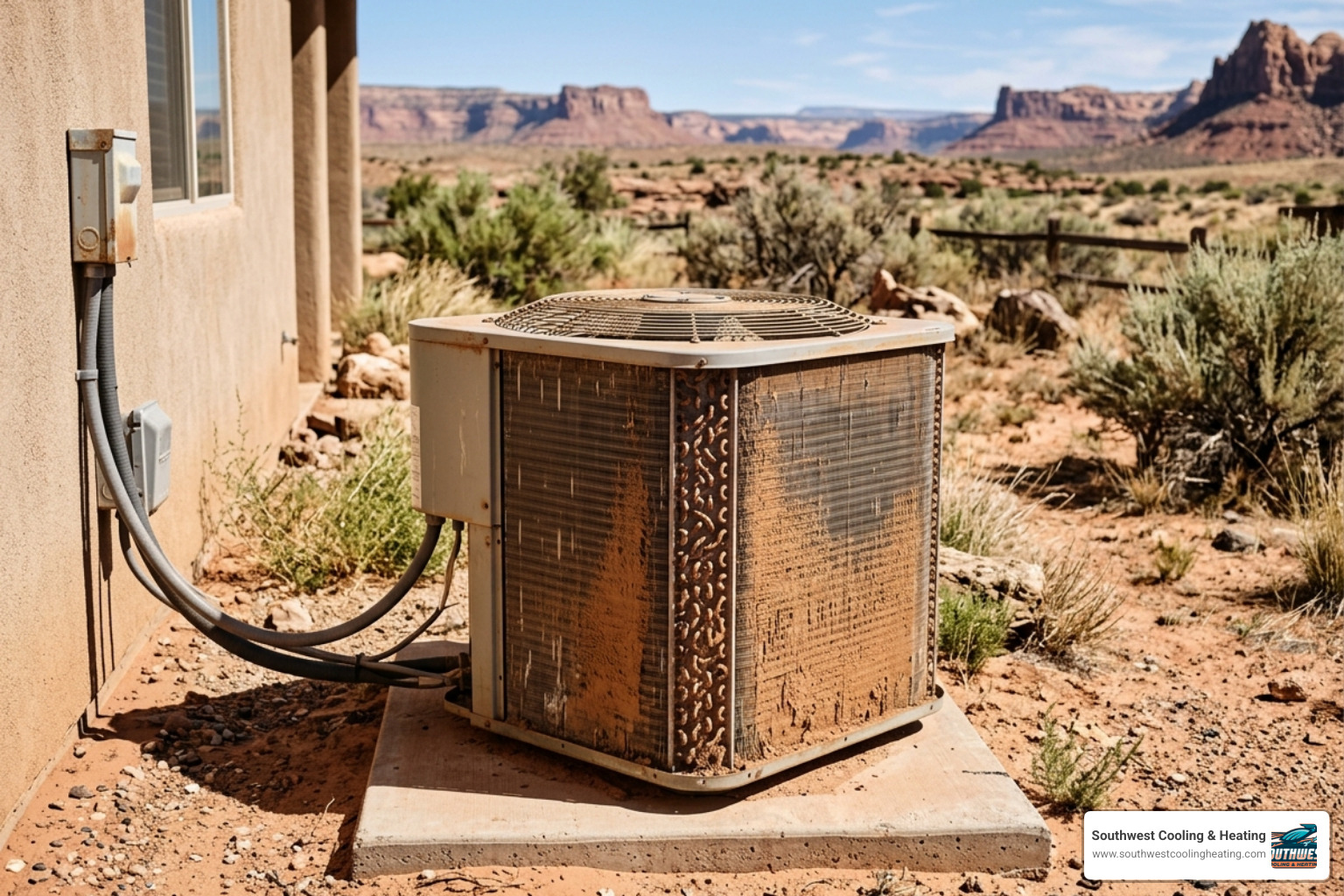
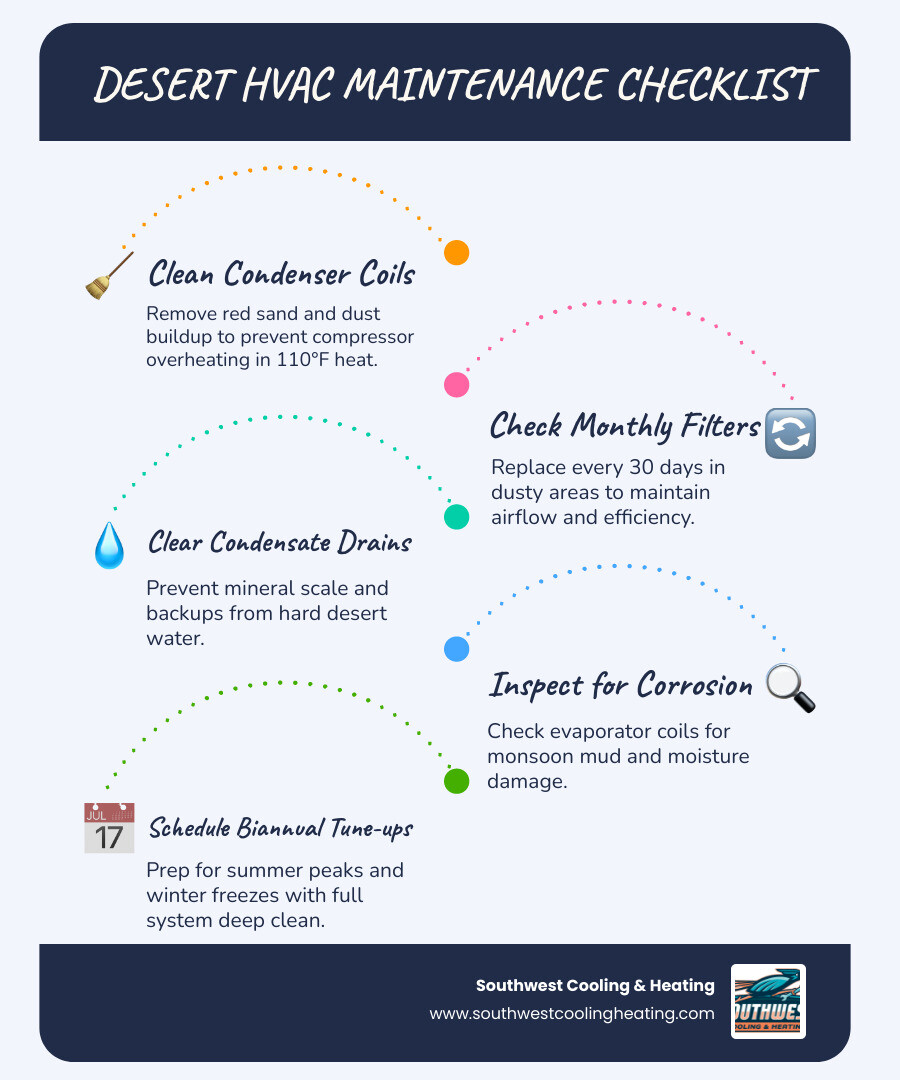
If you live in Santa Clara or Bloomington, you know the “red sand” isn’t just a part of the landscape—it’s a part of your life. That fine dust is an insulator. When it coats your outdoor condenser coils, it acts like a warm blanket, preventing the system from releasing heat. This causes the compressor to overheat and eventually fail.
Biannual tune-ups are the only way to stay ahead of this. We recommend a spring visit to prep for the 110-degree gauntlet and a fall visit to ensure your heating components are safe. During these visits, we don’t just “check” things; we perform deep cleanings of the coils and clear out the condensate drain lines. In our climate, the mineral content in the water can lead to “scale” buildup in the drains, which causes water to back up into your home.
You might wonder, how much does it really cost to cool your home? The answer often depends on your filter. In the desert, we recommend checking your filters every single month. If you have pets or live near a construction site in a growing area like Coral Canyon, you may need to replace them every 30 days to maintain proper airflow.
Protecting Your System from Monsoon Moisture and Dust
The late summer monsoons bring a unique challenge: a sudden spike in relative humidity. While it might only last for a few hours in the afternoon, it completely changes how your AC functions. Suddenly, the system has to deal with “latent heat”—the energy required to turn water vapor into liquid condensate.
This moisture, combined with the fine red dust, creates a “mud” that can clog your evaporator coils and create a breeding ground for biological growth. High-efficiency filtration (like MERV 11 or 13) is essential here to capture those fine particulates before they can settle on your damp coils and cause corrosion.
Frequently Asked Questions about Southern Utah HVAC
Are evaporative coolers better than central air in St. George?
It’s a classic desert debate. Evaporative coolers (or “swamp coolers”) are incredibly efficient in our dry climate, consuming approximately 75% less electricity than a standard AC. However, they have a hard limit. Once the outdoor relative humidity exceeds roughly 60%—which happens during our monsoon season—they stop cooling effectively. Most modern Washington County homes use central air for reliable comfort, though some utilize hybrid solutions to save on power during the dry “shoulder” months of May and June.
Why does my AC struggle during the 2026 summer monsoons?
As we look toward the summer of 2026, we expect the usual monsoon patterns to bring those humid afternoon spikes. When humidity rises, your AC has to spend more energy removing water from the air and less energy lowering the actual temperature. This can lead to “evaporator coil saturation,” where the coil is so busy dripping with water that airflow is restricted. If your home feels “clammy” even when the AC is running, it’s likely struggling with this latent load.
What is the best SEER2 rating for Washington County homes?
Following the 2023 Department of Energy updates, the absolute minimum for our region is 14.3 SEER2 (often marketed as 15.0 SEER). However, given our extreme utility demands, many homeowners find that jumping to 17 or 18 SEER2 provides a much faster return on investment. In a climate where the AC might run for 12 hours a day, even a small bump in efficiency leads to massive savings over the 15-year lifespan of the unit.
Conclusion
At Southwest Cooling & Heating, we’ve spent over four decades learning the “personality” of the Southern Utah climate. We know that a home in Hidden Valley has different needs than one in Diamond Valley, simply because of the elevation and wind patterns. We don’t just install boxes; we design systems that can survive the 110-degree peaks and the 25-degree dips.
Whether you are in Santa Clara, Bloomington Hills, or Hurricane, our team is committed to providing the expert assistance you need to keep your home a sanctuary. Don’t let the desert heat win—stay ahead of the weather with proactive care.
If you’re concerned about how the heat is affecting your utility bills or your comfort, explore our full range of HVAC Services today. We are here to ensure your system is ready for whatever the Washington County sky throws at it.