


Why Getting Your HVAC Right in St. George’s High Desert Climate Matters
Finding the best HVAC setup for high desert weather is one of the most important decisions you’ll make as a homeowner in St. George, Utah. Summers here regularly push past 100°F, winter nights can drop below freezing, and the air stays bone-dry almost year-round — a combination that pushes ordinary HVAC systems to their limits fast.
Here’s a quick summary of the best HVAC options for high desert conditions:
| System Type | Best For | Key Advantage |
|---|---|---|
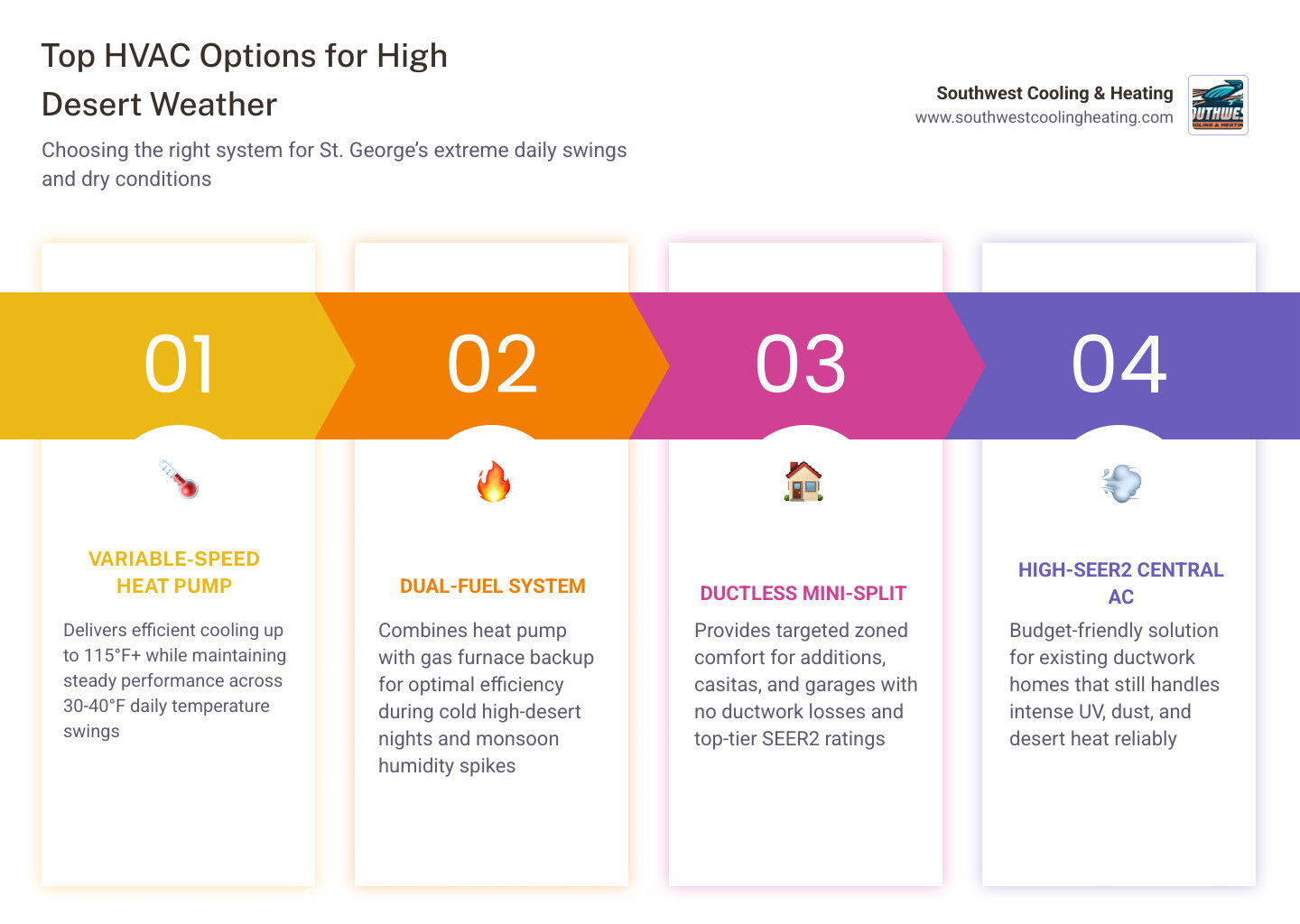
| Variable-Speed Heat Pump | Most homes; new construction | Efficient cooling and heating year-round; operates up to 115°F+ |
| Dual-Fuel (Heat Pump + Gas Furnace) | Homes with existing gas; colder high desert elevations | Intelligent switching for maximum efficiency in variable winters |
| Ductless Mini-Split | Additions, casitas, garages, zoned rooms | No ductwork needed; highest SEER2 ratings available |
| High-SEER2 Central AC + Furnace | Homes on tight budgets with existing ductwork | Lower upfront cost; reliable proven setup |
| Evaporative Cooler (Hybrid) | Very dry periods only; used alongside refrigerant AC | Low energy use when humidity stays below 30% |
What makes St. George different from most U.S. cities is the sheer range your HVAC system has to handle. Daily temperature swings of 30–40°F are common. Summer afternoons demand relentless cooling capacity, while desert dust, intense UV exposure, and occasional monsoon humidity spikes all add stress to equipment that wasn’t designed with these conditions in mind. Getting the right system — and having it sized, installed, and maintained correctly — is what separates a comfortable home from one that runs up energy bills and breaks down mid-August.
I’m Bruce Hymas, owner of Southwest Cooling and Heating, and with over four decades of serving the St. George area, I’ve seen what works and what fails when it comes to the best HVAC setup for high desert weather. The guidance in this article comes from real-world experience with our unique Southern Utah climate, not a generic playbook written for somewhere else.
Why High Desert Climates Demand Specialized HVAC Solutions
Living in areas like Santa Clara, Ivins, or Hurricane means your home is essentially a “thermos in the sun.” The high desert climate presents a unique set of challenges that standard off-the-shelf HVAC systems often struggle to overcome.
Extreme Temperature Fluctuations
The most striking feature of our weather is the “diurnal swing.” It isn’t uncommon to see a 40-degree difference between a crisp morning and a scorching afternoon. This requires a system that can ramp up quickly as the sun hits your roof but also operate efficiently at lower capacities during the cooler evening hours.
Low Humidity and Intense UV
In the high desert, humidity often drops below 20%. While this makes the heat feel “dry,” it also means your HVAC system must focus almost entirely on “sensible cooling”—lowering the actual air temperature rather than removing moisture. Furthermore, the intense UV exposure in Southern Utah can cause the surface temperatures of outdoor units to reach 140°F to 150°F. Budget systems with thin plastic components or untreated coils often fail within 8–10 years due to this environmental stress.
Desert Dust and Monsoon Spikes
We all know the red dust that settles on everything after a windstorm. This fine particulate can clog HVAC fins and filters, forcing the system to work harder. Additionally, during the late summer monsoon season, humidity can spike from 10% to over 60% in a matter of hours. This is why Desert Comfort Decoded and Why Heat Pumps Love Southern Utah is a must-read for locals; it explains how modern technology handles these rapid shifts.
Identifying the Best HVAC Setup for High Desert Weather
When we evaluate the best HVAC setup for high desert weather in May 2026, we look at how different technologies handle the specific heat load of the Southwest.
| Feature | Variable-Speed Heat Pump | Dual-Fuel System | Ductless Mini-Split |
|---|---|---|---|
| Efficiency | Extremely High (Up to 24 SEER2) | High (Varies by fuel) | Highest (Up to 28 SEER2) |
| Heating Source | Electricity (Heat Transfer) | Electric + Natural Gas | Electricity (Inverter) |
| Best Use Case | Whole-home replacement | Homes with gas service | Casitas & room additions |
| Performance at 115°F | Excellent (Inverter-driven) | Excellent | Superior |
The shift toward inverter technology has been a game-changer for St. George. Unlike older single-stage systems that are either “all on” or “all off,” variable-speed compressors modulate their output to match the exact cooling needs of the home. This prevents the “blast of cold followed by a warm spell” cycle common in older homes. You can learn more about this in our guide on Variable Speed vs Single Stage AC Installation St. George.
Why Variable-Speed Heat Pumps are the Best HVAC Setup for High Desert Weather
Modern heat pumps are no longer just for mild climates. Today’s high-efficiency units maintain full cooling capacity even when outdoor temperatures hit 115°F. Because they run almost continuously at lower speeds, they provide more even temperatures and significantly lower energy bills.
In fact, switching from an older 10 SEER system to a modern 20 SEER heat pump can approach 50% energy savings. For Utah residents, there are also significant financial incentives available to help with the transition. Check out the Heat Pump Conversion Utah HVAC Credits to see how you can save on installation.
When to Consider Dual-Fuel or Ductless Mini-Split Systems
While heat pumps are the gold standard, some situations call for a hybrid approach. A dual-fuel system pairs an electric heat pump with a natural gas furnace. This is ideal for colder high-elevation areas like Diamond Valley, where winter nights can occasionally dip low enough that gas heating becomes more cost-effective.
Ductless mini-splits are the perfect “spot cooling” solution. If you have a casita, a garage workshop in La Verkin, or a sunroom with floor-to-ceiling glass that always stays too hot, a mini-split provides targeted comfort without the need for expensive ductwork. For a deeper dive into these options, see The Best Way to Cool Your Southern Utah Home This Summer.
Efficiency Metrics: Understanding SEER2 and EER2 in Extreme Heat
In 2026, efficiency standards are more rigorous than ever. You’ll see two main ratings: SEER2 (Seasonal Energy Efficiency Ratio) and EER2 (Energy Efficiency Ratio).
- SEER2: This measures how efficient the system is over an entire season. In the desert, we recommend aiming for a SEER2 of 18 to 22.
- EER2: This is actually more critical for desert dwellers. It measures how the system performs at a specific, high-load temperature (usually 95°F). A high EER2 ensures that when the sun is beating down on your Bloomington Hills home at 3:00 PM, your system isn’t hemorrhaging electricity.
Upgrading to a high-efficiency system isn’t just about comfort; it’s a financial strategy. Many homeowners ask, Will a New HVAC System Actually Save You Money? In our experience, high-SEER systems in Climate Zone 2B (our zone) can cut cooling costs by 25%–40% compared to older 13-SEER units.
Maximizing Efficiency with the Best HVAC Setup for High Desert Weather
To get the most out of your system, consider these modern enhancements:
- Solar-Ready HVAC: These systems can connect directly to photovoltaic arrays, allowing you to use the desert sun to cool your home for free during peak daylight hours.
- R-32 Refrigerant: This next-generation refrigerant offers 68% lower global-warming potential than R-410A and improves heat transfer efficiency, which is vital in extreme heat.
- Smart Thermostats and Pre-Cooling: Use your thermostat to “pre-cool” your home in the early morning when electricity is cheaper and the air is cooler. This “loads” your home’s thermal mass, allowing the inverter compressor to merely idle during the hottest part of the afternoon.
Critical Installation and Maintenance for Arid Environments
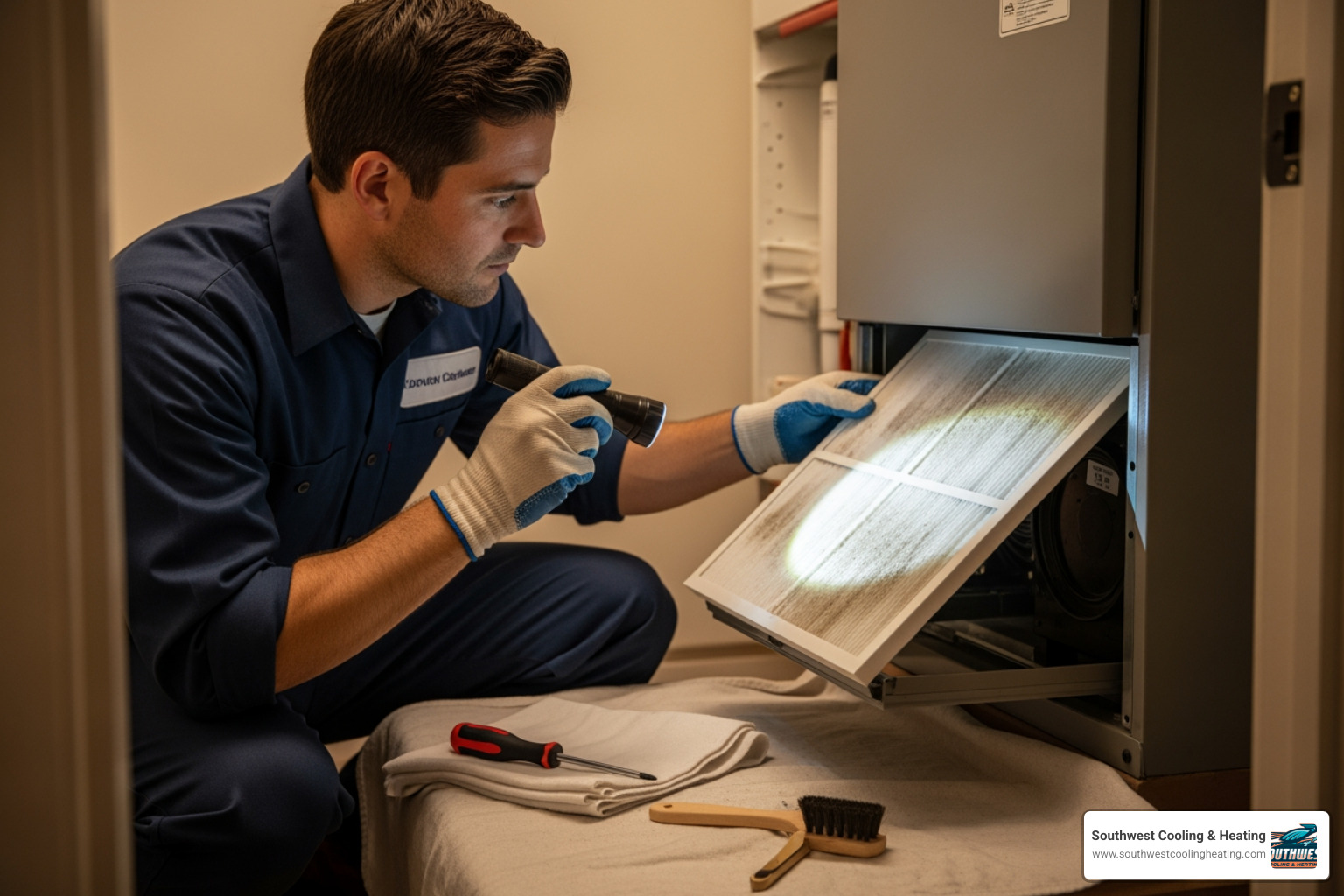
The best HVAC setup for high desert weather is only as good as its installation. Because air is less dense at higher elevations like Toquerville or Winchester Hills, systems must be “derated” or adjusted to ensure they move enough air to keep the compressor cool.
Manual J Load Calculations and Sizing
We never guess on system size. An oversized system will “short-cycle,” turning on and off rapidly, which wastes energy and wears out parts. An undersized system will simply never catch up. We use Manual J calculations to account for your home’s insulation, window direction, and even the color of your roof. For more details, read Why Correct System Sizing Matters for Your Home.
Duct Sealing and Insulation
In the desert, leaky ducts are like a bucket with holes. We use mastic sealant—not cloth tape—to ensure every joint is airtight. We also recommend insulating attic ducts to at least R-8 to prevent the 140°F attic air from heating up your freshly cooled air before it reaches your living room.
Protecting Your Investment: Repair or Replace?
If your system is over 12 years old and struggling, you might be at a crossroads. Desert conditions accelerate wear on capacitors and contactors. When deciding, Should I Repair or Replace My HVAC System?, consider that a new system often pays for itself in energy savings within 5–7 years. Plus, if you’re planning to move, Will a New HVAC Help Sell Your Home Faster? The answer is almost always yes; buyers in St. George prioritize a reliable, efficient cooling system above almost any other home feature.
Frequently Asked Questions about Desert HVAC
Do modern heat pumps work in 115°F desert heat?
Absolutely. Modern variable-speed heat pumps are specifically rated for high-ambient operation. While older technology might have struggled, current inverter systems can operate effectively in temperatures up to 125°F. They maintain steady cooling by modulating their speed rather than shutting down.
Is an evaporative cooler a viable primary cooling option?
Evaporative (swamp) coolers can be excellent supplements when the humidity is below 30%, as they use about a tenth of the power of a compressor-based AC. However, they fail during the monsoon season when humidity spikes. We recommend them as a hybrid addition rather than a primary system for most St. George homes.
How does high elevation affect HVAC performance in the desert?
Elevation affects air density. In higher areas like Diamond Valley, the thinner air doesn’t carry heat away from the outdoor coils as efficiently as it does at sea level. This requires our technicians to adjust fan profiles and verify refrigerant charges under local conditions to ensure the system reaches its rated capacity.
Conclusion
At Southwest Cooling & Heating, we’ve been helping our neighbors in Santa Clara, Hurricane, Ivins, and throughout the St. George area stay comfortable since 1980. We understand that the best HVAC setup for high desert weather isn’t just about the brand on the box—it’s about a system designed, sized, and maintained for our unique Southern Utah environment.
Whether you’re looking to upgrade to a high-efficiency heat pump or need expert maintenance to survive the next heatwave, we combine modern technology with old-school values to keep your home a sanctuary.
Ready to optimize your home’s comfort? More info about HVAC services is just a click away, or give us a call for a personalized consultation.