


How to Know When an HVAC Failure Is a True Emergency
When an hvac failure is a true emergency depends on whether it poses an immediate risk to your health, your family’s safety, or your home’s structure — not simply whether it’s uncomfortable.
Here’s a quick way to tell:
| Situation | Emergency? |
|---|---|
| Gas or rotten egg smell near furnace | Yes — evacuate immediately |
| Carbon monoxide detector alarming | Yes — leave and call 911 |
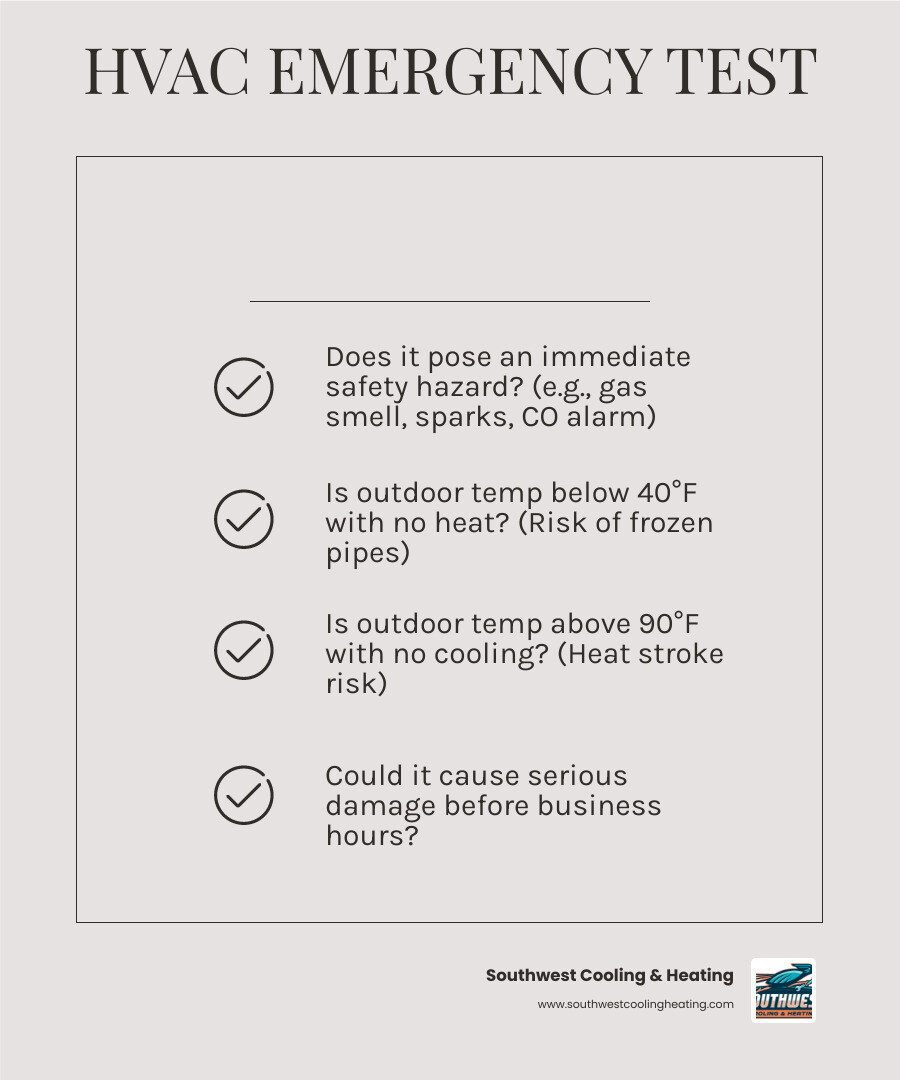
| Complete heat loss below 40°F outdoors | Yes — risk of frozen pipes and health harm |
| Complete cooling loss above 90°F outdoors | Yes — risk of heat stroke for vulnerable people |
| Burning or electrical smell from unit | Yes — shut off system and call now |
| Sparks, smoke, or repeated breaker trips | Yes — electrical hazard |
| Hissing sounds near refrigerant lines | Yes — potential compressor damage |
| Dirty filter or mild temperature fluctuation | No — can wait for regular service hours |
| Thermostat acting up in mild weather | No — schedule routine service |
If your answer to “Could this harm someone or cause serious damage before business hours?” is yes, treat it as an emergency.
When something feels wrong with your HVAC system, the hardest part is often not the discomfort — it’s the uncertainty of not knowing whether to act right now or wait until morning. That uncertainty is exactly what this guide is here to clear up. HVAC problems range from minor annoyances to genuine safety crises, and knowing the difference can protect your family, your home, and your wallet.
I’m Bruce Hymas, owner of Southwest Cooling and Heating, and after decades in the HVAC industry serving St. George homeowners, I’ve seen how quickly a seemingly small issue can escalate into a situation that qualifies as when an hvac failure is a true emergency. In the sections below, I’ll walk you through the specific red flags, temperature thresholds, and warning signs that separate a true crisis from something that can safely wait.
When an hvac failure is a true emergency

In the industry, we often say that a true emergency is any situation that threatens the “Three Pillars”: Health, Safety, or Property. While a broken AC on a 75-degree day in Santa Clara is annoying, it isn’t an emergency. However, when the conditions inside your home become unsafe or could lead to catastrophic structural damage, the clock starts ticking.
Emergency HVAC Services are designed for those moments when waiting until Monday morning isn’t just uncomfortable—it’s dangerous. We consider a failure an emergency if it involves:
- Safety Hazards: Risks of fire, explosion, or poisoning.
- Health Concerns: Extreme temperatures that the human body (especially the very young or elderly) cannot safely regulate.
- Property Damage: Issues like flooding from a backed-up condensate line or pipes that are minutes away from bursting in a freeze.
- Unsafe Conditions: Any scenario where the home becomes uninhabitable due to air quality or extreme thermal stress.
Critical Safety Hazards: Gas, CO, and Electrical
Some signs of trouble are subtle, but the following “Sensory Red Flags” are loud and clear. If you experience any of these, stop what you are doing and take action immediately. These are the primary reasons why we emphasize that when an hvac failure is a true emergency, safety must come before troubleshooting.
- The “Rotten Egg” Smell: Natural gas is odorless, so utilities add a chemical called mercaptan to make it smell like sulfur or rotten eggs. If you smell this near your furnace, do not flip any light switches or start your car. Evacuate and call for Furnace Repair and your gas provider from a safe distance.
- Burning or Ozone Odors: A smell like burning plastic or “electrical” ozone usually indicates a motor is seizing or wires are melting. This is a significant fire risk.
- Hissing Sounds: If your AC sounds like a literal snake, you likely have a high-pressure refrigerant leak. Not only is refrigerant harmful to breathe, but running the system with a leak can “slug” the compressor, leading to a total (and expensive) system replacement.
- Electrical Sparks or Smoke: If you see sparks flying from your outdoor unit in Bloomington or smoke wafting from your indoor vents, shut the power off at the breaker immediately.
Responding when an hvac failure is a true emergency involving gas or CO
Carbon monoxide (CO) is often called the “silent killer” because it is colorless, tasteless, and odorless. According to the CDC, unintentional carbon monoxide poisoning sends over 100,000 Americans to emergency departments every single year.
If your CO detector goes off, or if members of your household suddenly experience unexplained headaches, dizziness, nausea, or flu-like symptoms that improve when you leave the house, you need Heating Repair expertise immediately.
Your Emergency Protocol:
- Evacuate: Get every person and pet out of the house.
- Ventilate: If safe to do so on your way out, crack a few windows, but do not linger.
- Call 911: Treat a CO alarm like a fire.
- Do Not Re-enter: Wait for a professional with calibrated equipment to tell you the air is safe.
Weather Extremes and Temperature Thresholds
In Southern Utah, our weather is beautiful but can be brutal. From the scorching 100-degree-plus afternoons in Hurricane to the biting winter nights in Diamond Valley, our HVAC systems work harder than most.
While a healthy adult might be fine in a 85-degree house for a few hours, “vulnerable occupants”—specifically infants, the elderly, and those with chronic respiratory or cardiovascular conditions—are at high risk for heat stroke or hypothermia when the HVAC fails.
Identifying when an hvac failure is a true emergency in extreme weather
We use specific temperature thresholds to help homeowners decide when to call for AC Repair:
- The 90°F Cooling Rule: If the outdoor temperature is 90°F or higher and your AC fails completely, this is an emergency. Indoor temperatures can climb 10 to 20 degrees above the outdoor ambient temp in a poorly ventilated home, leading to dangerous dehydration and heat exhaustion.
- The 40°F Heating Rule: If it is 40°F or lower outside and your furnace quits, your home’s insulation will typically only hold a safe temperature for about 8 to 12 hours. Beyond that, you risk health issues and the very real threat of frozen pipes.
- The Humidity Factor: If indoor humidity climbs above 70% persistently because the HVAC isn’t dehumidifying, it can trigger severe asthma attacks and rapid mold growth, qualifying as a health emergency.
Troubleshooting and Non-Emergency Situations
Not every “thump” in the night requires an emergency dispatch fee. In fact, industry data suggests that about 40% of HVAC emergencies actually begin with simple thermostat malfunctions that a homeowner can fix in five minutes.
Before you call for emergency service in Ivins or Santa Clara, run through this basic troubleshooting list:
| The Problem | The Simple Check |
|---|---|
| System won’t turn on | Check the thermostat batteries. If the screen is blank, replace them. |
| No air blowing | Check your air filter. A 100% clogged filter can cause the system to “freeze up” or overheat and shut down. |
| Sudden total power loss | Check your electrical panel. Did a circuit breaker trip? Flip it back once—if it trips again, stop and call us. |
| Outdoor unit isn’t running | Ensure the outdoor “disconnect” switch (usually in a box on the wall near the unit) hasn’t been bumped to the “Off” position. |
What is NOT an emergency?
- A slightly noisy fan that still cools the house.
- Uneven temperatures between rooms (usually a ductwork or balance issue).
- A system failure when the outdoor temperature is between 60°F and 75°F.
- Routine maintenance reminders or “service required” lights that don’t affect performance.
Preventing Crisis Through Regular Maintenance
The best way to handle an HVAC emergency is to make sure it never happens. Statistics show that homeowners who invest in regular maintenance are 50% less likely to experience a catastrophic breakdown.
By the time April 2026 rolls around, modern HVAC standards emphasize “Predictive Maintenance.” This means using tech to catch a capacitor that is slightly out of spec or a motor that is drawing too much amperage before it actually fails on a Saturday night.
Why Maintenance Matters:
- Longevity: A well-maintained furnace in Toquerville can last 18-20 years, whereas a neglected one might give out at age 12.
- Efficiency: A system with dirty coils or low refrigerant (even just 10% low) can see a 20% spike in your monthly energy bills.
- Prevention: 75% of all “no-cooling” calls are preventable with a simple bi-annual tune-up.
Frequently Asked Questions about HVAC Emergencies
What should I do immediately if I smell gas near my furnace?
Stop what you are doing. Do not use your phone, do not turn off lights, and do not light a match. Evacuate everyone from the home immediately. Once you are safely outside and away from the structure, call your local gas utility and an emergency HVAC professional.
How long can my home retain heat during a winter outage?
In our region, the average well-insulated home will retain a safe indoor temperature for approximately 8 to 12 hours. However, if the temperature outside is below freezing, that window narrows. To help retain heat, keep curtains closed, seal drafts at the bottom of doors with towels, and avoid opening exterior doors.
Is a loud banging noise considered a true emergency?
It depends. If the system is still heating or cooling and the noise is a dull “thump,” it might be ductwork expanding. However, if it sounds like metal-on-metal grinding, loud banging, or screaming, shut the system off. This usually indicates a broken blower wheel or a failed motor bearing. Running it in this condition will cause significantly more damage, potentially turning a simple motor repair into a full system replacement.
Conclusion
At Southwest Cooling & Heating, we’ve been serving the St. George community since 1980. We know that when your HVAC fails, your home stops feeling like a sanctuary. Whether you are in La Verkin, Winchester Hills, or Coral Canyon, our commitment is to provide quick, expert assistance that combines modern technology with old-school values.
We stand behind our work with performance and satisfaction guarantees because we believe you deserve peace of mind. If you find yourself facing a situation where you suspect when an hvac failure is a true emergency, don’t wait for the problem to get worse. Our team is ready to help you restore your comfort and, more importantly, your safety.
For immediate assistance or to prevent your next crisis with a professional tune-up, contact us today for Emergency HVAC Services.