


Why Desert Temperature Swings Are Unlike Anything Else Your Home Has to Handle
How desert temperature swings create unique comfort challenges is something every St. George homeowner feels — but few fully understand. During a typical summer day in Southern Utah, temperatures can soar past 105°F, then plunge 30 to 40 degrees by early morning. That’s not just uncomfortable. It puts real stress on your home, your HVAC system, and your body.
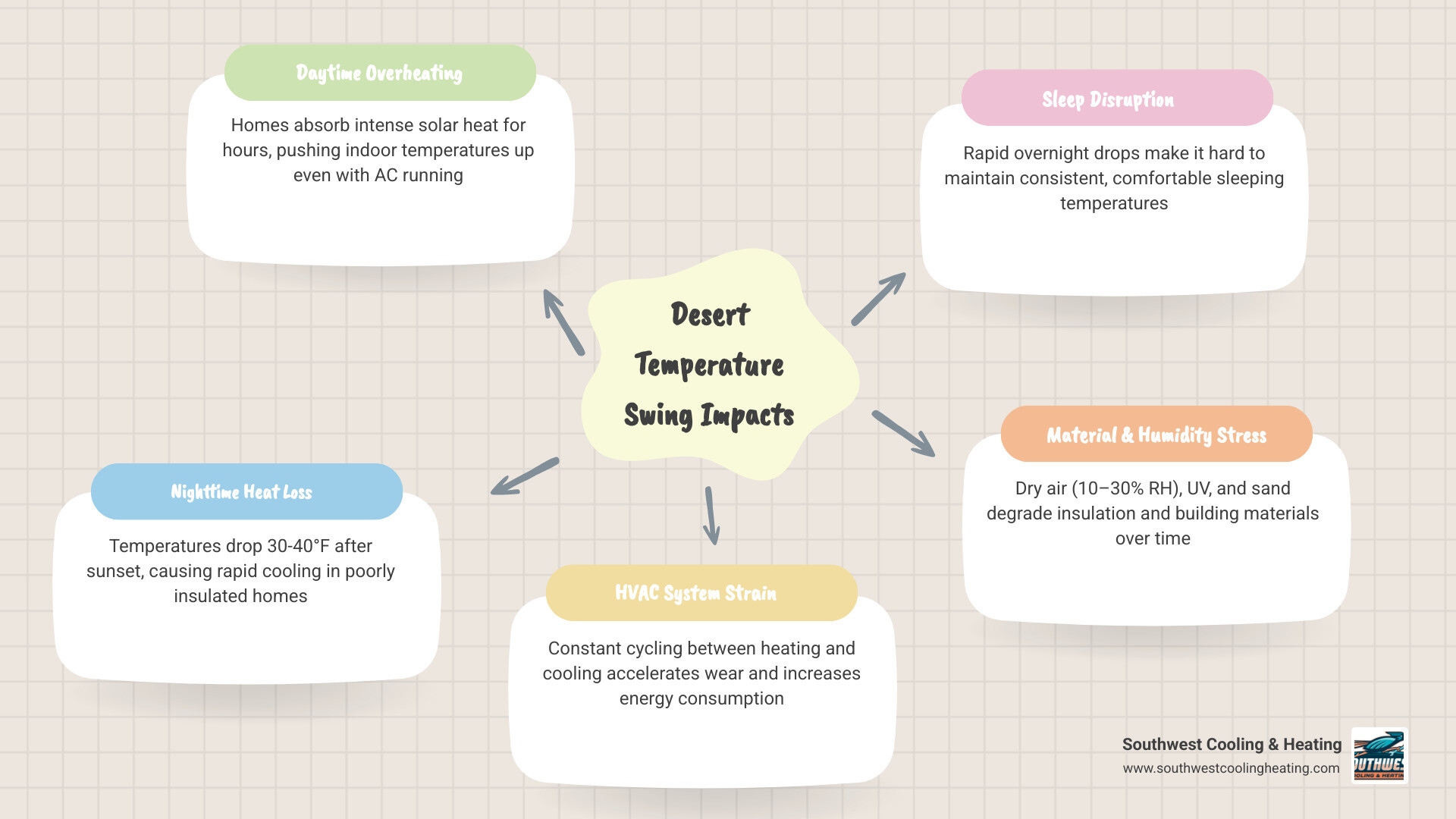
Here’s a quick look at the core challenges desert temperature swings create:
- Daytime overheating – Your home absorbs intense solar heat for hours, pushing indoor temperatures up even with AC running.
- Nighttime heat loss – Once the sun sets, temperatures drop fast, and poorly insulated homes lose warmth just as quickly.
- HVAC system strain – Constant cycling between heating and cooling modes accelerates wear and drives up energy use.
- Sleep disruption – Rapid overnight temperature drops make it hard for your home to stay at a consistent, comfortable temperature.
- Low humidity stress – Desert air is extremely dry (often 10–30% relative humidity), which affects how you feel temperature and how your equipment performs.
- Moisture and material stress – Even without rain, the combination of UV exposure, sand, and temperature extremes degrades insulation and building materials over time.
Desert climates don’t just run hot. They run hot and cold, often within the same 24-hour period. That dual demand is what makes them so demanding on homes and HVAC systems alike.
I’m Bruce Hymas, owner of Southwest Cooling and Heating, and with over four decades of family history serving St. George homeowners, I’ve seen how desert temperature swings create unique comfort challenges that standard HVAC advice simply doesn’t address. In the sections ahead, I’ll walk you through exactly what’s happening to your home — and what you can do about it.
How Desert Temperature Swings Create Unique Comfort Challenges

To truly understand how desert temperature swings create unique comfort challenges, we have to look at the physical mechanics of the desert diurnal cycle. In places like Washington County — whether you are in Santa Clara, Bloomington Hills, or out in Hurricane — the daily temperature swing is a massive design variable.
While temperate regions might experience a gentle 10°F to 15°F difference between day and night, our hyper-arid climate regularly sees extreme diurnal temperature swings of 25°C to 35°C (which translates to a whopping 45°F to 60°F difference) within a single 24-hour period.
This rapid shift creates a phenomenon known as thermal shock. During the day, intense solar radiation beats down on your roof and walls, baking the building envelope. The materials expand. Once the sun dips behind the red rocks, dry air and clear skies allow that heat to radiate back into space almost instantly. The temperature drops like a stone, and materials quickly contract.
For homeowners, this creates several distinct indoor comfort issues:
- The “Thermostat Tug-of-War”: You might find yourself running the air conditioning at 4:00 PM to combat 100°F heat, only to feel a distinct chill by 4:00 AM as the outdoor temperature drops to 55°F. This constant shift makes it incredibly difficult to maintain a steady indoor “neutral” zone.
- Sleep Quality Disruption: Human biology relies on a steady core body temperature drop to achieve deep sleep. When your home’s envelope is lagging — releasing stored daytime heat late into the night while the outdoor air is freezing — your indoor air can feel stuffy and hot, only to suddenly freeze you out just before dawn.
- The Humidity Drop Factor: Our local humidity levels typically range between 10% and 30%. This incredibly dry air accelerates evaporation, making the heat feel dry but also making rapid temperature drops feel much more piercing.
Because the air is so dry, your HVAC system has to work in a completely different physical environment than a system in a humid climate. To dive deeper into why our unique local landscape poses such a threat to your comfort systems, read our guide on Why the Southern Utah Desert Is Your HVAC System’s Toughest Opponent.
Thermal Insulation Needs: Desert vs. Temperate Climates
Most building standards and insulation practices were designed for temperate or cold climates, where the primary goal is simple: keep the heat inside during winter, or keep it outside during summer.
In the Southern Utah desert, however, insulation must be a master of multi-tasking. It is not just about blocking heat; it is about managing time.
In a temperate climate, insulation works against a relatively steady-state temperature differential. In the desert, insulation must manage a dynamic, reversing flow of heat. During the day, the thermal drive is inward; at night, it reverses completely as heat attempts to escape into the cool night air.
If your insulation is poorly designed, it will trap heat inside your home during the hot evening hours when you want it to cool down, or fail to keep the warmth in during chilly winter desert nights. Additionally, the extreme dryness of our climate means vapor drive behaves differently. While we don’t deal with the constant high humidity of coastal regions, the vast differences in temperature between the air-conditioned indoor space and the baking outdoor air can create localized condensation points inside wall assemblies if the vapor barrier and insulation types are mismatched.
To illustrate these differences, let’s compare how insulation needs to perform in our desert environment versus a standard temperate climate:
| Feature / Requirement | Desert Climates (e.g., St. George, Ivins, Toquerville) | Temperate / Humid Climates |
|---|---|---|
| Primary Insulation Goal | Dual-function: Block intense daytime heat ingress and prevent rapid nighttime heat loss. | Single-direction: Retain indoor heat (winter) or block moderate outdoor heat (summer). |
| Diurnal Temperature Range | Extreme (45°F to 60°F daily swings). | Mild to moderate (10°F to 20°F daily swings). |
| Role of Thermal Mass | Crucial: Acts as a “thermal flywheel” to delay heat transfer until the cool night. | Minimal: Often leads to damp, cold interiors if not heavily heated. |
| Vapor Drive Dynamics | High dry-to-wet pressure difference; risk of localized condensation from extreme temperature gaps. | High seasonal humidity-driven vapor drive; steady-state moisture barrier needs. |
| Material Durability Needs | Must resist intense UV degradation, extreme thermal expansion/contraction, and sand/dust infiltration. | Must resist high relative humidity, mold, and consistent rainfall moisture. |
| Target Roof R-Value | High (up to R-50 or R-60) to combat direct, overhead solar radiation. | Moderate (typically R-38 to R-49). |
When your insulation isn’t up to the task of handling these unique demands, your cooling system has to work twice as hard to make up the difference. You can read more about how Washington County’s extreme weather patterns impact your cooling equipment in our article Why Washington County Weather Is Hard on Your AC.
Passive Strategies and Modern Materials for Arid Homes
Long before modern air conditioning was invented, desert dwellers lived comfortably in extreme climates. They did this by working with the laws of physics rather than fighting them. Today, we can combine these ancient, time-tested passive strategies with cutting-edge material science to create highly efficient, comfortable homes in areas like Winchester Hills, Diamond Valley, and Coral Canyon.
The secret weapon of desert architecture is thermal mass. Think of thermal mass like a battery, but instead of storing electricity, it stores heat.
Materials with high thermal mass — like thick concrete, brick, stone, or rammed earth — absorb heat very slowly during the hottest parts of the day. Instead of passing that heat directly into your living room, the wall holds onto it.
By the time the heat finally works its way through the thick wall (a process called thermal lag), the sun has set, the outdoor air has cooled down, and that stored warmth is actually welcome.
Modern research shows that rammed earth assemblies in arid contexts can achieve a peak indoor temperature reduction of approximately 5.15°C (about 9.3°F) and a cooling energy demand reduction of up to 31.8%. When combined with modern passive cooling and heating techniques, these strategies can reduce energy consumption by up to 50% during transitional seasons in desert-climate residences.
Selecting Materials to Solve How Desert Temperature Swings Create Unique Comfort Challenges
To successfully manage how desert temperature swings create unique comfort challenges, we have to look at modern, high-performance materials designed for extreme environments:
- Phase-Change Materials (PCMs): These are smart materials integrated into drywall or insulation that melt and solidify at specific temperatures. As the home warms up, the PCM melts, absorbing large amounts of latent heat and keeping the room cool. At night, as temperatures drop, the material solidifies again, releasing that stored heat back into the home.
- Reflective and Cool Roof Coatings: Standard dark shingles absorb up to 90% of solar radiation. Using highly reflective elastomeric coatings or specialized cool-roof tiles deflects solar heat before it ever enters your attic.
- Aerogel Insulation: Known as “frozen smoke,” aerogel offers incredibly high R-values in extremely thin profiles, making it perfect for sealing hard-to-reach thermal bridges.
- UV and Sand-Resistant Materials: In places like Toquerville and La Verkin, red rock dust and intense UV rays can quickly degrade standard building materials. High-quality exterior insulation finishing systems (EIFS) must be UV-stabilized and sealed tightly to prevent abrasive dust from degrading the thermal barrier.
Passive Cooling Techniques to Mitigate How Desert Temperature Swings Create Unique Comfort Challenges
When designing or retrofitting a home to handle desert temperature swings, passive ventilation is just as important as insulation:
- Night-Flush Ventilation: This technique involves opening high and low vents or windows at night when the outdoor air is cool. The cool air flushes out the daytime heat stored in the home’s thermal mass, priming the house to stay cool the following day.
- Wind Catchers: Historically used in traditional Middle Eastern architecture, wind catchers are towers designed to catch cool breezes high above the ground and direct them downward into the living spaces, often passing over water or wet clay to provide natural evaporative cooling.
- Bioclimatic Shading: Designing deep roof overhangs and placing porches on the west and south sides of your home protects your windows from the harsh afternoon sun while still allowing low-angle winter sun to help warm the home naturally.
Optimizing Mechanical Systems for Extreme Diurnal Cycles
While passive strategies are incredibly effective, they cannot completely eliminate the need for mechanical climate control during our blistering summer months or freezing winter nights. To achieve true comfort, we must pair passive home design with highly optimized, modern HVAC systems.
Because our desert climate demands both heating and cooling — often on the very same day — traditional single-stage furnaces and air conditioners can struggle. They are designed to turn on at full blast, run until the thermostat is satisfied, and then turn off. In a climate with rapid temperature swings, this leads to frequent cycling.
Frequent cycling is incredibly hard on your equipment. It is like driving your car in stop-and-go traffic; it burns more energy and places immense stress on the compressor, fan motors, and electrical components. This is where modern heat pump technology shines.
Unlike traditional systems, variable-capacity heat pumps can adjust their output precisely to match the real-time heating or cooling load of your home. If your home only needs a tiny bit of cooling on a mild morning, the heat pump runs at a low, highly efficient whisper. As the afternoon heat climbs, it smoothly ramps up to keep you perfectly comfortable.
To learn more about the physics behind this incredible technology, check out The Science of Comfort and How Heat Pumps Actually Work.
Furthermore, heat pumps don’t create heat; they move it. This makes them incredibly efficient in desert environments where we can utilize the ambient air to manage our indoor climate. If you want to know why these systems are a perfect match for our local weather patterns, read our deep dive on Desert Comfort Decoded and Why Heat Pumps Love Southern Utah.
To get the most out of your mechanical systems during extreme diurnal cycles, keep these best practices in mind:
- Install a Smart Thermostat: A smart thermostat can be programmed to anticipate temperature swings, pre-cooling your home during the cooler morning hours so your system doesn’t have to work as hard during peak afternoon rates.
- Prioritize Regular Maintenance: Desert dust and sand can quickly coat your outdoor condenser coils, acting as an insulating blanket that traps heat inside your system. Regular professional cleanings prevent poor heat exchange and keep your energy bills low.
- Seal Your Ductwork: The extreme attic temperatures in Southern Utah can easily reach 130°F or more. If your ducts have even minor leaks, they will suck in that superheated attic air and blow it straight into your living spaces.
Frequently Asked Questions About Desert Comfort
Managing a home in our beautiful but harsh Southern Utah landscape comes with plenty of questions. Here are some of the most common inquiries we hear from homeowners in Ivins, Hurricane, Bloomington, and beyond.
Why are desert temperature swings so extreme?
The primary reason desert temperature swings are so dramatic is the lack of moisture in both the air and the soil.
In humid climates, water vapor in the air acts as a natural greenhouse blanket. It absorbs daytime solar heat and holds onto it, keeping the temperature from dropping too quickly at night.
Because our desert air is incredibly dry and we have very little cloud cover, there is no blanket to trap the heat. Once the sun goes down, the heat absorbed by the earth during the day escapes rapidly back into the upper atmosphere through radiative cooling. This dry soil and low humidity allow for those rapid 30-to-40-degree drops before dawn.
Can passive cooling completely replace my AC in the desert?
While bioclimatic strategies like thermal mass, night-flush ventilation, and shading are incredibly powerful, they generally cannot completely replace a modern air conditioning system during the peak of a Southern Utah summer.
When afternoon temperatures consistently exceed 100°F, the thermal phase differences are simply too high for passive systems to maintain modern comfort standards on their own.
However, passive strategies are highly effective at reducing your reliance on your HVAC system. By implementing these design principles, you can significantly shorten the hours your AC needs to run, lowering your energy consumption by up to 30% to 50% during the spring and fall transitional seasons.
Should I repair or replace my HVAC system if it struggles with desert weather?
If your system is constantly running, struggling to keep up with afternoon heat, or cycling on and off rapidly during temperature swings, it is important to evaluate its overall health.
If your system is over 10 to 12 years old, frequently breaks down, or uses outdated, inefficient refrigerants, upgrading to a modern, variable-speed heat pump can dramatically improve your comfort and slash your utility bills.
On the other hand, if your system is relatively new, a professional tune-up, duct sealing, or a thermostat calibration might be all it takes to get it back on track. For a detailed breakdown to help you make this decision, read our guide: Should I Repair or Replace My HVAC System?.
Conclusion
Living in Southern Utah means embracing a landscape of unmatched beauty, from the red rocks of Snow Canyon to the sweeping vistas of the Hurricane Valley. But it also means living in a climate of extremes. Knowing how desert temperature swings create unique comfort challenges is the first step toward taking control of your indoor environment.
By combining smart, passive design strategies — like maximizing thermal mass and utilizing night ventilation — with high-performance insulation and modern, variable-capacity HVAC systems, you can create a home that remains a perfect sanctuary of comfort all year long, no matter what the outdoor thermometer says.
At Southwest Cooling & Heating, we have been helping our neighbors in St. George, Santa Clara, Bloomington, Hidden Valley, and the surrounding areas navigate these unique desert challenges since 1980. We pride ourselves on combining cutting-edge technical expertise with old-school customer service values.
If you are ready to optimize your home’s comfort and cut your energy bills, we are here to help. Explore our comprehensive HVAC Services or give us a call today to schedule a professional comfort consultation. Let’s make sure your home is ready for whatever the desert sky throws our way!