


Central Air vs Mini Split for Southern Utah Homes: Which Is Right for You?
When it comes to central air vs mini split for southern utah homes, here’s the quick answer:
| Factor | Central Air | Mini Split |
|---|---|---|
| Best for | Homes with existing ductwork | Homes without ducts or with hot/cold spots |
| Efficiency | Up to 26 SEER — loses up to 30% through ducts | Up to 35 SEER2 — no duct losses |
| Zoning | Single thermostat for whole home | Independent room-by-room control |
| Installation | Disruptive if adding new ducts | Minimal — just a 3-inch wall hole |
| Ideal home type | New builds, ducted homes | Older homes, additions, multi-story |
| Desert heat performance | Reliable whole-home cooling | Highly efficient targeted cooling |
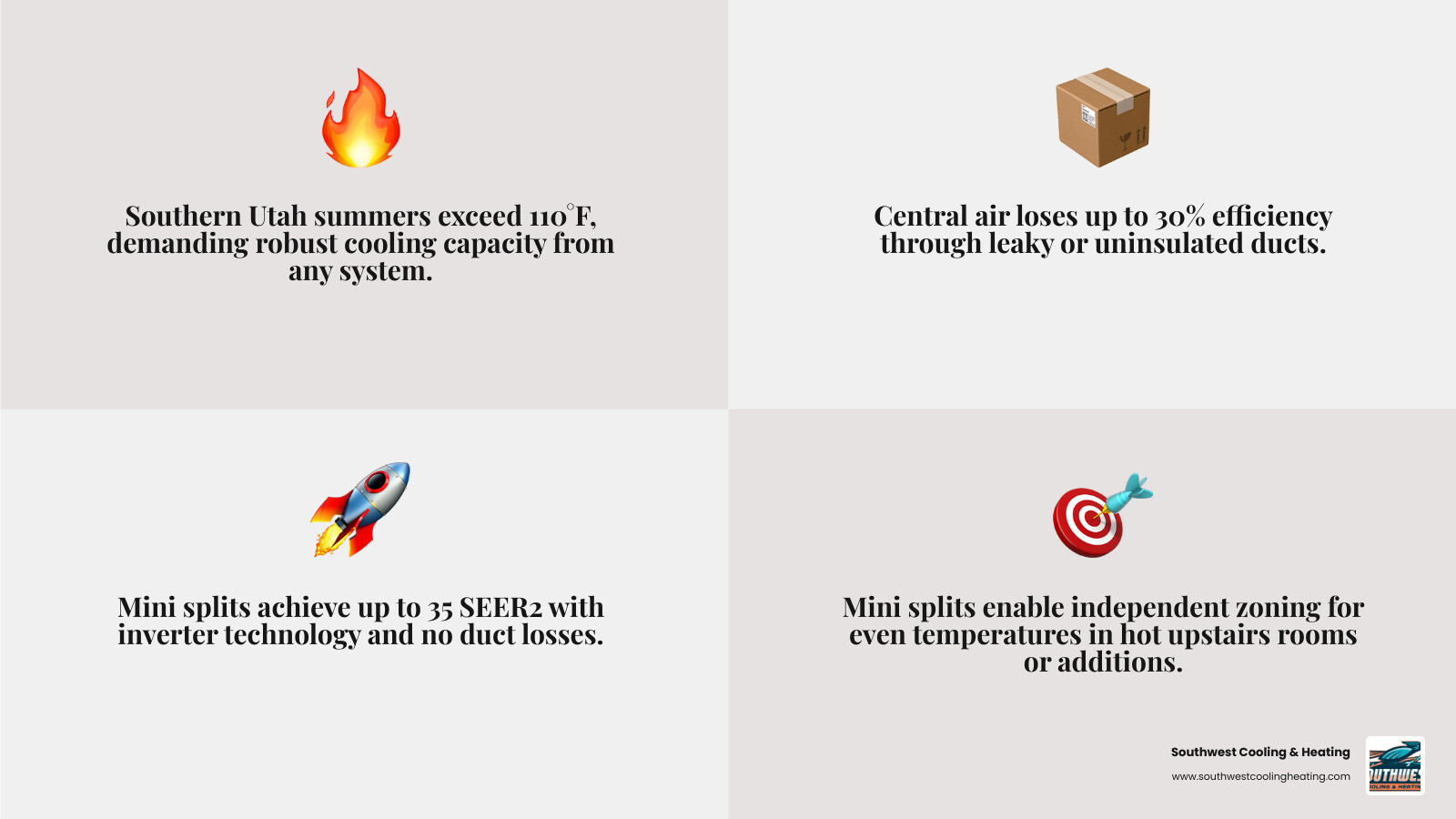
Southern Utah’s summers are no joke. St. George regularly sees temperatures climb past 110°F, putting enormous strain on any cooling system. Whether you’re in a newer build in Coral Canyon or an older home near historic downtown St. George, choosing the wrong cooling system means higher energy bills, uneven temperatures, and a system that works harder than it should.
The decision between central air and a ductless mini split isn’t one-size-fits-all — it depends on your home’s layout, existing ductwork, energy goals, and budget. Both systems have real strengths in the desert climate, and both have trade-offs worth understanding before you commit.
I’m Bruce Hymas, owner of Southwest Cooling & Heating, and I’ve spent years helping Southern Utah homeowners navigate exactly this decision — evaluating the real-world performance of central air vs mini split for southern utah homes across everything from slab homes in Ivins to multi-story builds in Washington. In the sections below, I’ll walk you through what actually matters so you can make a confident, informed choice.
Understanding central air vs mini split for Southern Utah homes
To make the best choice for your home in Santa Clara or Hurricane, we first need to look at how these systems actually function. While both systems use the same basic refrigeration cycle—absorbing heat from inside and releasing it outside—the way they deliver that comfort to your living room is vastly different.
Central air is what most of us grew up with. It relies on a large indoor air handler (often in a closet or attic) and a network of hidden ducts to push air into every room at once. It’s a “whole-home” philosophy. If you already have ductwork in good condition, a professional AC Installation can be a straightforward way to keep your entire square footage at a consistent temperature.
Mini splits, on the other hand, are the “special forces” of cooling. They are ductless, meaning they bypass the attic vents entirely. Instead, a small outdoor condenser connects to one or more indoor air handlers mounted directly on your walls or ceilings. Because they don’t lose energy through leaky ducts, a Mini Split Installation is often the most efficient way to cool specific zones or homes where traditional ducting just isn’t an option.
How central air vs mini split for Southern Utah homes handles desert heat
April 2026 has already shown us that Southern Utah weather is becoming more unpredictable. When the mercury hits 110°F in St. George, your cooling system faces a “thermal load” that would make a coastal AC unit quit.
Central air systems are workhorses, but they can struggle if they aren’t sized perfectly for our dry heat. An Oversized AC St. George AC Service is a common pitfall here; a system that is too large will “short-cycle,” turning on and off so quickly that it never properly dehumidifies or balances the air, leading to a clammy feeling even when it’s hot.
Mini splits excel in extreme heat because of their flexibility. They use inverter technology to speed up or slow down based on the exact cooling need of the room. Instead of blasting on at 100% and then shutting off, they “cruise” at a lower speed, maintaining a steady temperature even when the sun is beating down on your roof in Ivins or Toquerville.
Comparing efficiency: central air vs mini split for Southern Utah homes
Efficiency is where the gap between these two systems becomes most apparent. In the HVAC world, we measure this using SEER2 (Seasonal Energy Efficiency Ratio) ratings.
- Central Air: Top-tier central systems can reach up to 26 SEER. However, the U.S. Department of Energy notes that central systems can lose up to 30% of their cooling energy through ductwork leaks and “conduction” (the air getting warmer as it travels through a hot attic).
- Mini Splits: These systems can reach staggering ratings of up to 35 SEER2. Because there are no ducts, 100% of the cold air produced goes directly into your living space.
When we look at Variable Speed vs Single Stage AC Installation St. George, the variable-speed technology found in almost all mini splits (and high-end central units) is a game-changer for Southern Utah. It allows the system to adjust to the cooling demand in real-time, preventing the massive energy spikes that happen when a traditional system kicks on.
Energy efficiency and performance in the St. George climate
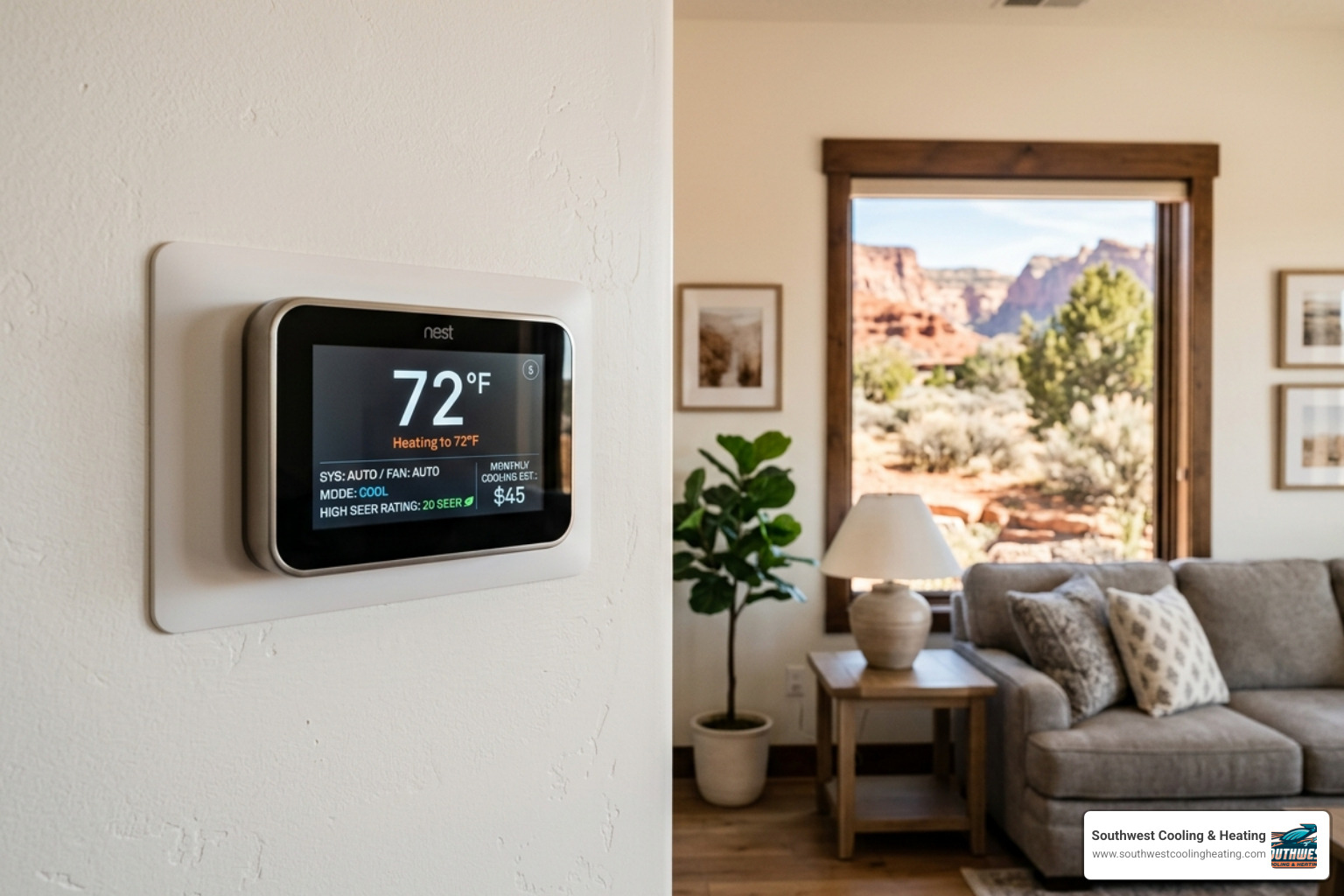
In a climate where the AC might run for six months straight, every percentage point of efficiency matters for your utility bill. One of the biggest advantages of the HVAC Ductless Heat Pump is its ability to provide “zoned” cooling.
Think about it: do you really need to cool your guest bedrooms in La Verkin to 72 degrees at 2:00 PM when no one is using them? With central air, you usually don’t have a choice—it’s all or nothing. With a mini split, you only cool the rooms you are actually using. This targeted approach can save Southern Utah homeowners up to 30% on their monthly cooling costs.
Additionally, local utility programs, such as those from Rocky Mountain Power, often offer incentives for upgrading to high-efficiency heat pump systems. These programs are designed to take the sting out of the initial investment, making the long-term savings of a ductless system even more attractive for residents in Bloomington and Diamond Valley.
Zoning and targeted comfort for multi-story living
If you live in a multi-story home in Washington or Bloomington Hills, you’re likely familiar with the “upstairs oven” effect. Because heat rises, the second floor is often 5 to 10 degrees warmer than the kitchen, even with the central AC running full blast.
This is where a Ductless Heat Pump St. George Upgrade shines. You can install a mini split head in that stubborn upstairs master bedroom, allowing you to keep it at a crisp 68 degrees for sleeping while the rest of the house stays at a more economical 75 degrees.
Mini splits are also the perfect solution for:
- Basements: Which often stay too cold in the winter and need just a touch of dehumidification in the summer.
- Guest Suites: Allowing visitors to control their own comfort without affecting the rest of the house.
- Home Offices: Providing extra cooling for computers and electronics that generate their own heat.
Choosing the right system for your property type
Your home’s age and construction play a massive role in the central air vs mini split for southern utah homes debate.
For those living in historic St. George neighborhoods, the prospect of cutting holes in lath-and-plaster walls to install bulky ductwork is a nightmare. It’s expensive, messy, and can compromise the home’s structural integrity. In these cases, a ductless system is a lifesaver, requiring only a small 3-inch hole for the refrigerant lines.
Conversely, if you are building a new home in a community like Coral Canyon, central air is often the standard choice. Our Coral Canyon Cooling: A Homeowner’s Guide to New AC Systems explains that when ducts are designed into the initial blueprints, central air provides a seamless, “invisible” comfort that many homeowners prefer.
However, even in new builds, we are seeing a trend toward hybrid approaches. Many homeowners choose central air for the main living areas but add a mini split for the garage or a room addition that wasn’t originally tied into the ductwork.
Maintenance and air quality in a dusty environment
Southern Utah is beautiful, but let’s be honest: it’s dusty. The red sand of Hurricane and Santa Clara has a way of finding its way into every nook and cranny of an HVAC system.
Central air systems rely on a single large filter, but they also have hundreds of feet of ductwork where dust, pet dander, and allergens can settle over the years. If those ducts aren’t sealed properly, they can actually pull in dust from the attic or crawlspace and distribute it throughout your home.
Mini splits offer a different advantage for air quality. Most units feature multi-stage filtration—including washable filters and sometimes even HEPA or ionizers—directly at the point where air enters the room. Because there are no ducts to collect dust, many of our customers in Hidden Valley and Winchester Hills report a noticeable improvement in their indoor air quality after switching to ductless.
Regardless of which system you choose, professional HVAC Services are essential. In our desert environment, we recommend:
- Cleaning filters monthly: Especially during monsoon season when dust is high.
- Clearing debris: Ensure the outdoor condenser is free of sand and weeds.
- Annual inspections: Checking refrigerant levels and electrical connections before the summer heat hits.
Frequently Asked Questions about Southern Utah Cooling
Which system is better for older homes without existing ductwork?
For older homes, especially those in historic areas of St. George or Santa Clara, mini splits are almost always the superior choice. Installing new ductwork can add significant labor and material costs—sometimes nearly doubling the total project price. A Mini Split Installation allows you to preserve the character of your home while enjoying modern, high-efficiency cooling without the construction mess.
Can mini-splits handle the 110-degree St. George heat effectively?
Yes, absolutely. Modern HVAC Ductless Heat Pump systems are designed with “high-ambient” cooling capabilities. While older heat pumps used to struggle when temperatures topped 100°F, today’s inverter-driven systems can maintain full cooling capacity even in extreme desert conditions. In fact, they often outperform traditional central units because they don’t lose cooling power through hot attic ducts.
Are mini-splits quieter than traditional central air systems?
Mini splits are significantly quieter. A traditional central air system can roar like a leaf blower when it kicks on, often vibrating the walls. Inside, a mini split air handler typically operates between 19 and 30 decibels—that’s quieter than a whisper or rustling leaves. This makes them ideal for noise-sensitive areas like master bedrooms or home theaters.
Conclusion
Choosing between central air vs mini split for southern utah homes doesn’t have to be a headache. If you have a large, open-concept home with existing, well-maintained ducts, a high-efficiency central air system is a fantastic, reliable choice. But if you’re looking to fix hot spots, save on utility bills through zoning, or cool an older home without the mess of construction, a ductless mini split is the clear winner.
At Southwest Cooling & Heating, we’ve been serving the St. George area since 1980. We know the local climate, the local neighborhoods, and the specific challenges that our desert heat brings. Whether you’re in Hurricane, Ivins, or right here in Bloomington, we’re here to help you find the perfect balance of comfort and efficiency.
Ready to see which system is the best fit for your unique home? Let’s chat about a HVAC Ductless Heat Pump or a new central air upgrade today.