


Is It Cheaper to Repair or Replace Your HVAC System?
The cost of repairing old hvac vs buying new system is one of the most common financial decisions homeowners face — and getting it wrong can cost thousands of dollars. Here’s a quick answer to help you decide:
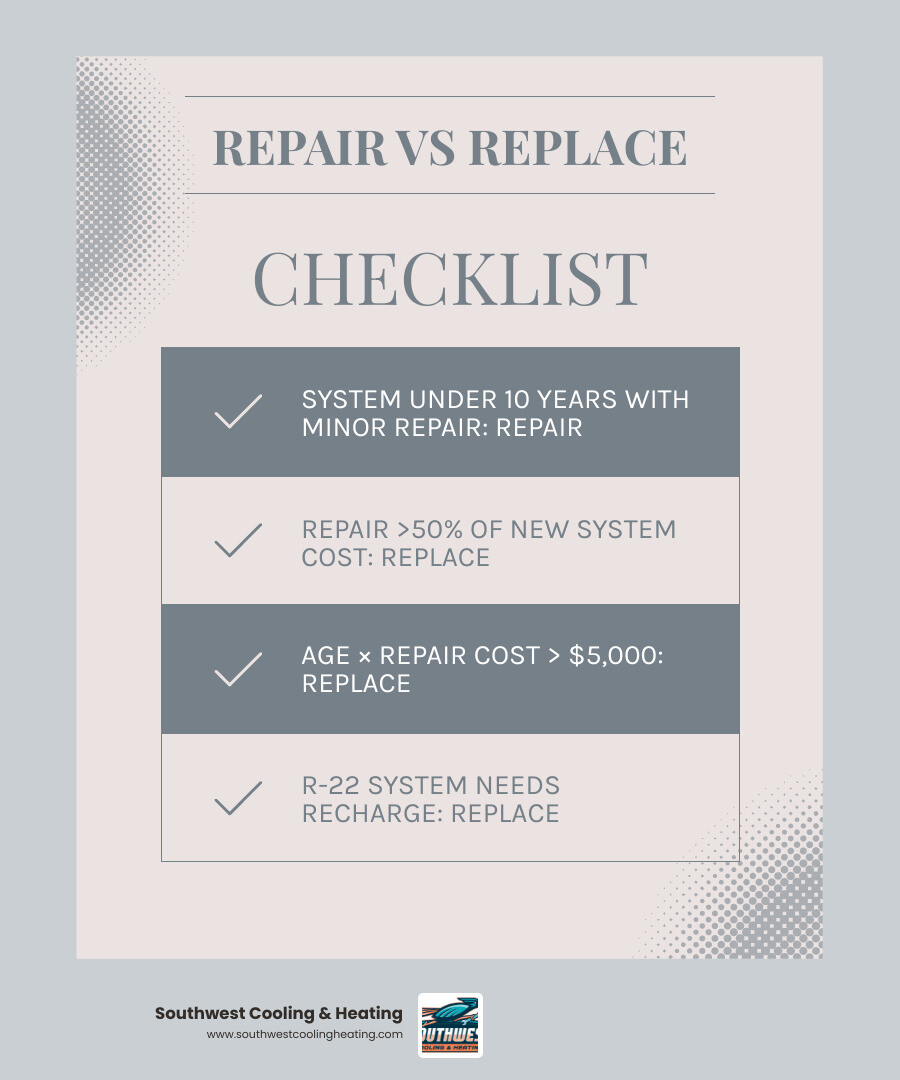
Quick Decision Guide: Repair vs. Replace
| Situation | Likely Best Choice |
|---|---|
| System under 10 years old, minor repair | Repair |
| Repair cost exceeds 50% of new system price | Replace |
| System age × repair cost exceeds $5,000 | Replace |
| System uses R-22 refrigerant and needs a recharge | Replace |
| System over 15 years old with major component failure | Replace |
| System under warranty with a single isolated issue | Repair |
| Energy bills rising steadily year over year | Evaluate replacement |
Your HVAC system works hard — especially in Southern Utah, where summer heat pushes equipment to its limits for months at a time. Most systems last between 10 and 15 years, but as they age, repair bills stack up and efficiency quietly erodes. What looks like a manageable fix today can quietly become a money pit over the next few years.
The real question isn’t just what the repair costs today. It’s what keeping that aging system will cost you over the next 5 to 10 years — in repairs, rising energy bills, and the risk of a full breakdown on the hottest day of the year.
I’m Bruce Hymas, owner of Southwest Cooling and Heating, and with decades of hands-on experience helping St. George homeowners navigate the cost of repairing old hvac vs buying new system, I’ve seen how the right decision at the right time can save families thousands. In the sections below, I’ll walk you through the exact numbers, rules, and scenarios you need to make a confident call.
Evaluating the Cost of Repairing Old HVAC vs Buying New System
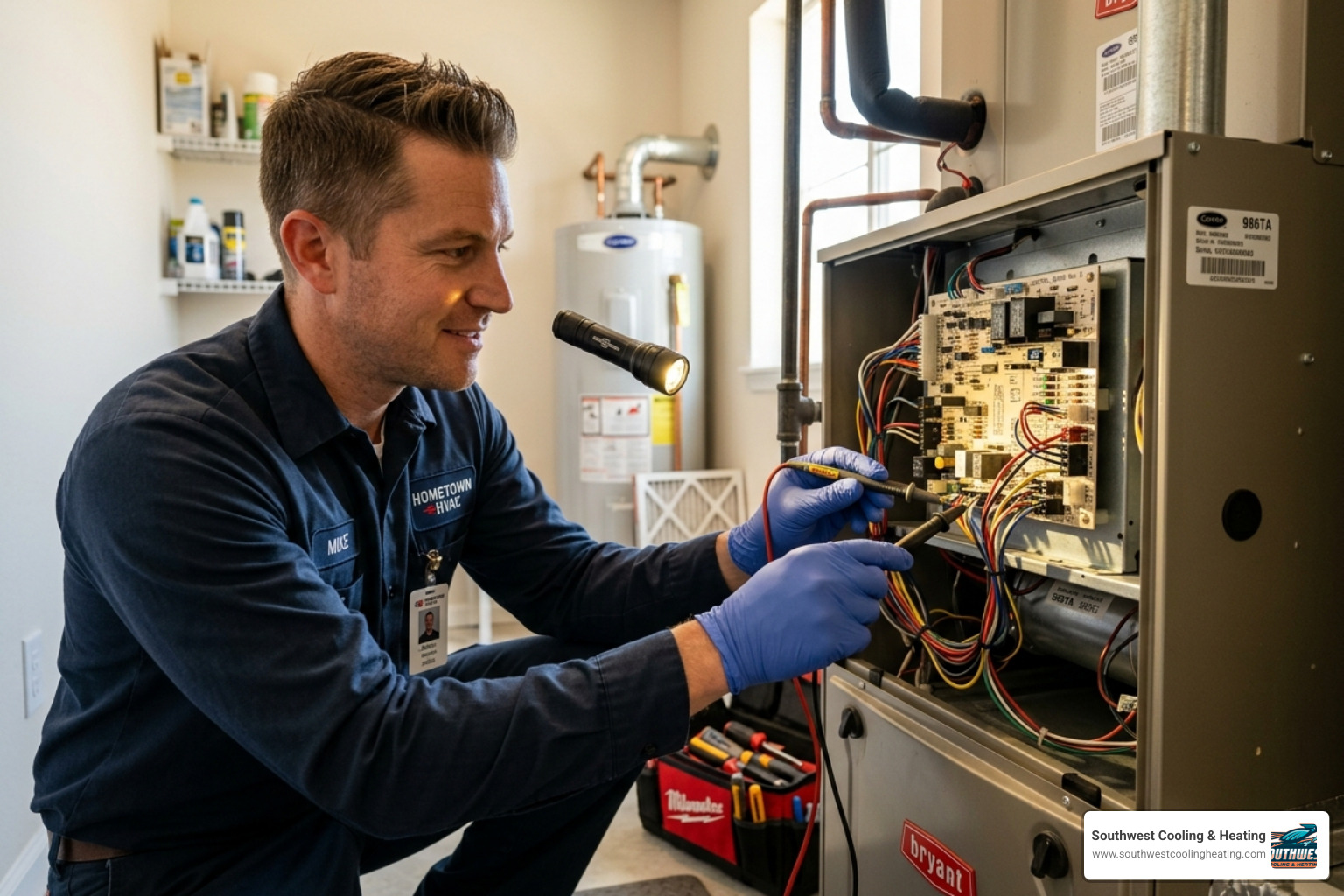
When your air conditioner or furnace stops working in the middle of a Hurricane or Ivins summer, the natural instinct is to fix it as quickly as possible. However, we always encourage our customers to look at the bigger picture. Evaluating the cost of repairing old hvac vs buying new system requires looking beyond the immediate invoice.
First, consider your repair history. A single breakdown might be a fluke, but three service calls in two years is a pattern. Frequent breakdowns are a signal that the internal components are reaching the end of their mechanical life. When we perform an AC Repair or Heating Repair, we check for “cascading failures”—this is when one old part (like a motor) works too hard because another part is failing, eventually leading to a total system collapse.
Total ownership costs include more than just the parts. You must factor in:
- The loss of comfort during downtime.
- The higher utility bills from an inefficient, aging motor.
- The “sunk cost” of putting money into a unit that may still fail next month.
If your system is reliable and the repair is a simple electrical fix, like a capacitor or a contactor, repairing is usually the way to go. But if you’re facing a major component failure on a unit that’s seen better days, the math often tips toward a fresh start.
Analyzing the cost of repairing old HVAC vs buying new system for R-22 units
If your system was installed before 2010, there is a high probability it uses R-22 refrigerant (often called Freon). This is a major factor in the cost of repairing old hvac vs buying new system. The EPA has officially phased out the production and import of R-22 because of its impact on the ozone layer.
Today, R-22 is only available through reclaimed supplies, making it incredibly expensive—often five to ten times the cost of modern refrigerants. If your old unit has a leak, a simple “recharge” can cost as much as a significant repair. Furthermore, because this refrigerant is becoming so scarce, you may eventually find that it’s simply unavailable when you need it most. In these cases, we almost always recommend AC Installation of a modern, eco-friendly system to avoid the “refrigerant trap.”
Comparing the long-term cost of repairing old HVAC vs buying new system
Over a five-year period, an old system can be surprisingly expensive. While a new system requires an upfront investment, it resets your “financial clock.”
- Utility Bills: A ten-year-old system might have been rated at 10 or 12 SEER when new, but it likely operates much lower now. A new high-efficiency system can slash your monthly cooling costs by 20% to 40%.
- Maintenance Expenses: Newer systems require less frequent emergency interventions. While Furnace Maintenance is still essential for any unit, the likelihood of needing an emergency midnight repair drops significantly.
- Warranty Coverage: A repair on an old unit usually only warranties the specific part replaced for maybe a year. A new installation comes with a 5-to-10-year parts warranty, giving you total peace of mind.
Decision Frameworks: The 50% Rule and the $5,000 Rule
Deciding between repair and replacement doesn’t have to be a guessing game. In the industry, we use two primary mathematical “rules of thumb” to help our clients in Bloomington Hills and Santa Clara make objective choices.
The 50% Rule
This rule is simple: If the cost of the repair is more than 50% of the cost of a brand-new system, you should replace it. Why? Because spending half the price of a new unit on a machine that still has old, worn-out secondary parts is a poor investment. You wouldn’t pay for a new engine in a car with 300,000 miles and a rusted frame; the same logic applies to your HVAC.
The $5,000 Rule
This is a more nuanced way to look at the cost of repairing old hvac vs buying new system. Take the age of your equipment and multiply it by the estimated repair cost.
- Example A: A 12-year-old unit needs a $500 repair. (12 x 500 = 6,000). Since 6,000 is greater than 5,000, the rule suggests replacement.
- Example B: A 6-year-old unit needs a $400 repair. (6 x 400 = 2,400). Since 2,400 is less than 5,000, Furnace Repair or AC repair is the smarter move.
These rules help remove the emotion from the situation, especially when you’re stressed by the heat. Whether you’re considering a standard central unit or a Heat Pump Installation, these thresholds provide a clear financial boundary.
How System Age and Refrigerant Phase-Outs Influence Your Choice
Age is the most relentless factor in HVAC performance. Even with perfect maintenance, metal fatigue, chemical degradation of coils, and electrical wear eventually take their toll. Most central air systems have a functional lifespan of 10 to 15 years. In the harsh, dry climate of St. George and Toquerville, systems often work double-time, which can accelerate this timeline.
We are currently in a period of significant transition regarding refrigerants. Following the R-22 phase-out, the industry is now moving away from R-410A in favor of newer, lower-GWP (Global Warming Potential) refrigerants like R-454B. By April 2026, these new standards are the baseline for all new equipment.
If you have a 12-year-old system using R-410A, it isn’t “obsolete” yet, but as the supply of R-410A begins its own regulatory “glide path” downward, repair costs for leaks will inevitably rise. Investing in a Mini Split Installation or a new central system now ensures you are on the right side of the technology curve. Regular AC Maintenance can help you track these changes and plan for a replacement before an emergency occurs.
Maximizing ROI with High-Efficiency Upgrades in St. George
In Southern Utah, efficiency isn’t just a buzzword—it’s a survival strategy for your bank account. The SEER2 (Seasonal Energy Efficiency Ratio) rating tells you how much cooling you get for every dollar of electricity.
Older units in Hidden Valley or Coral Canyon might be operating at a SEER of 8 or 10. Modern minimum standards have pushed that much higher, with premium systems reaching 18 to 22 SEER2. Similarly, the AFUE (Annual Fuel Utilization Efficiency) for furnaces has jumped from 70% in older models to over 96% in high-efficiency units.
When you choose a new Furnace Installation, the ROI comes from three places:
- Monthly Savings: Lowering your bill every single month.
- Tax Credits: Federal programs often provide significant tax credits for high-efficiency heat pumps and furnaces.
- Rebates: Many local utility providers offer “instant” rebates to encourage energy conservation.
Annual Energy Consumption Comparison
| System Efficiency | Estimated Annual Cooling Cost* | Annual Savings vs. 10 SEER |
|---|---|---|
| 10 SEER (Old) | $720 | – |
| 14 SEER (Standard) | $515 | $205 |
| 16 SEER (High) | $450 | $270 |
| 18 SEER (Ultra) | $400 | $320 |
Based on average Southern Utah run times for a 3-ton unit.
When Professional Maintenance and Repair Are the Smarter Choice
We aren’t here to tell you that every broken part requires a new system. In many cases, the cost of repairing old hvac vs buying new system favors the repair.
If your system is less than 10 years old and the repair is “minor”—meaning it’s an electrical component, a fan motor, or a clogged drain line—repairing is the logical choice. This is especially true if your unit is still under a manufacturer’s parts warranty. We often find that a simple seasonal “tune-up” or AC Maintenance visit can resolve performance issues that homeowners feared were terminal.
Consistent Furnace Maintenance is the best way to avoid the “repair vs. replace” dilemma altogether. By catching small issues before they stress the compressor or heat exchanger, we can often push a system’s lifespan toward that 20-year mark.
Frequently Asked Questions about HVAC Replacement
What is the $5,000 Rule for HVAC?
The $5,000 Rule is a formula used to decide if an HVAC unit should be repaired or replaced. You multiply the age of the unit by the cost of the repair. If the result is more than $5,000, replacement is generally the more cost-effective long-term move. If it’s less, the repair is usually justified.
How does the 2025 refrigerant change affect my current system?
The transition to newer refrigerants (like R-454B) mostly affects new equipment manufactured after 2025. Your current R-410A system can still be repaired, but the cost of R-410A refrigerant is expected to increase as production is scaled back. You cannot “retrofit” an old system to use the new refrigerant; if a major leak occurs in an old unit, replacement is often the only viable path.
Can a new HVAC system really lower my St. George utility bills by 20%?
Yes, and in many cases, the savings are even higher. If you are moving from an old 10 SEER unit to a modern 18 SEER2 system, you are looking at a nearly 45% reduction in the electricity used for cooling. In the intense heat of Diamond Valley or Winchester Hills, those percentages translate into hundreds of dollars saved every summer.
Conclusion
At Southwest Cooling & Heating, we’ve been serving the St. George community since 1980. We understand that the cost of repairing old hvac vs buying new system is a significant concern for your family’s budget. Our goal isn’t to sell you something you don’t need; it’s to provide an expert, unbiased assessment of your system’s health.
Whether you are in La Verkin, Ivins, or Bloomington, our team combines modern technology with old-school values to ensure you stay comfortable year-round. We stand behind our work with performance guarantees and a commitment to quick, expert assistance. Don’t leave your comfort to chance or waste money on a system that’s past its prime.
Schedule your professional HVAC evaluation today and let us help you find the most cost-effective solution for your home.