


Why Correct HVAC System Sizing is Key for Your St. George Home
Here’s a quick look at why correct system sizing matters for your home:
- Comfort: Prevents uneven temperatures and humidity problems.
- Energy Efficiency: Avoids wasted energy and high utility bills.
- System Lifespan: Reduces wear and tear, making your unit last longer.
- Indoor Air Quality: Proper humidity control limits mold growth.
For homeowners in St. George, understanding why correct system sizing matters for your home is crucial for comfort and savings. Many people think bigger is better when it comes to HVAC, but that’s a common mistake. An improperly sized system can cause many problems, from high energy bills to uncomfortable indoor temperatures. It can also lead to your system breaking down sooner than it should. Getting the right size is one of the most important parts of expert HVAC services.
To learn more about optimizing your home’s comfort, visit our HVAC Services page, or Contact Us today for a personalized evaluation.
As Bruce Hymas, owner of Southwest Cooling & Heating, I’ve seen how vital this is. My commitment to our St. George community stems from ensuring every homeowner understands why correct system sizing matters for your home for long-term comfort and efficiency.
The Science of HVAC Capacity: Understanding BTUs and Tonnage
When we talk about the “size” of an HVAC system, we aren’t referring to how much space it takes up in your side yard or attic. Instead, we are talking about its capacity to move heat. In HVAC, heat is measured in BTUs, or British Thermal Units. One BTU is roughly the amount of energy needed to heat or cool one pound of water by one degree Fahrenheit.
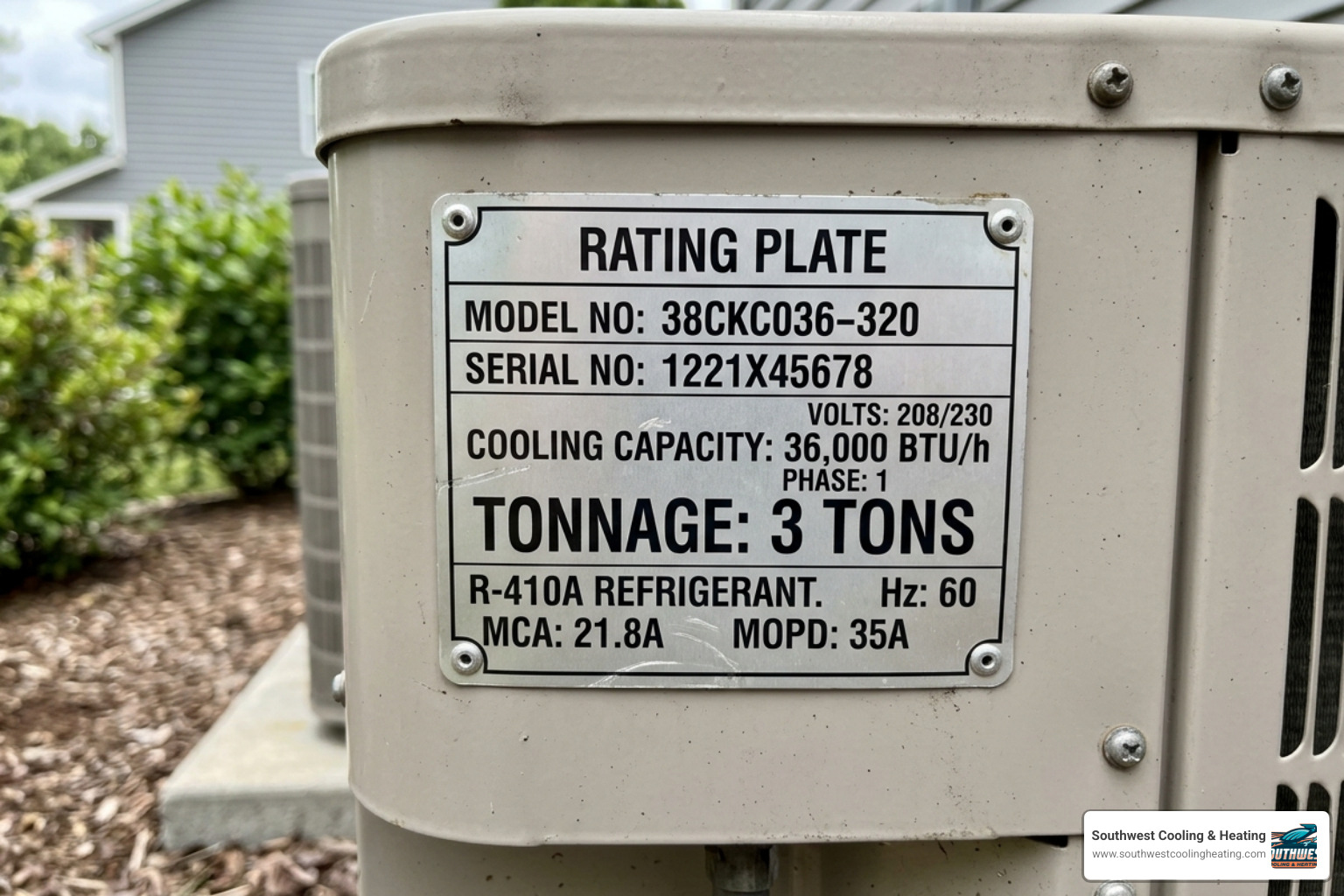
In the industry, we often group these BTUs into “tons.” This term is a bit of a history lesson: it refers to the cooling power provided by melting one ton of ice over 24 hours. One ton of cooling capacity is equal to 12,000 BTUs per hour. So, if we tell you that your home in Hurricane or Ivins needs a 3-ton unit, we are saying your home requires a system capable of moving 36,000 BTUs of heat every hour.
Properly managing these units is a delicate balance of sensible heat (the temperature you see on the thermostat) and latent heat (the moisture in the air). If a system is sized incorrectly, it may drop the temperature quickly but leave the air feeling heavy and damp. This is why a professional AC Installation is about more than just “swapping boxes”; it’s about calculating the exact thermal needs of your specific living space.
What is a Manual J load calculation?
For decades, many contractors used a “rule of thumb” based solely on square footage. However, modern engineering has given us a much better tool: the Manual J load calculation. Developed by the Air Conditioning Contractors of America (ACCA), this is the gold standard for determining the precise heating and cooling load of a home.
A Manual J doesn’t just look at how big your house is. It looks at the “building envelope”—everything that separates your indoor air from the Utah desert heat. We take into account the direction your home faces, the type of insulation in your walls, the number of windows you have, and even how many people live in the house. This scientific approach is exactly what we discuss in our Coral Canyon Cooling: A Homeowner’s Guide to New AC Systems, ensuring that your new system is matched perfectly to your home’s unique DNA.
Why correct system sizing matters for your home humidity levels?
One of the most overlooked reasons why correct system sizing matters for your home is humidity control. Even in our relatively dry climate in Southern Utah, indoor activities like showering, cooking, and even breathing add moisture to the air.
An air conditioner’s job is two-fold: it lowers the temperature and removes moisture. To remove moisture effectively, the evaporator coil needs to stay cold for a significant amount of time. If your system is too large, it will reach the target temperature so quickly that it shuts off before it has a chance to pull the water out of the air. This results in “clammy” air—where it’s technically 72 degrees, but you feel sticky and uncomfortable. Over time, this excess moisture can even lead to mold growth behind furniture or in closets.
Why Correct System Sizing Matters for Your Home and Energy Efficiency
Efficiency is the name of the game in April 2026. With energy standards evolving, having a system that operates at its peak performance is the only way to keep utility bills manageable. When a system is sized correctly, it runs in long, steady cycles. This is much more efficient than the “stop-and-go” nature of an oversized unit.
| System Sizing | Cycle Length | Energy Consumption | Comfort Level |
|---|---|---|---|
| Oversized | Short (5-10 mins) | Very High (Frequent starts) | Poor (Clammy/Uneven) |
| Undersized | Constant (Never stops) | High (Runs 24/7) | Poor (Too warm) |
| Correctly Sized | Moderate (15-20 mins) | Optimized/Low | Excellent (Steady/Dry) |
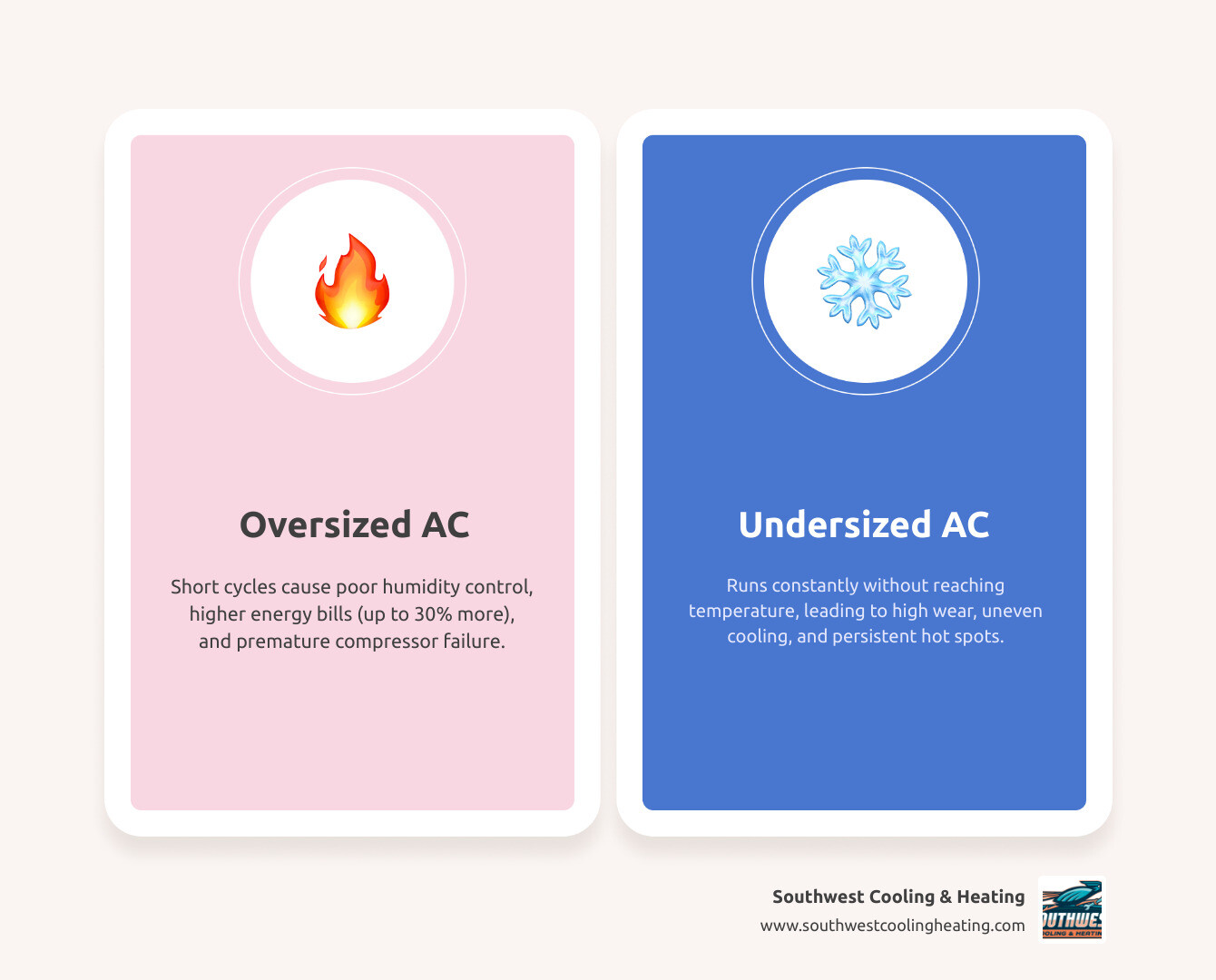
As we move through 2026, the cost of energy continues to be a major concern for families in Toquerville and La Verkin. Research shows that an improperly sized system can increase your energy usage by as much as 30%. When a unit “short cycles”—turning on and off every few minutes—it consumes a massive amount of electricity during the startup phase. You can learn more about the specific pitfalls of this in our guide on Oversized AC St. George AC Service.
Why correct system sizing matters for your home lifespan?
Think of your HVAC system like a car. If you only used your car to drive one block at a time, stopping and starting every sixty seconds, the engine and starter would wear out incredibly fast. The same logic applies to your air conditioner or heat pump.
Frequent startups place immense mechanical stress on the compressor—the “heart” of your system. An oversized unit might cycle 10 to 15 times an hour, whereas a correctly sized unit might only cycle two or three times. This reduction in “wear and tear” is a primary reason why correct system sizing matters for your home longevity. Whether you are looking at a traditional unit or a Heat Pump Installation, getting the size right can mean the difference between a system that lasts 15 years and one that fails in 8.
Avoiding the “Bigger is Better” myth in St. George
It is a common tactic for some contractors to suggest a larger unit “just to be safe.” They might worry that a smaller unit won’t keep up on a 110-degree St. George afternoon. However, “padding” the numbers by 20% or 50% is a disservice to the homeowner.
Precision beats guesswork every time. If a contractor offers you a quote for a Furnace Installation or AC replacement without performing a load calculation, they are essentially guessing with your money. At Southwest Cooling & Heating, we believe in using data, not “rules of thumb,” to ensure your home remains a sanctuary.
Key Factors Influencing Your Home’s Load Calculation
Every home in the St. George area is different. A home in Winchester Hills might have different wind exposure than one in Bloomington. To get an accurate sizing, we look at several key factors.
- Square Footage: The baseline, but only the beginning.
- Insulation R-values: How well your attic and walls hold in the “cool.”
- Window Orientation: South-facing windows in Utah act like giant heaters.
- Ceiling Height: Vaulted ceilings increase the volume of air that needs to be treated.
- Occupancy Patterns: A family of six generates more heat than a couple.
- Lighting and Appliances: Modern LED lights stay cool, while older appliances can add significant heat.
For homes where traditional ductwork isn’t ideal or for room additions, we often look at Ductless Heat Pump Services as a way to provide targeted, perfectly sized comfort without overhauling the entire home’s system.
How insulation and windows affect tonnage
In our desert climate, solar heat gain is your HVAC system’s biggest enemy. If you have older, single-pane windows, your home’s “load” will be significantly higher than a neighbor with low-E, double-pane glass. Similarly, if your attic insulation has settled over the years, your AC has to work much harder to fight the heat radiating from your roof.
When we perform a sizing evaluation, we often find that a Mini-Split Installation is the perfect solution for “problem rooms” that were originally sized incorrectly or have high solar gain. By addressing these specific thermal barriers, we can often recommend a smaller, more efficient main system for the rest of the house.
Spotting the Signs of an Improperly Sized HVAC System
How do you know if your current system is the wrong size? You don’t always need a technician to tell you; the signs are often right in front of you.
- Uneven Temperatures: Do you have “hot spots” in the kitchen while the bedroom is freezing? This often points to a system that isn’t running long enough to circulate air to the furthest vents.
- Constant Operation: If your system runs 24/7 and still can’t get the house down to 75 degrees, it’s likely undersized.
- Frequent Cycling: If the unit kicks on and off every five minutes, it’s almost certainly oversized.
- High Utility Bills: If your bills are skyrocketing despite regular maintenance, the system is likely fighting its own sizing.
- Thermostat Lag: If the thermostat says it’s 72, but you feel hot, the humidity levels are likely too high due to short cycling.
If these symptoms sound familiar, it’s time to Contact Us for a professional evaluation. Living with an improperly sized system is like wearing shoes two sizes too small—you can make it work, but it’s going to be painful and costly.
Questions to ask your contractor about sizing
When you are interviewing contractors for a new system, don’t be afraid to get technical. A reputable professional will be happy to explain their process. Here are a few “must-ask” questions:
- “Will you perform a full Manual J load calculation before giving me a quote?”
- “Can you show me the data used for the calculation (insulation levels, window types)?”
- “Does my existing ductwork support the airflow requirements of this new unit?”
- “What is your experience with Variable Speed vs Single Stage AC Installation St. George?”
Advanced Solutions: Zoning and Variable-Speed Technology
Proper sizing is the foundation, but modern technology allows us to build an even more comfortable home. While Manual J tells us the size of the unit, Manual D helps us design the ductwork to ensure that air actually gets where it needs to go.
Our HVAC Services often include recommendations for variable-speed technology. Unlike traditional systems that are either “100% On” or “Off,” variable-speed compressors can modulate their output. They can run at 40% capacity on a mild Santa Clara morning and ramp up to 100% during a scorching Bloomington afternoon. This provides a level of “sizing forgiveness” and extreme efficiency that single-stage systems simply can’t match.
Zoning is another fantastic tool. By splitting your home into different zones, you can send more cooling to the upstairs bedrooms at night and more to the living areas during the day. This allows us to use the system’s capacity exactly where it’s needed most.
Frequently Asked Questions about HVAC Sizing
Can I size my HVAC system based on square footage alone?
Absolutely not. While square footage is a starting point, it ignores 80% of what actually matters. Two 2,000-square-foot homes in Diamond Valley could have vastly different needs if one has vaulted ceilings and floor-to-ceiling windows while the other is a single-story home with heavy shade trees. Relying on square footage alone is why up to 90% of systems are installed incorrectly.
What happens if my AC is too small for my St. George home?
An undersized AC will struggle to keep up when the Southern Utah heat hits its peak. It will run constantly, which leads to incredibly high energy bills and premature motor failure. More importantly, you’ll never actually be comfortable; the house will likely stay 5 to 10 degrees warmer than your desired setting during the hottest part of the day.
Does a higher SEER rating change the size I need?
No. SEER (Seasonal Energy Efficiency Ratio) measures efficiency, while tonnage measures capacity. A 3-ton 14 SEER unit and a 3-ton 20 SEER unit both provide the same amount of cooling. The 20 SEER unit just does it using significantly less electricity. You must get the size right first; then, you can choose the efficiency level that fits your budget and goals.
Conclusion
At Southwest Cooling & Heating, we’ve been serving the St. George area since 1980. We know our local climate, and we know exactly why correct system sizing matters for your home. Whether you are in Santa Clara, Bloomington Hills, or Hurricane, your home deserves a system that is engineered for comfort, not just “installed.”
By insisting on a Manual J load calculation and looking at your home as a complete system, you can enjoy lower bills, a longer-lasting unit, and the peace of mind that comes with true home comfort. If you’re ready to see the difference that precision makes, explore Our HVAC Services and let our expert team help you find the perfect fit for your home.