


The Financial Framework: Using the repair vs replace your hvac decision guide
Repair vs replace your hvac decision guide — here’s a quick answer before we dive in:
Repair your system if:
- It is less than 10 years old (AC/heat pump) or less than 15 years old (furnace)
- The repair cost is less than 50% of a new system’s price
- Your system age × repair cost is under $5,000 (the $5,000 rule)
- You’ve had few or no repairs in the past 2–3 years
- The issue is a minor component like a capacitor, contactor, or thermostat
Replace your system if:
- It is over 10–15 years old (AC/heat pump) or over 15–20 years old (furnace)
- The repair cost exceeds 50% of a new system’s price
- Your system age × repair cost is over $5,000
- You’ve had 3 or more repairs in the last 3 years
- It uses R-22 refrigerant and needs a significant repair
- A major component like the compressor or heat exchanger has failed
- You’re experiencing safety issues such as carbon monoxide concerns
It’s one of the most stressful decisions a homeowner faces: your HVAC system breaks down, a technician is standing in your living room, and you need to decide — right now — whether to repair or replace it. In St. George’s desert climate, where summer temperatures routinely exceed 100°F and winters can drop well below freezing, that decision carries real stakes. A system that can’t keep up isn’t just uncomfortable — it’s a problem. And with repair quotes that can range from a straightforward fix to a cost that rivals a new system entirely, it’s easy to feel like you’re guessing in the dark.
The good news is that this doesn’t have to be a guessing game. There are clear, proven frameworks — like the $5,000 rule and the 50% rule — that take the emotion out of the decision and help you evaluate it logically. Whether your system is aging, inefficient, or just needs a minor tune-up, this guide walks you through every factor that matters.
I’m Bruce Hymas, owner of Southwest Cooling & Heating, and with over four decades of family HVAC history behind me and a hands-on background running businesses and streamlining operations, I’ve helped countless St. George homeowners work through exactly this repair vs replace your hvac decision guide to make confident, cost-smart choices. Let’s break it down step by step.

When we talk to homeowners in Santa Clara or Bloomington Hills, the conversation usually starts with the wallet. HVAC systems are a significant investment in your home’s value and your family’s comfort. To decide whether to keep an old unit running or invest in a new one, we use two primary mathematical formulas that act as a repair vs replace your hvac decision guide. These rules help us move past the “I hope it lasts another year” phase and into data-driven decision-making.
The logic here is simple: every dollar you spend on a repair is a dollar that could have gone toward a new, warrantied, high-efficiency system. If your current system is already past its prime, pouring money into it is often like putting a new transmission into a car with 300,000 miles on it — it might get you down the road, but something else is likely to break next week.
| Indicator | Favor Repair | Favor Replacement |
|---|---|---|
| System Age | Under 10 years | Over 12–15 years |
| Repair Cost | Less than 50% of new unit | More than 50% of new unit |
| $5,000 Rule | Result is under $5,000 | Result is over $5,000 |
| Refrigerant | R-410A (Modern) | R-22 (Phased out/Freon) |
| Efficiency | High SEER/AFUE | Low SEER/Rising bills |
Applying the $5,000 rule to your repair vs replace your hvac decision guide
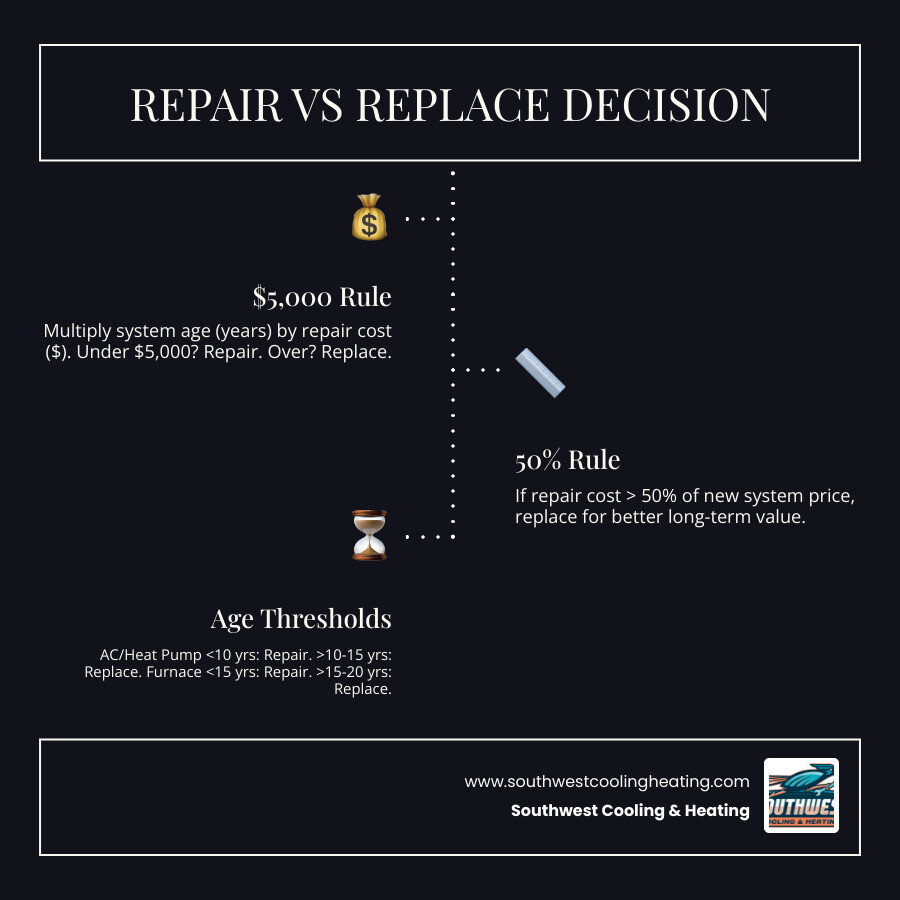
The $5,000 rule is one of the most popular industry standards for a reason: it’s incredibly easy to calculate. You simply take the age of your system and multiply it by the repair quote you just received. If the total is more than $5,000, it’s time to consider a replacement.
For example, if you live in Hidden Valley and your 12-year-old AC unit needs a $500 repair, the math looks like this: 12 × 500 = 6,000. Since $6,000 is over the $5,000 threshold, the rule suggests replacement. However, if that same unit only needed a $200 capacitor, the result would be 2,400, making the repair a much safer bet. This rule accounts for the “remaining life” of the system. We always recommend regular AC Maintenance to keep these repair costs low and stay on the “repair” side of the math for as long as possible.
Evaluating the 50% rule for major component failures
The 50% rule is even more direct. If the cost of a single repair is more than 50% of what a brand-new system would cost, you should almost always opt for the new unit. This is especially true if your current system is out of warranty.
A major repair, like a failed compressor or a cracked heat exchanger, can easily approach this threshold. When you choose AC Installation over an expensive repair, you aren’t just fixing the immediate problem; you’re resetting the clock with a 10-year parts warranty and significantly lower monthly utility bills. In our experience serving Toquerville and La Verkin, homeowners who follow the 50% rule avoid the “repair spiral” where they end up paying for a new system one part at a time without ever getting the benefits of a new unit.
When Age and Frequency Signal It’s Time for an Upgrade
Age is the most predictable factor in any repair vs replace your hvac decision guide. While proper maintenance can stretch the life of a system, mechanical parts eventually reach their “fatigue limit.” In the intense heat of Diamond Valley or Winchester Hills, air conditioners and heat pumps typically have a reliable lifespan of 10 to 15 years. Furnaces, which don’t have to work quite as hard in our climate, can often last 15 to 20 years.
If your system is knocking on the door of these age limits, even “small” repairs should be viewed with skepticism. An older system is less efficient by design, meaning it costs you more every single month just to turn it on. If you find yourself calling for AC Repair or Furnace Repair every season, the equipment is telling you it’s tired.
Identifying the “repair spiral” in older systems
We often see what we call the “repair spiral.” It starts with a small service call this year, followed by another next summer, and then a major component failure the year after. If you’ve had three or more repairs in the last three years, your system is in a state of systemic decline.
Frequent breakdowns are a sign that the internal components are wearing out at a similar rate. Replacing a fan motor today doesn’t stop the compressor from failing tomorrow. This lack of reliability is a huge burden for homeowners in Hurricane or Ivins who rely on their HVAC for safety during extreme weather. To prevent getting caught in this spiral, we suggest proactive Furnace Maintenance to monitor the health of your system and plan for a replacement before an emergency strike.
Critical Components and Safety Red Flags in Southern Utah
Some repairs are more than just a matter of convenience or money; they are matters of safety. This is a critical part of any repair vs replace your hvac decision guide. Certain component failures are “red flags” that signal the end of the road for your equipment.
The most serious of these is a cracked heat exchanger in your furnace. The heat exchanger is what keeps combustion gases, like carbon monoxide, separate from the air you breathe. If it cracks, it can leak deadly CO into your home. Because the cost to replace a heat exchanger is so high and the safety risk is so great, we almost always recommend a full replacement of the furnace in these cases. If you suspect your heater is acting up, don’t wait — seek Heating Repair immediately for a professional safety inspection.
Why R-22 refrigerant systems are a replacement priority
If your air conditioner was manufactured before 2010, there is a high chance it uses R-22 refrigerant, commonly known as Freon. The EPA officially phased out the production and import of R-22 in 2020 because it depletes the ozone layer.
Today, R-22 is extremely scarce and expensive. A simple recharge for a leak can cost more than many major mechanical repairs. If your R-22 system has a leak or a failed compressor, repairing it is rarely the right move. You would be investing heavily in an obsolete technology that will only become more expensive to maintain. For more details on why we prioritize these upgrades, you can read more About HVAC Service and the transition to modern, eco-friendly refrigerants like R-410A.
Maximizing Efficiency and Comfort in the St. George Climate
Living in Southern Utah means our HVAC systems are some of the hardest-working appliances in our homes. If you’re still using a system from the early 2000s, you’re likely using a unit with a SEER (Seasonal Energy Efficiency Ratio) rating of 10 or lower. Modern standards now require a minimum of SEER2 14.3 in our region, with many high-efficiency units reaching SEER2 20 or higher.
Upgrading to a new system via Furnace Installation can reduce your cooling costs by 20% to 40% almost overnight. Over the 15-year lifespan of a new unit, those monthly savings can actually pay for a significant portion of the replacement cost. Furthermore, a new system solves common comfort issues like uneven temperatures between rooms or high indoor humidity that older, struggling units just can’t handle.
How efficiency ratings impact your repair vs replace your hvac decision guide
When evaluating your repair vs replace your hvac decision guide, look at the ratings: SEER2 for cooling, AFUE for gas furnaces, and HSPF2 for heat pumps.
- SEER2: Higher is better. Moving from a SEER 10 to a SEER2 16 can save hundreds of dollars a year in St. George.
- AFUE: This measures how much fuel is converted to heat. Older furnaces might be 80% efficient, while new ones reach 96% or higher.
- HSPF2: This is the heating efficiency for heat pumps.
If your bills are rising even though your usage hasn’t changed, your system is losing its efficiency. In these cases, Heat Pump Installation is often the smartest long-term financial move, as it provides both high-efficiency heating and cooling in one package.
Frequently Asked Questions about HVAC Decisions
Making the final call can be tough, so we’ve gathered some of the most common questions we hear from our neighbors in Coral Canyon and beyond.
Is it worth repairing an HVAC system over 15 years old?
Generally, no. Even if the repair is relatively cheap, a 15-year-old system is at the very end of its expected life. The efficiency gap between a 2011 model and a 2026 model is massive. You’re likely better off using that repair money as a down payment on a new system that comes with a fresh warranty and lower operating costs.
What types of repairs are always worth doing regardless of age?
Some minor “wear and tear” parts are almost always worth fixing to get a little more life out of a system. These include:
- Capacitors: These are like batteries that help the motors start. They are a common and affordable AC Repair.
- Contactors: These are simple electrical switches.
- Thermostats: Sometimes the “HVAC problem” is just a faulty wall controller.
- Clogged Condensate Lines: A simple cleaning can prevent water damage and get you back up and running.
How can I tell if my contractor is pressuring me to replace?
A trustworthy technician will always provide options. At Southwest Cooling & Heating, we believe in giving you the facts and letting you make the choice. If a contractor tells you a system must be replaced but can’t show you a cracked heat exchanger, a grounded compressor, or explain the math behind the $5,000 rule, get a second opinion. Always ask for an itemized quote and a root cause analysis of why the part failed.
Conclusion
Deciding whether to repair or replace your HVAC system is a big moment for any homeowner. Whether you are in Santa Clara, Bloomington, or the heart of St. George, the goal is the same: reliable comfort and predictable costs. By using the repair vs replace your hvac decision guide, you can move forward with confidence knowing you’ve made the best choice for your home and your budget.
At Southwest Cooling & Heating, we’ve been serving the Southern Utah community since 1980. We’ve seen every type of system and every type of failure, and we’re here to help you navigate these choices with honesty and expert skill. If you’re facing a tough decision with your heating or cooling system, let our team provide the high-quality, reliable assistance you deserve. From Ivins to La Verkin, we are your local partners in home comfort.
Ready to get your system back in top shape? Explore our full range of HVAC Services or give us a call today for an expert evaluation.