


What AC Making Strange Noises Means — and What to Do Right Now
If you’re hearing ac making strange noises what they mean is probably the first thing on your mind — and the short answer is this: different sounds point to different problems, and some need attention faster than others.
Here is a quick-reference guide to the most common AC noises and what they usually mean:
| Sound | Most Likely Cause | Urgency |
|---|---|---|
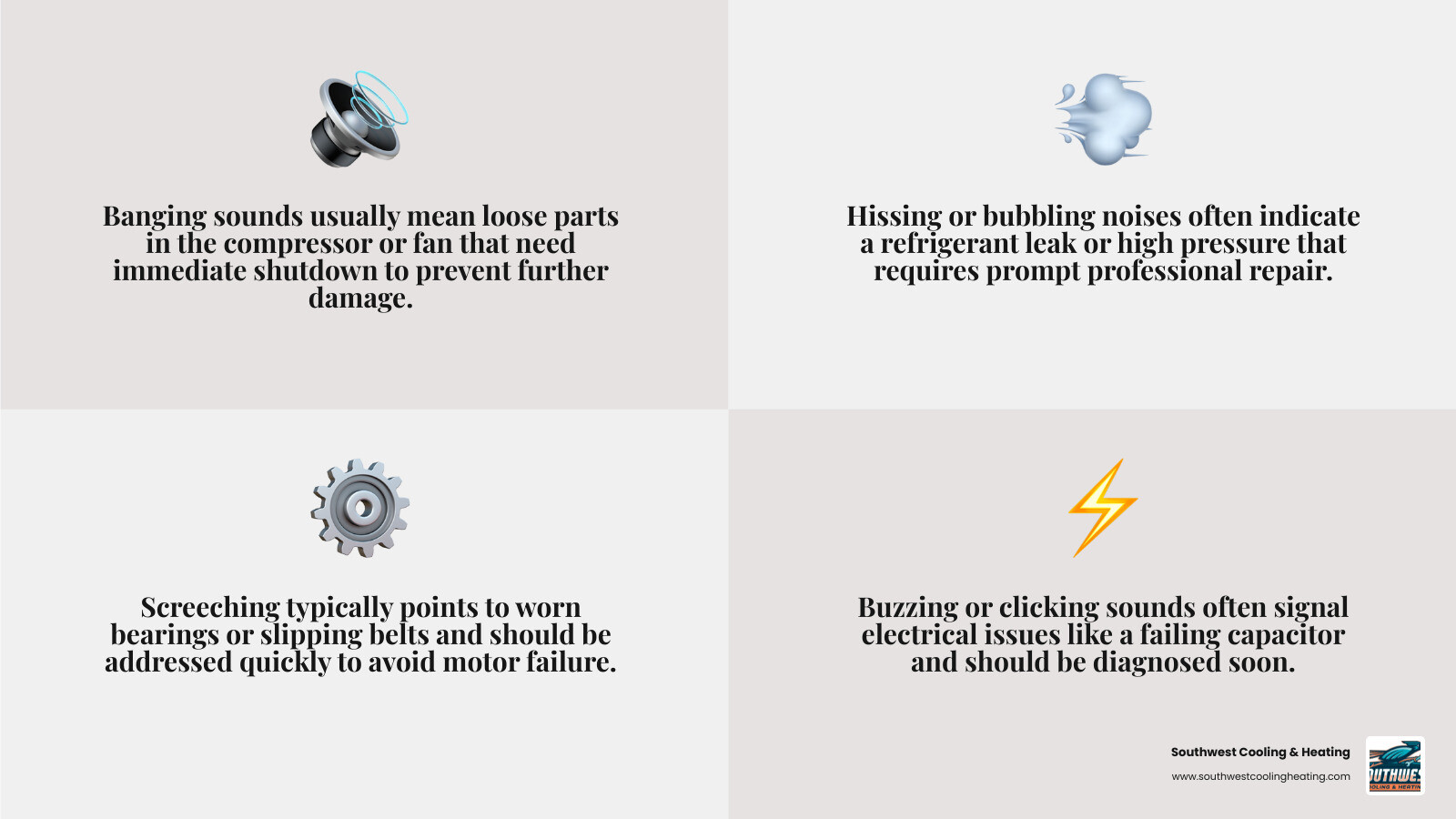
| Banging or clanking | Loose or broken part inside compressor or fan | High — turn off system now |
| Hissing | Refrigerant leak or high compressor pressure | High — call a technician |
| Screeching or squealing | Worn motor bearings or slipping fan belt | High — shut down and inspect |
| Buzzing | Electrical issue, failing capacitor, or frozen coils | Medium-High — schedule soon |
| Rattling | Loose panel, debris in outdoor unit | Medium — inspect and clear |
| Clicking (repeated) | Failing relay, thermostat, or capacitor | Medium — have it diagnosed |
| Whistling | Dirty air filter restricting airflow | Low — replace filter first |
| Gurgling or bubbling | Clogged condensate drain or refrigerant leak | Medium — check drain line |
| Single click at startup/shutdown | Normal thermostat relay operation | Normal — no action needed |
| Steady low hum | Normal compressor operation | Normal — no action needed |
Most modern air conditioners run between 25 and 55 decibels — roughly the volume of a quiet conversation. Some high-efficiency units run as low as 19 decibels, softer than a whisper. When your system suddenly sounds louder, harsher, or just different than usual, that change in sound is your AC telling you something is wrong.
Here in St. George, Utah, where summer temperatures regularly push past 100°F, a struggling air conditioner is not just an inconvenience — it is a genuine comfort and safety issue. The last thing you want is to ignore a small rattle in May and find yourself with a failed compressor in the middle of July.
The good news is that catching these sounds early almost always means the difference between a simple repair and a full system replacement.
I’m Bruce Hymas, owner of Southwest Cooling and Heating, and with over four decades of HVAC experience serving the St. George area, I’ve heard just about every strange noise an air conditioner can make and what AC making strange noises what they mean looks like in real homes. In the guide below, I’ll walk you through each sound, what’s likely causing it, and exactly what to do next.
Ac making strange noises what they mean terms made easy:
- Who has been doing air conditioner repair in the St. George area since the 1980s?
- Who should I call for ac air conditioner repair in Coral Canyon?
AC Making Strange Noises What They Mean: The Diagnostic Guide

When we set out to diagnose a noisy cooling system, we don’t just listen to the volume. We use a structured diagnostic framework based on three key factors: location, timing, and rhythm.
- Location: Is the sound coming from the indoor air handler in your closet or attic, or is it echoing from the outdoor condenser unit sitting on the side of your home?
- Timing: Does the sound only occur for a brief 10 to 15 seconds during startup, does it persist steadily throughout the entire cooling cycle, or does it happen right after the system shuts down?
- Rhythm: Is it a constant, rhythmic metal-on-metal sound, an intermittent rattle, or a continuous high-pitched squeal?
By mapping these auditory clues to specific mechanical and electrical components — such as the compressor, condenser fan motor, blower wheel, run capacitor, or refrigerant line sets — we can pinpoint the issue before we even open up the access panels.
If your air conditioner is making loud, harsh, or unfamiliar noises, the safest first step is to turn the system off at the thermostat. Running a damaged system can cause minor issues to cascade into catastrophic failures. For a deeper look at the warning signs that indicate your system is in trouble, read our guide on Red Alerts and Cold Comforts: Signs Your HVAC Needs Help ASAP.
Banging and Clanking: AC Making Strange Noises What They Mean for Your Compressor
If your outdoor unit sounds like a bucket of rocks in a clothes dryer, you are likely dealing with a serious mechanical issue. Banging or heavy clanking sounds typically point to loose, unbalanced, or broken parts inside the compressor or the outdoor fan assembly.
The compressor is the heart of your air conditioning system. Inside its sealed metal casing, pistons, connecting rods, and crankshafts work under extreme pressure to pump refrigerant. Over years of heavy use in hot Utah summers, these internal components can wear down. A broken connecting rod or a loose crankshaft pin will slam against the outer shell of the compressor during every single cycle.
Alternatively, a loud clanking noise from the outdoor unit could mean that a fan blade has bent, come loose from its motor shaft, or is striking a foreign object like a stray branch that fell through the top grille.
Ignoring a banging sound is incredibly risky. A small, loose internal part can quickly break completely free. When this happens, it can fly through the system and puncture your expensive condenser coils or destroy the compressor motor entirely. If you hear heavy metal-on-metal banging, shut down your system immediately and seek professional help. Learn more about when to take immediate action by reviewing the Signs You Need Emergency HVAC Service Immediately.
Hissing and Bubbling: AC Making Strange Noises What They Mean for Your Refrigerant
A hissing or bubbling sound from your air conditioner is almost always related to the refrigerant that cools your home. Refrigerant is kept under high pressure in a closed loop of copper lines. When a tiny crack or pinhole leak develops in these lines or the evaporator coils, the escaping pressurized gas creates a distinct, continuous hissing sound.
In some cases, you might hear a bubbling or gurgling sound instead of a hiss. This happens when air bubbles get drawn into the refrigerant lines due to low charge levels, or when water from a clogged condensate drain line cannot flow away properly.
Another cause of hissing is high internal compressor pressure. If your compressor is operating under unsafe pressure levels, you may hear a loud, high-pitched hissing or screaming sound that lasts for 10 to 15 seconds right when the unit starts up. This is a critical safety concern, as modern systems have built-in pressure relief valves that will vent if the system is overloaded.
Because refrigerant leaks reduce system efficiency, increase your monthly utility bills, and can even pose respiratory health risks if ignored, they must be addressed by an EPA-certified technician. Running your AC without enough refrigerant will eventually starve the compressor of the cooling oil it needs, leading to complete motor burnout. If your system goes down during a blistering summer heatwave, be sure to read our survival tips on What to Do When Your AC Breaks in Extreme Heat.
Screeching and Squealing: Worn Bearings and Fan Belts
A high-pitched screeching or squealing sound can set your teeth on edge, and it is a clear warning that something is binding or running dry. In most residential air conditioners, this sound is caused by worn bearings in either the indoor blower motor or the outdoor condenser fan motor.
Older HVAC systems often utilize a belt-driven blower motor in the indoor air handler. Over time, these rubber V-belts dry out, stretch, slip, or misalign on their pulleys, creating a loud squealing sound very similar to a slipping fan belt on an older car. If the belt is simply slipping, it can sometimes be adjusted or replaced easily.
However, most modern systems use direct-drive motors. If you hear a screeching or grinding sound from a direct-drive unit, it means the sealed motor bearings have lost their lubrication and are wearing down. This metal-on-metal friction generates extreme heat. If the bearings fail completely, the motor will seize up, which can cause the electrical windings to overheat and burn out.
If you hear a persistent screeching noise, shutting the system down before the motor seizes can save you from a much larger repair bill. For step-by-step guidance on how to manage a sudden system breakdown, check out The Ultimate Survival Guide for When Your HVAC Quits.
Buzzing and Clicking: Electrical Issues and Failing Capacitors
Buzzing and clicking are among the most common electrical noises we hear in St. George homes. While some clicking is completely normal, persistent or rapid clicking is a clear sign of electrical trouble.
A single, distinct click when your air conditioner turns on and off is normal. This is simply the sound of your thermostat sending a low-voltage signal to the outdoor contactor relay, which closes to send high-voltage power to the compressor and fan. However, if you hear rapid, continuous clicking from the outdoor unit and the system refuses to start, you likely have a failing contactor relay, a weak capacitor, or a thermostat electrical issue.
Buzzing noises often point to:
- A failing run capacitor: The capacitor acts like a temporary battery, providing the electrical boost your compressor and fan motors need to start and run. When a capacitor weakens, the motor will draw power but won’t be able to turn, resulting in a loud, deep electrical buzz.
- Loose electrical connections: Over time, the vibrations of normal operation can loosen wire terminals, causing electrical arcing that produces a buzzing or sizzling sound.
- Frozen evaporator coils: When airflow is restricted or refrigerant is low, the indoor coils can freeze solid into a block of ice. This ice can block the blower fan or cause the system to vibrate and buzz loudly.
Catching a buzzing capacitor early is incredibly beneficial. A capacitor that is caught failing on a Tuesday is a quick, straightforward part replacement. But if you ignore that buzz and let the system struggle to start for a week, the motor can overheat and fail, turning a simple fix into a major repair.
Indoor Unit vs. Outdoor Unit Noises
To narrow down the cause of a strange noise, it helps to isolate whether the sound is originating inside your home or outside.
The indoor unit, often referred to as the air handler or evaporator coil unit, is responsible for circulating air throughout your home. Common indoor unit noises include:
- Whistling or whooshing: Usually caused by restricted airflow. This can happen if you have a dirty air filter, closed supply vents, or undersized ductwork trying to handle too much air pressure.
- Gurgling or dripping: Often indicates a clogged condensate drain line. As your AC pulls gallons of water out of the humid summer air, that water must drain away. If the drain line is blocked by algae or debris, water will back up in the drain pan, creating a gurgling sound like finishing a soda through a straw.
- Popping or creaking: This is often just the sound of your sheet metal air ducts expanding and contracting as temperature changes occur when the cooling cycle starts and stops.
The outdoor unit, or condenser, houses the compressor, the condenser fan, and the electrical control box. Because it is exposed to the elements, outdoor noises are often caused by:
- Rattling and vibrating: Twigs, leaves, or gravel can fall through the top grille and get struck by the fan blades. Loose cabinet panels or missing rubber isolation feet under the compressor can also cause loud vibrations against the concrete pad.
- Loud humming: A healthy compressor produces a steady, uniform hum. A loud, irregular hum with a fan that sits completely still indicates a seized motor or a failed capacitor.
DIY Troubleshooting and Preventive Maintenance
While most complex air conditioner issues require specialized tools and diagnostic equipment, there are several simple troubleshooting steps you can take to resolve minor noises and prevent new ones from developing:
- Check and replace your air filter: A clogged air filter is the leading cause of whistling noises, weak airflow, and frozen evaporator coils. We recommend replacing standard 1-inch filters every 30 days, and high-efficiency pleated filters every 60 to 90 days.
- Clear debris from the outdoor unit: Keep a 2-to-3-foot clear zone around your outdoor condenser. Clear away grass clippings, weeds, leaves, and fallen branches that could get caught in the fan or block airflow.
- Tighten loose panel screws: The constant vibration of your AC can loosen cabinet screws over time, causing a loud rattling sound. Grab a screwdriver and check that all external panels are snug.
- Clear your condensate drain line: If you hear gurgling, you can often clear a clogged drain line by attaching a wet/dry vacuum to the outdoor drain outlet to pull out any accumulated algae or debris.
The absolute best way to keep your air conditioning system running quietly and efficiently is to schedule regular professional maintenance. An annual tune-up includes tightening electrical connections, lubricating moving parts, checking refrigerant levels, and cleaning the coils. For more information on protecting your system from unexpected breakdowns, read An Ounce of Prevention: Keeping Your HVAC Out of the ER and find out how often your system needs professional care in Is Your HVAC Crying for Help? Here Is How Often You Should Service It.
Frequently Asked Questions About Noisy AC Units
Is it safe to run my AC if it is making a loud banging noise?
No, it is not safe. A loud banging or clanking noise almost always indicates that an internal component has come loose or broken inside the compressor or fan assembly. If you continue to run the system, that loose part can cause severe, irreversible damage to surrounding components. Turn the system off at your thermostat immediately and call a professional to inspect it.
Can a dirty air filter cause my AC to make whistling or buzzing sounds?
Absolutely. A dirty air filter severely restricts the volume of air entering your system. This restriction forces air through tiny gaps at high velocity, creating a high-pitched whistling sound. Additionally, the lack of airflow can cause your indoor evaporator coils to freeze, leading to a vibrating or buzzing sound as the system struggles to operate.
Why does my air conditioner make noise after it shuts off?
Some mild clicking or ticking after your system shuts down is completely normal. This is usually just the sound of metal components cooling down and contracting. You might also hear a brief, soft hissing sound for a minute or two after shutdown, which is simply the refrigerant pressures equalizing within the system. However, a loud thump or a persistent electrical buzz after shutdown is not normal and should be checked by a technician.
Conclusion
An air conditioner that runs quietly is a system that is doing its job efficiently. When your AC starts making strange noises, it is trying to communicate with you. Paying attention to these early warning signs can help you address minor issues before they turn into major, stressful breakdowns during the peak of summer.
Since 1980, Southwest Cooling & Heating has been helping homeowners in St. George, Santa Clara, Bloomington Hills, Bloomington, Hidden Valley, Coral Canyon, Diamond Valley, Winchester Hills, Hurricane, Ivins, Toquerville, and La Verkin keep their homes cool, comfortable, and quiet. We combine modern technical expertise with old-school customer service values to ensure your peace of mind.
If your air conditioner is making a sound you don’t recognize, don’t wait for the system to stop working. For expert guidance on whether it makes sense to fix your current unit or upgrade to a newer, whisper-quiet system, read our guide on Should I Repair or Replace My HVAC System?.
To restore the quiet comfort of your home, contact the team at Southwest Cooling & Heating to schedule your professional AC Repair service today!