


Why Extreme Heat in St. George Is Quietly Killing Your AC
Understanding how extreme heat shortens AC lifespan starts with one simple fact: your air conditioner was never designed to run forever — and in Southern Utah, it’s working far harder than most systems ever will. Most residential AC units are engineered and tested at an outdoor temperature of 95°F. In St. George, triple-digit days are routine, and when temperatures push past 110°F, your system doesn’t just work harder — it ages faster. Every hour of operation under those conditions chips away at critical components, from the compressor to the capacitors, in ways that quietly shorten the life of your system long before most homeowners notice anything is wrong.
Here is a quick summary of how extreme heat shortens AC lifespan:
How Extreme Heat Shortens AC Lifespan at a Glance
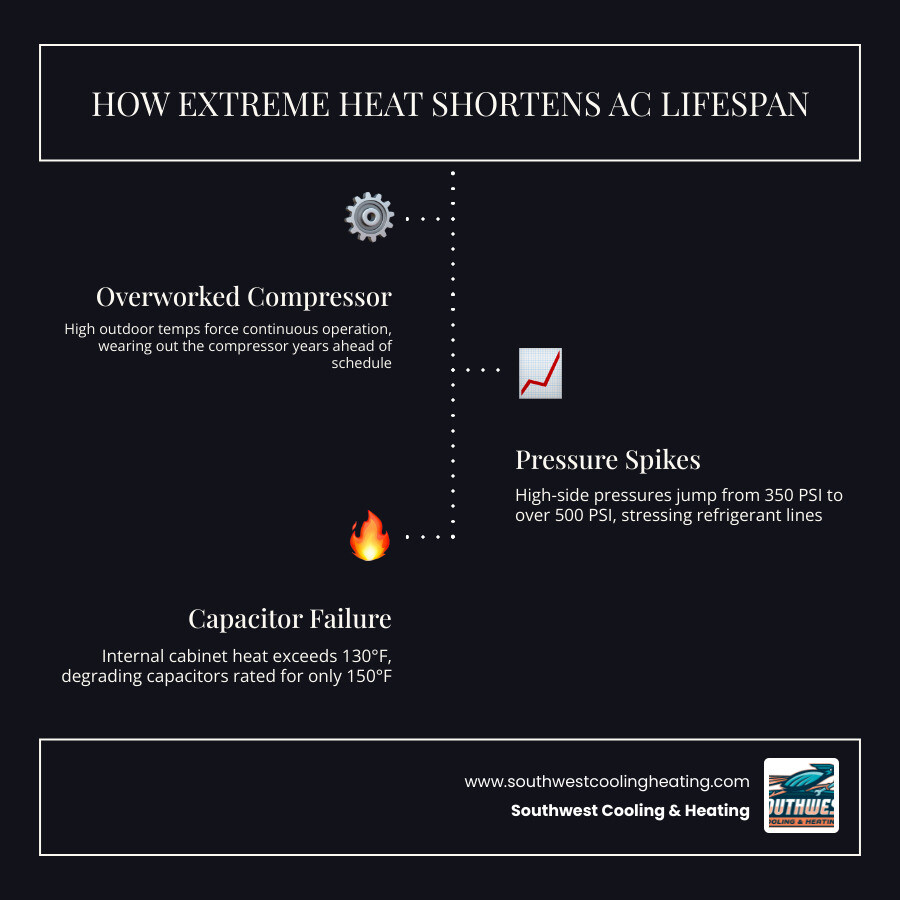
- Compressor overwork — High outdoor temps force the compressor to run continuously, wearing it out years ahead of schedule
- Capacitor failure — Internal cabinet temperatures can exceed 130°F, degrading capacitors rated for only 150°F
- Refrigerant pressure spikes — High-side pressures can jump from 350 PSI to over 500 PSI during intense heat waves, stressing refrigerant lines
- Electrical component stress — Contactors, circuit boards, and wiring insulation degrade faster under sustained high heat
- Extreme runtime hours — AC systems in hot desert climates like St. George run 2,500+ hours per season versus 600–900 hours in cooler northern states
- Shortened lifespan — The national average AC lifespan is 15–20 years, but in extreme heat zones it drops to 8–12 years
I’m Bruce Hymas, owner of Southwest Cooling and Heating, and our team has been serving St. George homeowners since 1980 — which means we’ve seen how extreme heat shortens AC lifespan season after season in this desert climate. Whether your system is five years old or fifteen, the information below will help you understand what’s happening inside your unit and what you can do about it.
The Science of How Extreme Heat Shortens AC Lifespan

In the HVAC industry, we often refer to the Southern Utah summer as “mechanical warfare.” To understand how extreme heat shortens AC lifespan, we have to look at the sheer volume of work the system performs. In a moderate climate, an air conditioner might run for 600 to 900 hours a year. In places like Hurricane or Santa Clara, that same unit is forced to sprint for 2,500 to 3,500 hours annually. It is the mechanical equivalent of driving your car 100,000 miles every year instead of the standard 15,000.
The primary driver behind this accelerated aging is the thermal differential. Most systems are designed based on the “20-degree rule,” which states that an AC is generally capable of lowering the indoor temperature by about 20 degrees compared to the air outside. When it is 92°F in Bloomington, your home stays a comfortable 72°F quite easily. However, when May 2026 brings us those 110°F spikes, your system is forced to bridge a 40-degree gap.
This creates a massive thermal load that leads to:
- High-Side Pressure Spikes: Refrigerant pressure that normally sits at 350 PSI can rocket to over 500 PSI when the outdoor temperature hits 115°F. This puts immense stress on the copper lines and seals.
- Lubrication Breakdown: The oil inside your compressor is designed to protect moving metal parts. When internal temperatures exceed 225°F, that oil thins out, leading to metal-on-metal friction.
- Sensible vs. Latent Load: In our dry desert heat, the “sensible load” (lowering the actual temperature) is extreme. Unlike humid climates where the system spends energy removing water, our systems are working purely to move massive volumes of heat out of the house.
Because the system is under such stress, Why Correct System Sizing Matters for Your Home becomes a life-or-death issue for your equipment. An undersized unit will run 24/7 without ever reaching the set point, while an Oversized AC St. George AC Service will “short cycle,” turning on and off so frequently that the startup amperage (which is 3 to 5 times higher than running amperage) burns out the motor.
Critical Components at Risk During Southern Utah Heatwaves
When the heat stays in the triple digits for a week or more, your AC doesn’t have a recovery period. This constant operation leads to a “cascade failure” pattern. It usually starts with a small, inexpensive part failing, which then forces a larger, more expensive part to overwork until it dies.
The most vulnerable components include:
- The Compressor: This is the “heart” of your system. Extreme heat forces it to work overtime to speed up the cooling process. If the lubrication fails due to heat, the compressor burns out, which often means you need a full system replacement.
- Motor Winding Degradation: The copper windings inside your fan motors are coated in a protective enamel. Sustained high temperatures cause this enamel to crack and peel, leading to electrical shorts.
- Electrical Contactor Pitting: Every time your AC starts, the contactor (a high-voltage switch) closes. In extreme heat, these can “arc weld” themselves shut, causing the unit to run even when the thermostat says it’s off.
- Fan Motor Bearings: The outdoor fan motor is responsible for pulling heat off the coils. If it slows down because the bearings are dry and overheated, the heat stays trapped in the unit, cooking the other parts.
To help you visualize the impact, we’ve put together a comparison of how the desert climate changes the “math” of your home’s comfort.
Component Lifespan Comparison: Moderate vs. Desert Climate
| Component | Lifespan (Moderate Climate) | Lifespan (St. George/Desert) |
|---|---|---|
| Compressor | 15–20 Years | 8–12 Years |
| Capacitor | 10–15 Years | 3–6 Years |
| Fan Motor | 15–20 Years | 10–12 Years |
| Contactors | 10+ Years | 5–7 Years |
| Entire System | 15–20 Years | 10–14 Years |
Monitoring these parts is essential. If you notice any of the Red Alerts and Cold Comforts: Signs Your HVAC Needs Help ASAP, it’s time to call in the experts before a small fix becomes a total breakdown.
How extreme heat shortens AC lifespan by degrading capacitors
If there is one part that we replace more than any other in Ivins and Toquerville, it’s the capacitor. Think of the capacitor as a large battery that provides the “kick” needed to start your motors. Most capacitors are rated to handle temperatures up to 150°F.
That might sound like plenty, but consider this: when it is 106°F outside, the internal cabinet of your AC (where the electrical parts live) can easily spike above 130°F. If the sun is beating directly on the metal casing, that internal temperature can climb toward 170°F. At these temperatures, the dielectric fluid inside the capacitor begins to evaporate or leak.
Once the capacitor loses its “charge capacity,” the compressor and fan motor have to draw 30% to 50% more amperage just to stay running. This extra electricity generates even more heat, creating a vicious cycle that ends in a blown fuse or a dead compressor. This is why An Ounce of Prevention: Keeping Your HVAC Out of the ER is so important; testing a capacitor takes five minutes, but replacing a burned-out motor takes hours and costs significantly more.
Warning Signs Your System is Struggling with High Temperatures
How do you know if the heat is winning the battle? Your AC will usually give you a few warning signs before it quits entirely. One of the most common signs that how extreme heat shortens AC lifespan is affecting your home is when the thermostat simply cannot reach the set point. If you have it set to 72°F but the display hasn’t dropped below 78°F all afternoon, your system is likely overwhelmed.
Other red flags include:
- Short Cycling: The unit turns on and off every few minutes. This is often a safety feature triggered by the system overheating.
- Lukewarm Airflow: If the air coming out of the vents feels “room temperature” rather than “crisp,” you may have a refrigerant leak or a failing compressor.
- Grinding or Squealing Noises: These are the sounds of metal-on-metal friction from failing bearings or a struggling compressor.
- Skyrocketing Utility Bills: If your power bill is significantly higher than last May (and rates haven’t changed), your system is likely losing efficiency and running longer to compensate for worn parts.
When these signs appear, you face the big question: Should I Repair or Replace My HVAC System?. In our area, we often suggest the “5,000 Rule.” Multiply the age of your unit by the cost of the repair. If the total is over $5,000, it’s usually time to look at a new unit. To get a better handle on the long-term finances of your cooling, check out our guide on How Much Does It Really Cost to Cool Your Home?.
Identifying how extreme heat shortens AC lifespan through reduced efficiency
The heat doesn’t just break parts; it makes the entire process of cooling less efficient. Air conditioners are rated by SEER (Seasonal Energy Efficiency Ratio). A 16 SEER unit is very efficient at 82°F. However, as the temperature rises, that “effective SEER” drops.
By the time the mercury hits 115°F in St. George, that 16 SEER unit might only be performing at an 11.8 SEER level. The system has to work twice as hard to move the same amount of heat. This “performance loss” is why older systems often fail during the first major heatwave of the year — they simply don’t have the “muscle” left to handle the drop in efficiency. If your system is over 10 years old, you might wonder, Will a New HVAC System Actually Save You Money?. In the desert, the answer is often a resounding yes, as modern units are built to maintain higher efficiency even at 115°F.
How to Protect Your Cooling System in Hurricane and St. George
While the heat is a formidable opponent, you aren’t helpless. There are several proactive steps you can take to mitigate the damage and extend the life of your system.
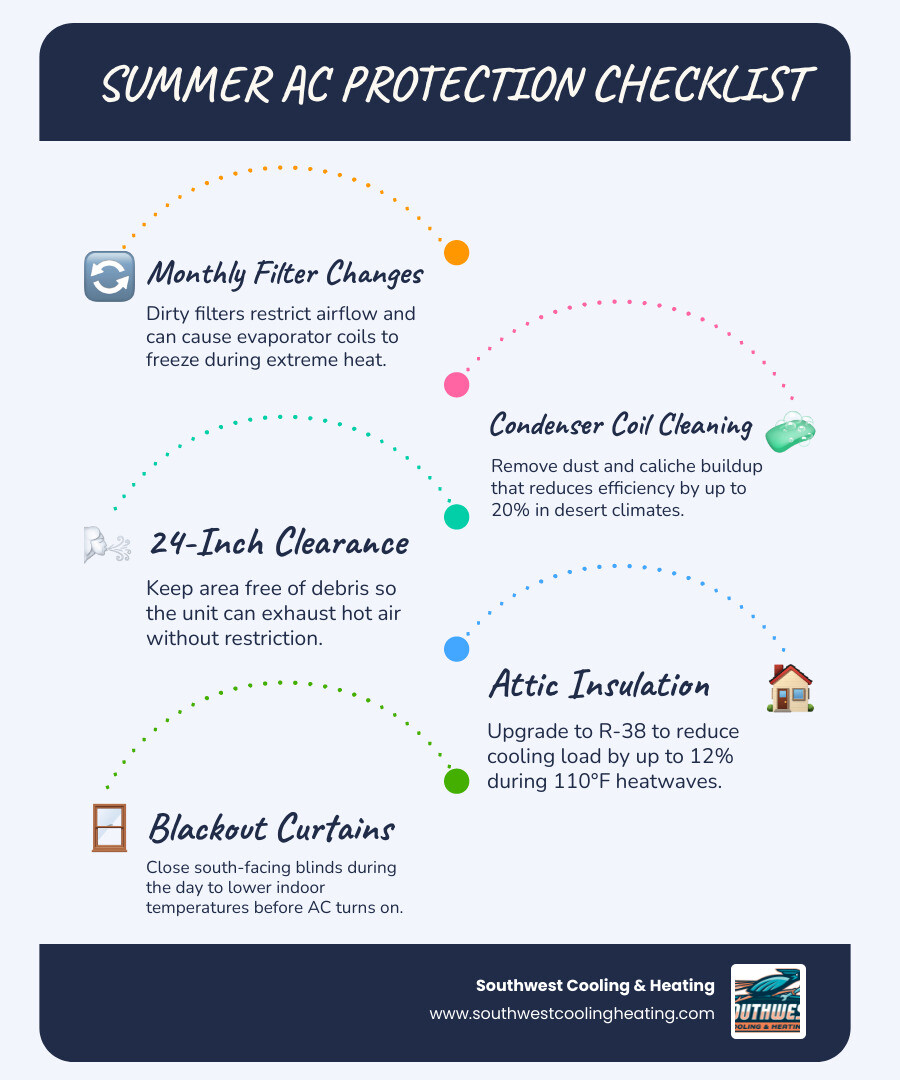
Your Summer Protection Checklist:
- Monthly Filter Changes: This is the single most important thing you can do. A dirty filter restricts airflow, which makes the blower motor work harder and can cause the evaporator coils to freeze — even when it’s 100 degrees outside!
- Condenser Coil Cleaning: Dust and “caliche” (that white, crusty desert mineral) can build up on your outdoor coils. A 0.1-inch layer of dust can reduce efficiency by 20%. Gently rinsing the coils with a garden hose (not a pressure washer!) can help the unit breathe.
- 24-Inch Clearance: Ensure there are no bushes, weeds, or storage items within 24 inches of your outdoor unit. It needs “room to breathe” to exhaust the hot air from your home.
- Attic Insulation: Heat doesn’t just come through the windows; it radiates through the roof. Upgrading your attic insulation from R-19 to R-38 can reduce your cooling load by up to 12%, giving your AC a much-needed break.
- Blackout Curtains: Close the blinds on south-facing windows during the day. This simple habit can lower your indoor temperature by several degrees before the AC even turns on.
Frequently Asked Questions about Heat and AC Longevity
Is it normal for my AC to run all day when it’s over 100 degrees?
Yes, it is perfectly normal. Most systems in our area are sized to maintain 75°F indoors when it is 95°F outdoors. When the temperature hits 105°F or 110°F, the system has reached its “design capacity.” It will run continuously because the heat entering your home through the walls and windows is equal to the heat the AC is removing. As long as the temperature isn’t rising inside, your system is doing its job — it’s just working at its absolute limit.
How many years does an AC last in a desert climate?
While the national average is 15 to 20 years, the reality in St. George and surrounding areas like La Verkin and Diamond Valley is closer to 8 to 12 years. The combination of extreme runtime (2,500+ hours) and high operating pressures causes accelerated aging. However, a system that receives professional maintenance twice a year can often push past that 12-year mark.
Does shading my outdoor unit help prevent heat damage?
It can, but you have to be careful. Shading the unit can reduce the ambient temperature around the coils by 10 to 15 degrees, which helps efficiency. However, airflow is more important than shade. If you build a structure that traps the hot air around the unit, you will actually cause it to overheat faster. Always maintain at least 48 inches of clear space above the unit so the hot air can escape vertically.
Conclusion
At Southwest Cooling & Heating, we know that your air conditioner is the most important appliance in your home during a Southern Utah summer. We’ve been the local experts in St. George since 1980, providing high-quality service that combines modern technology with old-school values. We stand behind our work with performance and satisfaction guarantees because we know how much is on the line when the heat hits.
Whether you are in Santa Clara, Bloomington, or Winchester Hills, don’t wait for your system to fail in the middle of a July heatwave. Proactive maintenance is the only way to counteract how extreme heat shortens AC lifespan. Our team is ready to provide the quick, expert assistance you need to keep your home a sanctuary of cool comfort.
Ready to protect your investment? Schedule your expert AC service in Hurricane or any of our surrounding service areas today!