


Why Dry Air and Dust Are Quietly Damaging Your HVAC System
How dry air and dust affect your HVAC equipment is one of the most overlooked threats to home comfort — especially in desert climates like St. George, Utah. Here is a quick summary before we dig in:
- Dust on coils acts as an insulating layer, forcing your system to run longer and work harder
- Low humidity dries out rubber seals and belts, leading to cracks and early component failure
- Static electricity from dry air can damage sensitive HVAC electronics
- Clogged filters from desert dust raise static pressure and strain blower motors
- Reduced airflow from dust buildup leads to uneven temperatures and higher energy bills
- Fine desert particles can bypass basic filters and settle deep inside ductwork and components
- HVAC systems in dusty, arid climates typically last 10–12 years compared to 15–20 years in cleaner, more humid regions
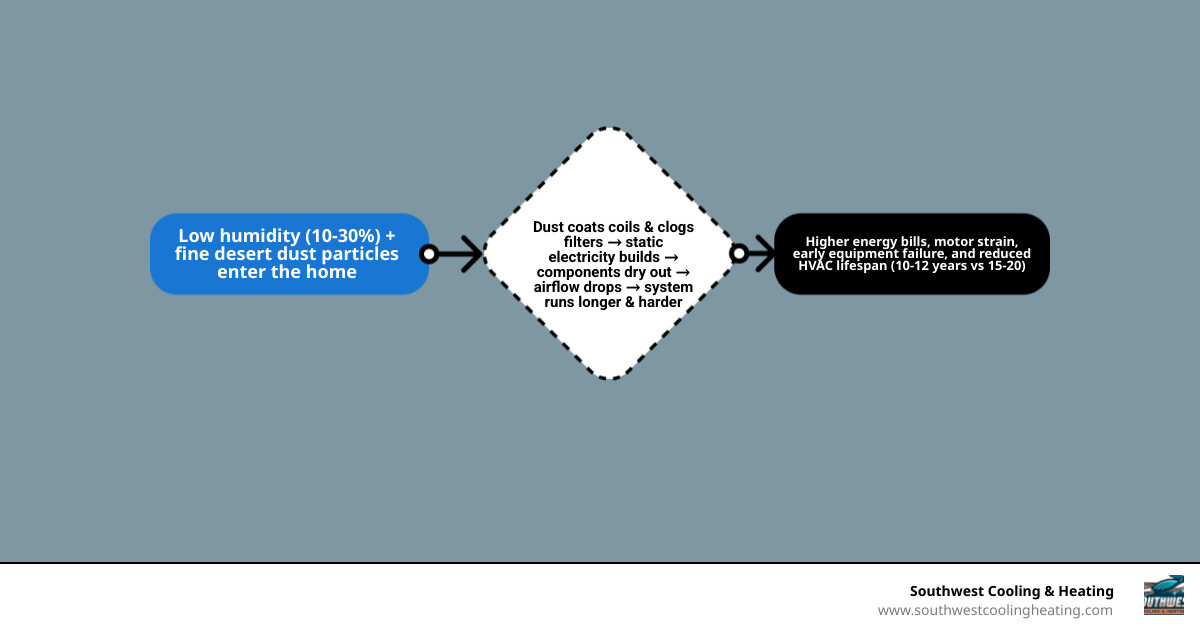
If you live in Southern Utah, your HVAC system faces these challenges every single day — through hot summers, dry winters, and everything in between. The fine red rock dust carried by desert winds does not just settle on your furniture. It works its way into your system’s coils, motors, and ducts, quietly reducing efficiency and shortening the life of your equipment. At the same time, humidity levels that regularly dip as low as 10–30% put mechanical and electrical components under stress that most homeowners never see coming.
I’m Bruce Hymas, owner of Southwest Cooling and Heating, and with decades of hands-on experience serving Southern Utah homes, I’ve seen how dry air and dust affect your HVAC equipment in ways that catch homeowners completely off guard. This guide will walk you through exactly what’s happening inside your system — and what you can do about it.
Explore more about how dry air and dust affect your hvac equipment:
The Science Behind How Dry Air and Dust Affect Your HVAC Equipment
To understand why the climate in communities like Santa Clara, Ivins, and Hurricane is so tough on heating and cooling systems, we have to look at the physics of dry air and airborne particulates. In Southern Utah, relative humidity levels routinely drop into the single digits or low teens during the hottest months. When the air is this dry, it acts like a giant sponge, pulling moisture out of everything it touches—including your skin, your wood furniture, and yes, even the physical components of your heating and air conditioning system.
At the same time, dry air lacks the natural moisture that helps weigh down dust particles. In more humid climates, tiny droplets of water in the air cling to dust, making it heavy enough to settle quickly onto the ground. In our semi-arid environment, dust remains suspended in the air far longer, floating freely until it is sucked directly into your HVAC system’s return vents.
This airborne dust isn’t just fluffy household dander. In Washington County, our windstorms carry fine, highly abrasive silica and mineral fragments from the surrounding desert. When these microscopic, razor-sharp particles enter your HVAC system, they act like sandpaper on moving parts. Additionally, the lack of moisture in the air dramatically increases static electricity. Without proper grounding and moisture control, static charges build up within the ductwork, causing these micro-fine dust particles to literally cling to the metal surfaces of your system, including the sensitive electronics and heat-exchanging coils.
Because of these unique environmental pressures, understanding Why the Southern Utah Desert is Your HVAC Systems Toughest Opponent is the first step toward protecting your investment.
How Dry Air and Dust Affect Your HVAC Equipment Efficiency
When relative humidity levels drop, the physical properties of the air change, directly impacting how your air conditioner or heat pump transfers heat. In a cooling cycle, your system relies on the evaporation and condensation process to pull heat from your home’s indoor air and release it outside.
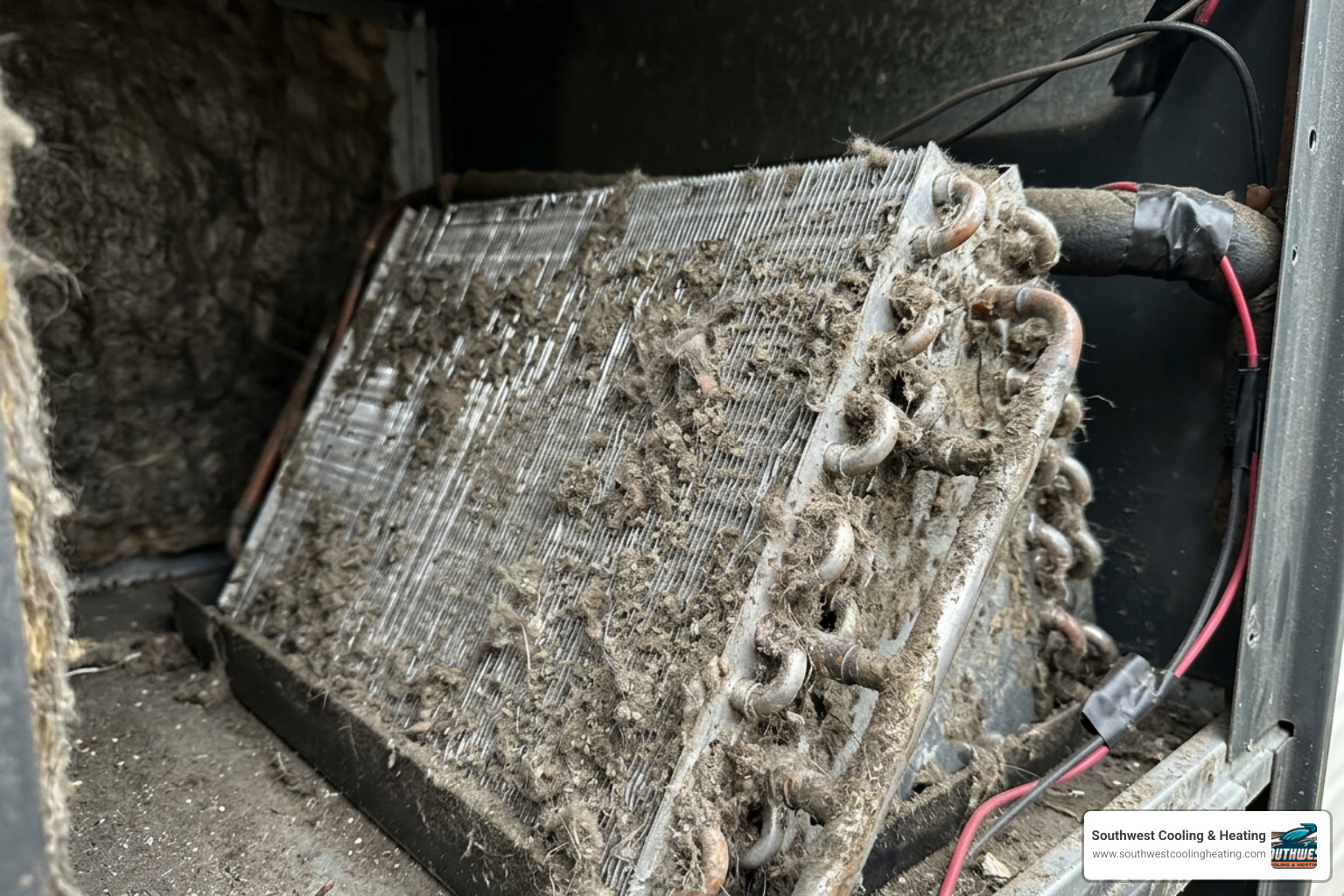
When the air is incredibly dry, your indoor evaporator coils produce very little condensate (water droplets). While this might sound like a good thing, it actually creates a major problem. In humid climates, the steady flow of condensation down the coils acts as a self-cleaning mechanism, washing away light dust. In our dry climate, the lack of moisture means that fine desert dust sticks to the dry metal fins of the coil. This creates an insulating blanket that blocks heat transfer, forcing your system to run much longer cycles to cool your home.
As these runtimes extend, the static pressure within your system rises. Static pressure is the resistance to airflow within your ductwork and HVAC components. When a thick layer of dust settles on your air filter and coils, your blower motor has to work twice as hard to push air through the restricted spaces. This dramatic increase in resistance leads to a sharp spike in energy consumption.
| HVAC Performance Metric | Humid Climate Performance | Dry, Dusty Desert Climate Performance |
|---|---|---|
| Average Equipment Lifespan | 15 to 20 Years | 10 to 12 Years |
| Coil Self-Cleaning Capability | High (Wash-off via heavy condensate) | Low (Dust sticks and bakes onto dry coils) |
| Static Pressure Build-Up | Normal | High (Rapid filter and coil loading) |
| Blower Motor Strain | Moderate | Severe (Must overcome restricted airflow) |
| Static Electricity Risk | Minimal | High (Risk to control boards & sensors) |
Vulnerable Components in Arid Climates
When we think about HVAC wear and tear, we often picture the heavy metal compressor sitting outside. However, some of the most vulnerable components are small, flexible parts made of rubber and plastic.
- Rubber Belts and Seals: Just like a leather boot cracks when left in the hot sun, the rubber belts and gaskets inside your furnace and air handler dry out, lose their elasticity, and crack under the constant influence of ultra-low humidity. Once a seal cracks, it can cause air leaks or allow dust to bypass your filtration system entirely.
- Electrical Control Boards: Dry air is the perfect breeding ground for static electricity. When static charges build up in your home, a simple touch can send a high-voltage shock through your system’s digital thermostat or main control board. These sensitive electronic components can easily short out, leading to sudden system failures.
- Compressor and Fan Bearings: The abrasive silica dust carried by our desert winds is small enough to work its way past basic protective seals and settle directly into the bearings of your outdoor condenser fan and indoor blower motor. This grit increases friction, raises operating temperatures, and can cause the motor to seize up entirely during a scorching July afternoon.
The Impact of Dust Accumulation on Critical HVAC Components
Now that we understand the science, let’s look at what actually happens inside your equipment when dust is allowed to accumulate unchecked. Every cubic foot of air that circulates through your home in Bloomington, Coral Canyon, or La Verkin carries millions of tiny particulates. If your filtration system isn’t up to the task, or if maintenance is neglected, this dust settles on the highly sensitive internal machinery of your system.
Over time, this accumulation creates a physical barrier that restricts airflow, inhibits heat transfer, and places an immense mechanical load on your equipment. This constant strain is the primary reason why desert-based systems require a more proactive approach to filter management. You can learn more about this by reading How High Desert Arid Conditions Affect Filter Replacement Frequency.
Evaporator and Condenser Coils
Your HVAC system has two main sets of coils: the indoor evaporator coil (which absorbs heat from your home) and the outdoor condenser coil (which releases that heat into the outside air). Both rely on maximum surface-area contact with the air to do their jobs efficiently.
When desert dust settles on these coils, it creates an insulating layer. Even a microscopic layer of dust can have a devastating impact. In fact, a 1/16th inch layer of dust on HVAC coils can reduce system efficiency by up to 21%.
Because your system cannot transfer heat efficiently through this dust barrier, it has to run much longer to cool your home. On the indoor side, this lack of heat absorption can cause the temperature of the evaporator coil to drop below freezing, leading to ice formation. When ice builds up, it completely blocks airflow, causing your system to blow warm air or shut down entirely. On the outdoor side, a dusty condenser coil prevents heat from escaping, causing the compressor to overheat and suffer premature mechanical failure.
Blower Motors and Air Filters
The blower motor is the heart of your ventilation system, responsible for circulating air through your entire home. However, as dust accumulates on the fan blades, it alters their aerodynamic shape, making them less efficient at moving air. The added weight of the dust also unbalances the fan wheel, creating tiny vibrations that wear out the motor’s bearings and generate loud squealing or grinding noises.
At the same time, your air filter is your system’s first line of defense. In our dry, dusty climate, filters load up with dirt far faster than they would in other parts of the country. When a filter becomes completely clogged, it acts like a solid wall. The blower motor must spin faster and consume significantly more electricity to pull air through this barrier, leading to overheating and eventual motor burnout.
This issue is amplified for pet owners. Dander and hair combine with fine desert dust to create an impenetrable mat over your filter. To keep your system running smoothly, check out our guide on How Pets Affect How Often You Change Your Filter.
Recognizing the Signs of Climate-Related HVAC Strain
Fortunately, your heating and cooling system will usually give you a few warning signs when it is struggling with the effects of dry air and dust. As a homeowner in Ivins, Toquerville, or Winchester Hills, keeping an eye out for these red flags can save you from a major mid-season breakdown:
- Weak Airflow from Vents: If you notice that the air coming out of your registers feels more like a gentle whisper than a strong breeze, your system is likely fighting high static pressure caused by a clogged filter or a heavily soiled evaporator coil.
- Uneven Temperatures: Are some rooms in your home freezing cold while others remain stuffy and warm? When dust restricts airflow, your system cannot distribute conditioned air evenly throughout your ductwork.
- Rising Utility Bills: If your energy bills are creeping up month after month, but your heating or cooling habits haven’t changed, your system is likely running longer, less efficient cycles to overcome dust insulation on its coils.
- Frequent Cycling: A system that turns on and off every few minutes (known as short-cycling) is often overheating. This is a common safety response when a dusty furnace or air conditioner cannot shed heat properly.
- Visible Dust Around Vents: If you notice a dark ring of dust forming on the drywall or ceiling directly around your supply vents, it means dust has bypassed your filter and is actively circulating through your ductwork.
Indoor Air Quality and Airborne Dust
When your HVAC system is coated in dust, it stops acting as an air purifier and starts acting as a dust distributor. Every time the blower motor kicks on, fine desert dust, pollen, and other airborne allergens are blasted out of your vents and into your living spaces.
In our dry climate, this problem is compounded by low humidity, which keeps these particles floating in the air longer where you are more likely to breathe them in. This can lead to dry, itchy skin, static shocks when touching doorknobs, and persistent sinus irritation or sore throats.
To combat this cycle and protect your family’s health, it is essential to take proactive steps to clean your home’s air. For practical tips, read our article on Simple Ways to Scrub Your Homes Air Clean.
Proactive Strategies to Protect Your System
While the Southern Utah climate presents real challenges, you are not powerless against the elements. By implementing a few smart, proactive strategies, you can completely mitigate the negative effects of dry air and dust, keeping your system running at peak efficiency for years to come.
Protecting your HVAC system requires a two-pronged approach: managing indoor humidity levels and upgrading your air filtration to capture micro-fine desert particles before they can settle on your equipment.
Mitigating Dry Air with Whole-Home Humidifiers
The most effective way to protect your system’s rubber components, reduce static electricity, and keep your family comfortable is by installing a whole-home humidifier. Unlike noisy, high-maintenance portable humidifiers that only treat a single room, a whole-home system is integrated directly into your existing HVAC ductwork.
When your furnace or heat pump runs, the humidifier injects a controlled, microscopic mist of water vapor directly into the warm air stream. This moisture is then distributed evenly throughout every room in your home. By keeping your indoor relative humidity within the ideal range of 30% to 50%, you prevent rubber seals from cracking, eliminate static shocks, and make the indoor air feel warmer. This allows you to set your thermostat a few degrees lower in the winter without sacrificing comfort, saving you money on your heating bills.
Upgrading Filtration to Combat How Dry Air and Dust Affect Your HVAC Equipment
Standard, budget-friendly fiberglass filters are designed to capture large debris like pet hair and lint, but they do almost nothing to stop the fine, abrasive silica dust common in St. George and surrounding areas. To truly protect your equipment, you need to upgrade to a higher-quality pleated filter.
Air filters are rated using the MERV (Minimum Efficiency Reporting Value) scale, which ranges from 1 to 16. For residential systems in our desert climate, we generally recommend filters rated between MERV 8 and MERV 13. These filters are dense enough to capture micro-fine desert dust, mold spores, and pollen, yet they are designed to maintain excellent airflow so they won’t overload your blower motor. To find the perfect match for your home, explore our guide on the Top Rated Air Filters to Keep Your Home Fresh.
For homes that struggle with extreme dust or lack ductwork entirely, transitioning to a different system setup can be a game-changer. Discover Why Desert Homeowners Are Switching to Ductless Systems to see how these ultra-efficient, highly filtered systems handle desert conditions.
Frequently Asked Questions about Dry Air and Dust
How often should I change my HVAC filter in a dusty desert climate?
In Southern Utah, we recommend checking your air filter every 30 days. During high-dust seasons—such as the windy spring months or periods of nearby construction—your filter can load up with dirt incredibly fast. If the filter looks gray, fuzzy, or filled with red desert silt, replace it immediately. At a bare minimum, you should change your filter every 90 days, but monthly checks are the safest way to prevent airflow restriction and protect your system.
Can dust buildup void my HVAC manufacturer warranty?
Yes, it absolutely can. Most major HVAC manufacturers explicitly state in their warranty agreements that damage caused by “neglect” or “lack of regular maintenance” is not covered. If your compressor fails or your blower motor burns out because a thick layer of dust blocked airflow and caused the system to overheat, the manufacturer may deny your warranty claim. Keeping detailed records of regular filter changes and professional annual tune-ups is your best protection.
What is the ideal indoor humidity level for HVAC health and comfort?
For optimal HVAC performance, structural protection, and personal comfort, you should aim to maintain an indoor relative humidity level between 30% and 50%. Keeping your humidity in this sweet spot prevents static electricity from damaging sensitive electronics, keeps wood floors and furniture from cracking, and ensures your respiratory system stays healthy and comfortable.
Conclusion
Living in the beautiful desert landscape of Southern Utah means accepting that dust and dry air are simply part of daily life. However, letting these elements quietly degrade your heating and cooling system doesn’t have to be. By understanding how dry air and dust affect your HVAC equipment, staying vigilant for the early warning signs of system strain, and investing in high-quality filtration and humidification, you can protect your home’s comfort and extend the lifespan of your system.
At Southwest Cooling & Heating, we have been helping our neighbors in St. George, Santa Clara, Hurricane, Ivins, and throughout Washington County keep their homes comfortable and dust-free since 1980. We combine modern indoor air quality technology with old-school customer service values to ensure your system is fully prepared to handle whatever the desert throws at it.
Are you wondering if your system is overdue for a professional deep cleaning? Read more about why Is Annual HVAC Maintenance Worth It in St. George and learn how a little bit of care now can prevent a major headache down the road in An Ounce of Prevention Keeping Your HVAC Out of the ER.
Don’t let desert dust and dry air wear down your system. Schedule professional HVAC services today with the team at Southwest Cooling & Heating, and breathe easier knowing your home comfort is in expert hands!