


My St. George AC Runs All Day but Won’t Cool the House — Is It Undersized?
How undersized systems fail to keep you comfortable comes down to one core problem: the equipment simply cannot remove heat and humidity fast enough to match what your home demands.
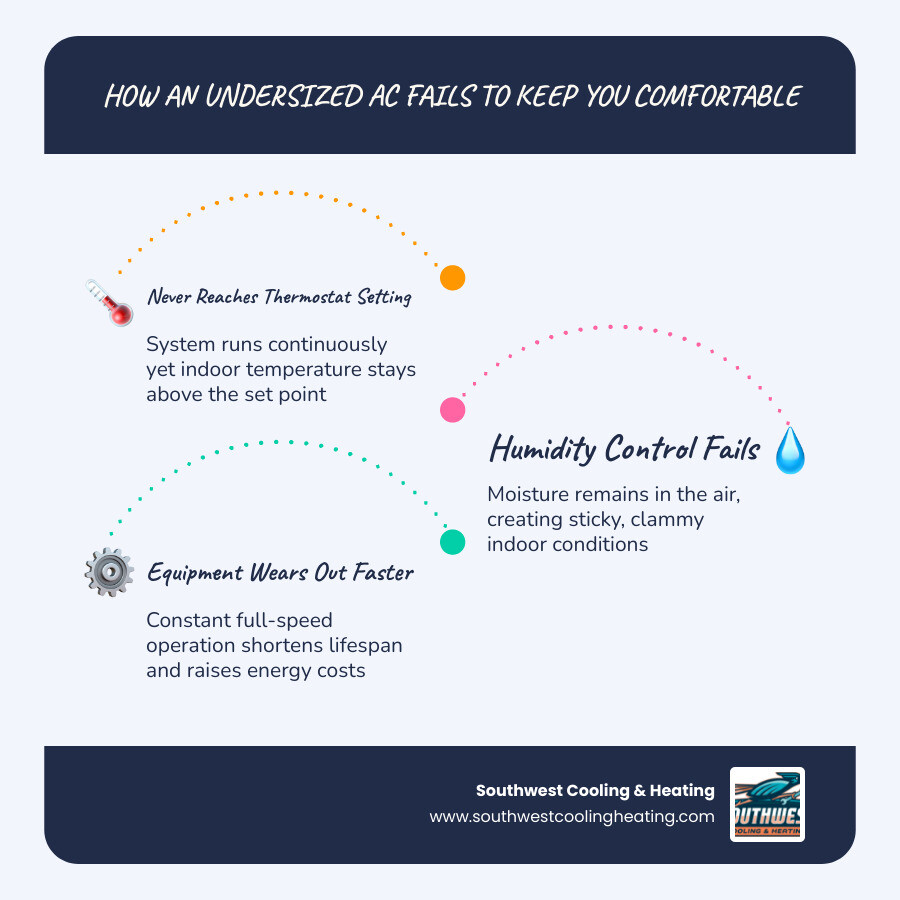
Here is a quick breakdown of the most common ways an undersized system falls short:
- Never reaches your thermostat setting — The system runs and runs but the indoor temperature stays stubbornly above what you set
- Uneven temperatures room to room — Some spaces feel tolerable while others feel like an oven, especially upstairs or on the sunny side of the house
- Sticky, humid indoor air — An undersized system runs too long at full capacity to ever properly remove moisture, leaving the air feeling clammy even when the thermostat reads 74°F
- Poor efficiency and nonstop runtime — Constant full-speed operation uses more energy while comfort still suffers
- Faster equipment failure — A system that never gets a proper rest cycle can wear out years ahead of schedule, sometimes failing before year 10 instead of lasting the expected 15 to 20 years
In St. George, Utah, where summer temperatures regularly push past 110°F, these problems go from annoying to genuinely miserable in a hurry. A system that might squeak by in a mild climate will be completely overwhelmed by Southern Utah’s desert heat loads. Yet this is exactly the situation many local homeowners find themselves in — either because their system was never sized correctly to begin with, or because their home has changed since the original installation.
I’m Bruce Hymas, owner of Southwest Cooling and Heating, and after decades of serving St. George area families I’ve seen how how undersized systems fail to keep you comfortable plays out in real homes during our brutal summers — and how the right-sized system changes everything. In this guide, I’ll walk you through exactly what’s happening inside an undersized system, how to recognize the warning signs, and what your real options are.
Discover more about how undersized systems fail to keep you comfortable:
- getting the right size hvac for southern utah homes
- how hvac load calculations work
- why correct system sizing matters for your home
What Does It Mean to Have an Undersized HVAC System?
When we talk about an HVAC system being “undersized,” we aren’t talking about its physical footprint in your yard or utility closet. Instead, we are referring to its capacity — the amount of heating or cooling energy it can produce compared to the thermal load of your home.
In simple terms, every home has a specific “heat gain” rate in the summer (how fast heat leaks in through walls, windows, and ceilings) and “heat loss” rate in the winter. If your cooling system’s capacity is lower than your home’s peak heat gain, the system is undersized.
Understanding this balance is crucial because buying a system that is too small undercuts your comfort from day one. You can read more about this dynamic in our detailed guide on Why Correct System Sizing Matters for Your Home.
Understanding Cooling Power in BTUs and Tons
To understand sizing, we have to look at how heating and cooling capacities are measured. In the HVAC world, we use two primary units: BTUs (British Thermal Units) and Tons.
- BTU (British Thermal Unit): This is the basic unit of heat energy. One BTU is the amount of heat required to raise the temperature of one pound of water by one degree Fahrenheit. In air conditioning, BTUs describe how much heat the system can extract from your home per hour.
- Ton: This is a larger unit of measurement used to describe central air systems. One “ton” of cooling capacity is equal to 12,000 BTUs per hour. The term originates from the historical practice of measuring the cooling power of a literal one-ton block of ice melting over a 24-hour period.
So, if you have a 3-ton air conditioner, it is rated to extract 36,000 BTUs of heat from your home every hour. If your home in Bloomington or Coral Canyon absorbs 45,000 BTUs of heat per hour on a blistering July afternoon, a 3-ton system is officially undersized. It faces a continuous 9,000 BTU deficit that it can never overcome, leaving you hot and frustrated.
Why Square Footage Rules of Thumb Fail Southern Utah Homes
One of the most common reasons homeowners in Santa Clara, Hurricane, and Ivins end up with undersized systems is the reliance on outdated “rules of thumb.” You might hear a well-meaning neighbor say, “You need one ton of cooling for every 500 square feet.”
While that kind of math might fly in a mild, humid climate, it is a recipe for disaster in Southern Utah. Sizing a system strictly by square footage ignores several critical variables:
- Ceiling Height: A 1,500-square-foot home with standard 8-foot ceilings has a vastly different volume of air to cool than a modern 1,500-square-foot home in Winchester Hills with 12-foot vaulted ceilings.
- Sun Exposure and Orientation: A home with massive south- or west-facing floor-to-ceiling windows will experience massive solar heat gain compared to an identical floor plan shaded by surrounding cliffs or facing north.
- Insulation and Air Sealing: An older home in Bloomington Hills with minimal attic insulation will gain heat much faster than a tight, newly constructed home in Coral Canyon built with modern energy-efficient materials.
- Our Desert Climate: St. George regularly sees summer temperatures soaring past 110°F. Our extreme temperature difference between the scorching outdoors and your desired indoor temperature requires a precise calculation, not a lazy guess.
How Undersized Systems Fail to Keep You Comfortable in Extreme Weather
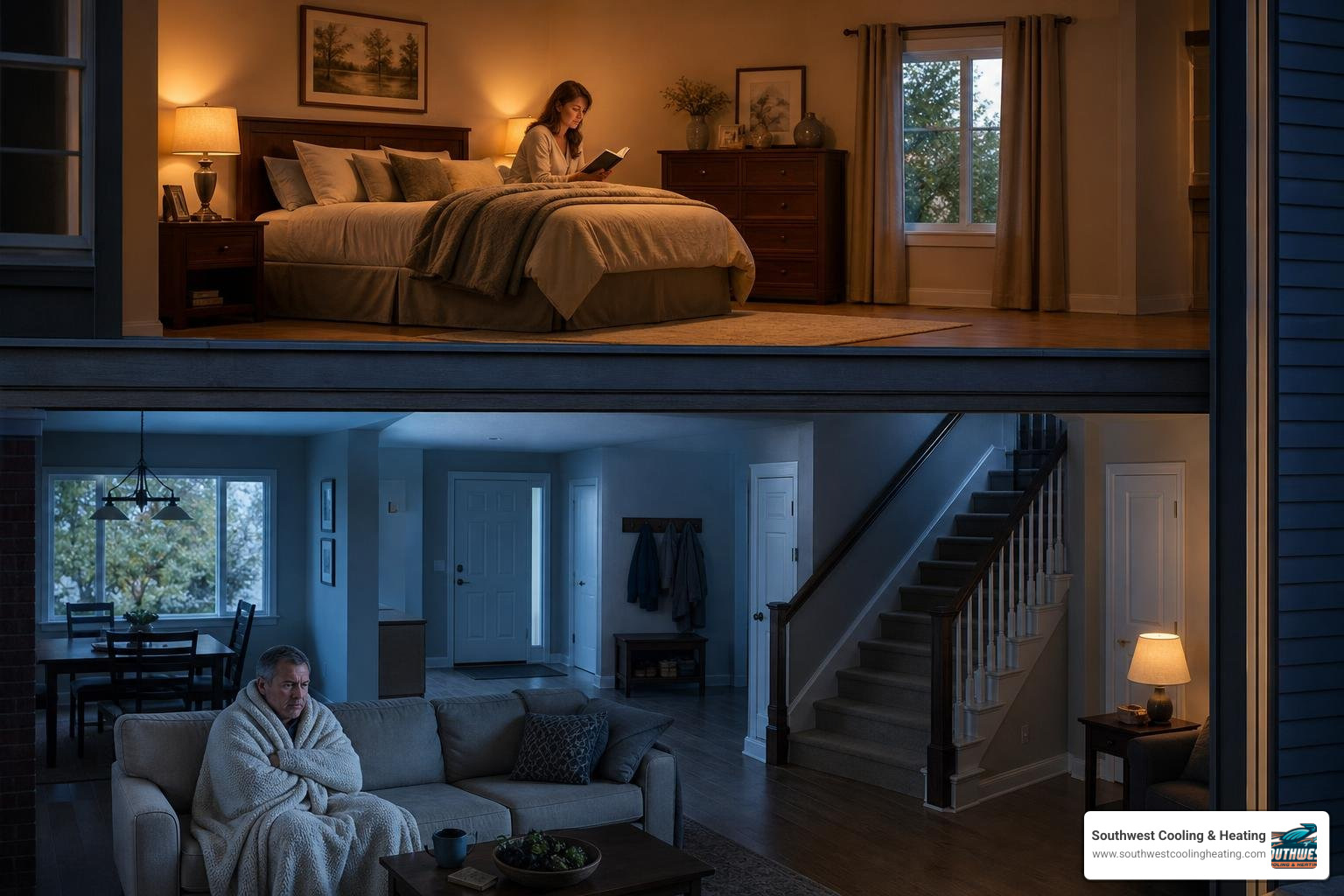
When the outdoor temperature rises, an undersized system’s limitations become painfully obvious. It is like trying to cool a warehouse with a desk fan. The unit simply cannot keep up with the rate of heat entering the building envelope.
To learn more about selecting the perfect equipment for our unique regional climate, check out The Ultimate Guide to Getting the Right Size HVAC for Southern Utah Homes.
The Science Behind How Undersized Systems Fail to Keep You Comfortable
To understand why your home won’t cool down, we have to look at the two types of heat your AC must handle: sensible heat (the actual air temperature you read on a thermometer) and latent heat (the moisture or humidity suspended in the air).
A properly sized air conditioner is designed to drop your home’s temperature by roughly one degree per hour during peak outdoor heat. It does this by running balanced cycles. However, when a system is undersized, it runs continuously at 100% capacity without ever satisfying the thermostat.
Because the system is constantly running, it struggles to lower the sensible heat. The temperature gap between what you want (say, 72°F) and what the system can actually achieve (often 78°F or higher on a hot afternoon) remains locked in place. The system is essentially running a marathon with no finish line, leaving your living room warm and your upstairs bedrooms feeling like a sauna.
Humidity Control Failures and Sticky Indoor Air
Even though Southern Utah is famous for its dry desert heat, indoor spaces still accumulate moisture from breathing, cooking, showering, and washing dishes. The Environmental Protection Agency (EPA) recommends maintaining indoor relative humidity between 30% and 50% for optimal comfort and health.
An air conditioner removes humidity by blowing warm indoor air across a freezing-cold evaporator coil. The moisture in the air condenses on the cold metal coil and drains away. However, this process relies on balanced, steady cycles.
When an undersized system runs continuously, it is often working so hard and under such high thermal stress that the evaporator coil cannot maintain the correct temperature balance. Air moves across the coil too quickly, or the coil itself struggles to keep up with the sheer volume of heat, preventing effective condensation. This results in sticky, humid indoor air. Even if the thermostat eventually creeps down to a reasonable number, the air will feel clammy and heavy, making the indoor environment feel much warmer than it actually is.
The Mechanical Toll: Why Constant Running Destroys Your Equipment
Running an undersized system isn’t just uncomfortable; it is mechanically destructive. Think of it like driving a compact car up a steep mountain highway with the gas pedal floored for hours on end. Eventually, the engine is going to overheat and blow a gasket.
If your current system is showing signs of severe mechanical wear, you may need to evaluate whether it is time to swap it out. Read our expert analysis on Should I Repair or Replace My HVAC System? to help make the right choice.
Accelerated Wear and Tear on Critical Components
An HVAC system is designed to cycle on and off throughout the day. A healthy system typically runs for 15 to 20 minutes, cools the home, and then rests. This rest period allows components to cool down and prevents thermal overload.
An undersized system doesn’t get to rest. It runs 18 to 24 hours a day during our hottest months. This continuous load puts immense stress on several vulnerable components:
- The Compressor: This is the “heart” of your AC system, responsible for pumping refrigerant. Continuous operation causes extreme heat buildup in the compressor, leading to premature mechanical failure or electrical burnout.
- Fan Motors: Both the indoor blower motor and the outdoor condenser fan motor are forced to run constantly, leading to bearing wear and motor burnout.
- Refrigerant Leaks: The constant vibration and high pressures associated with nonstop running can cause copper refrigerant lines to rub together or develop stress fractures, leading to refrigerant leaks.
While starting a system is highly stressful — with startup currents drawing 6 to 10 times the normal running current — running continuously at maximum capacity for months on end is equally lethal. An improperly sized system can easily have its expected lifespan cut in half, failing in just 8 to 10 years instead of lasting 15 to 20 years.
Frozen Evaporator Coils and Airflow Restrictions
It sounds counterintuitive, but an air conditioner that is running constantly in a hot house can actually freeze solid.
When an undersized system runs nonstop, the temperature of the refrigerant flowing through the indoor evaporator coil can drop below freezing. If there is any slight restriction in airflow — such as a dusty air filter or slightly undersized ductwork — the moisture condensing on the coil will instantly turn to ice.
Once a thin layer of ice forms, it acts as an insulator, blocking warm air from reaching the refrigerant. This causes the coil to freeze even faster, eventually turning the entire indoor unit into a solid block of ice. Airflow is completely restricted, cooling stops entirely, and the system can suffer a liquid slugging event, which instantly destroys the compressor.
How We Determine the Perfect Fit: The Manual J Load Calculation
At Southwest Cooling & Heating, we never guess when it comes to your comfort. To ensure your home in Toquerville, La Verkin, or Diamond Valley gets the exact system capacity it needs, we perform a professional Manual J Load Calculation. This is the industry-standard protocol established by the Air Conditioning Contractors of America (ACCA).
Here is how a professional Manual J load calculation compares to a basic, inaccurate “rule of thumb” estimate:
| Sizing Factor | Square Footage Rule of Thumb | ACCA Manual J Load Calculation |
|---|---|---|
| Accuracy | Poor (often results in undersized or oversized units) | Highly precise and customized to your specific home |
| Ceiling Height | Completely ignored | Calculated by total room volume (cubic feet) |
| Window Details | Ignored | Evaluates window area, glazing, tinting, and orientation |
| Insulation Levels | Ignored | Factors in exact R-values of walls, ceilings, and floors |
| Air Leakage | Ignored | Evaluates building tightness and infiltration rates |
| Occupancy & Appliances | Ignored | Accounts for heat generated by occupants and electronics |
To see how our team performs these calculations with absolute precision, take a look behind the scenes at The Heavy Lifting Behind HVAC Load Calculations.
Key Factors That Influence Your Home’s Thermal Load
A true Manual J load calculation is incredibly detailed. It takes into account every pathway through which heat can enter or leave your home.
- Window Exposure: We look at which direction your windows face. A west-facing window in Hidden Valley receives intense, direct afternoon sun, adding significantly to your home’s cooling load.
- Insulation Quality: We verify the insulation levels in your attic, exterior walls, and crawlspaces.
- Ductwork Integrity: Leaky or uninsulated ducts running through a scorching 130°F attic can allow up to 30% of your cooled air to escape before it ever reaches your living spaces.
- Air Leakage (Infiltration): We evaluate how drafty your home is. Uncontrolled outdoor air leaking into your home brings heat and dust with it, increasing the load on your system.
Why Oversizing Is Not the Solution to How Undersized Systems Fail to Keep You Comfortable
When homeowners learn about the dangers of an undersized system, their natural reaction is often, “Well, let’s just install the biggest system possible to be safe!”
Unfortunately, oversizing is just as bad as undersizing. An oversized system will suffer from a phenomenon called short cycling. Because the system is too powerful, it will quickly blast cold air into your home, satisfy the thermostat in 5 to 8 minutes, and shut off.
Because it runs for such short bursts, it never runs long enough to pull moisture out of the air. You end up with a home that feels cold, damp, and clammy. Furthermore, because startup is the most stressful event for an HVAC system, short cycling 30 to 50 times a day (compared to a normal 6 to 8 cycles) will rapidly destroy the compressor and blower motor.
To learn more about the pitfalls of going too big, read our article on Oversized AC St. George AC Service.
Practical Solutions and Supplemental Fixes for Inadequate Cooling
If you suspect your system is undersized, you don’t always have to jump straight to a full system replacement. Depending on your home’s layout and comfort needs, there are several highly effective ways to ease the load on your existing system or supplement your comfort.
- Ductless Mini-Splits: If you have a specific room that is always hot — like an upstairs loft, a converted garage, or a sunroom with large windows — a ductless mini-split is the perfect solution. These systems provide targeted, highly efficient cooling to a single zone, allowing your main central system to focus on the rest of the house.
- Zoning Systems: Installing dampeners in your ductwork allows us to split your home into different temperature zones. This directs cooling power exactly where it is needed most throughout the day, preventing you from wasting energy cooling unoccupied guest rooms.
- Home Efficiency Upgrades: Sometimes, the easiest way to fix an undersized system is to reduce your home’s heat gain. Adding blown-in cellulose insulation to your attic, sealing leaky windows, and applying reflective window films to west-facing glass can drop your home’s thermal load enough that your existing system can suddenly keep up.
- Duct Sealing: Since leaky ducts waste up to 30% of your system’s capacity, sealing and insulating your ductwork ensures that every bit of cold air your system produces actually makes it into your living spaces.
Frequently Asked Questions About HVAC Sizing
What are the most common signs that my AC is too small?
The most obvious sign is continuous runtime during moderately hot days. If your system runs nonstop from 11:00 AM to 9:00 PM and the indoor temperature continues to rise above your thermostat setting, it lacks the capacity to handle the load. Other signs include uneven cooling (hot and cold spots throughout the house), excessive energy use from nonstop operation, and frequent mechanical breakdowns.
Can I add more ductwork to fix an undersized system?
No. Adding more ductwork or registers will not solve a capacity problem. In fact, if your central air unit lacks the physical capacity (tons/BTUs) to cool your home, adding more ducts will actually reduce system performance. It lowers the static pressure in your duct system, causing air to move too slowly and reducing the velocity of the air coming out of your vents.
How long should a properly sized AC run during a hot St. George summer day?
On a typical hot summer afternoon in Southern Utah (when temperatures are near our local design temperature of roughly 105°F to 110°F), a properly sized, single-stage system should run for steady, extended cycles of 20 to 40 minutes to maintain your indoor temperature. If you have a modern variable-speed system, it is designed to run almost continuously at a very low, highly efficient speed to maintain a perfectly steady indoor climate.
Conclusion: Get Your Comfort Back on Track with Southwest Cooling & Heating
At Southwest Cooling & Heating, we believe that your home should be your sanctuary from the intense Southern Utah heat. If you are tired of dealing with hot spots, sticky air, and an AC system that runs nonstop without keeping you comfortable, it is time to stop guessing and get real answers.
Since 1980, we have provided homeowners in St. George, Santa Clara, Hurricane, Ivins, and the surrounding areas with honest, reliable, and high-quality HVAC services. We combine modern technical expertise with old-school customer values, backed by our ironclad satisfaction guarantees.
Don’t spend another summer sweating through the afternoon. Contact us today to schedule a professional Manual J load calculation and find out how we can restore perfect, efficient comfort to your home. Explore our full range of HVAC Services and let our family take care of yours.