


The Most Common Signs Your Air Filter Needs Changing (And Why They Matter in St. George)
Knowing the signs your air filter needs changing can save you from a surprise breakdown — especially during a scorching St. George summer. Here’s a quick look at the key warning signs:
Signs your air filter needs changing:
- Weak or uneven airflow from vents throughout your home
- Spiking energy bills without a clear change in usage
- More dust buildup on surfaces shortly after cleaning
- Increased allergy or respiratory symptoms indoors
- Strange noises or musty odors coming from your HVAC system
- Ice forming on your evaporator coils
Most homeowners don’t think about their air filter until something feels off — a room that won’t cool down, a utility bill that jumps for no obvious reason, or sneezing that just won’t quit. By then, the filter has often been overdue for weeks or even months. In a high-desert environment like St. George, where dust, pollen, and dry air are constant factors, filters tend to clog faster than the national average — meaning the standard replacement timelines may not apply to your home.
I’m Bruce Hymas, owner of Southwest Cooling and Heating, and with over four decades of HVAC experience serving Southern Utah homeowners, I’ve seen how a neglected air filter is one of the most common — and most avoidable — causes of system inefficiency and early equipment failure. Recognizing the signs your air filter needs changing early is one of the simplest ways to protect your comfort and your investment.
Similar topics to signs your air filter needs changing:
- best air filter for your home
- how high desert arid affects filter replacement frequency
- how often should you change your hvac air filter
Why Air Filtration Matters: Home HVAC vs. Car Engines
To understand why a clean air filter is so critical, it helps to look at a familiar comparison: your car. Both your vehicle’s combustion engine and your home’s HVAC system rely on a steady, unrestricted stream of clean air to function safely and efficiently.
In a car, the engine requires a massive volume of air to operate. In fact, a modern engine consumes about 10,000 gallons of air for every gallon of fuel burned (or roughly 10,000 liters of air for every liter of petrol). When a car’s engine air filter becomes clogged, it creates severe airflow restriction. This leads to an unbalanced fuel-to-air ratio, forcing the engine to run “rich” (too much fuel, not enough air). The symptoms of a dirty car filter are highly noticeable:
- A drop in fuel economy and engine performance
- Higher tailpipe emissions
- A rough idle or engine misfiring
- The check-engine light illuminating on the dashboard
- Black, sooty smoke or unburned fuel smells exiting the exhaust
Your home’s HVAC system behaves in a very similar way, though instead of burning fuel, it uses electricity to transfer heat. Instead of an engine, it uses a blower motor to pull air through your home, condition it, and push it back out. When the HVAC filter is clogged, the blower motor must work twice as hard to pull air through the thick layer of dust. This restriction starves the system of the airflow it needs to regulate your home’s temperature.
Just like a car running on a choked filter, a choked HVAC system suffers from decreased system efficiency, experiences short cycling, and incurs unnecessary wear and tear on vital components.
To help visualize how these two systems compare when their filters are neglected, take a look at the symptom comparison below:
| Symptom Category | Car Engine Air Filter (Clogged) | Home HVAC Air Filter (Clogged) |
|---|---|---|
| Primary Function | Traps dirt, bugs, and debris from entering combustion chambers | Traps dust, pollen, pet dander, and mold from home air circulation |
| Efficiency Impact | Reduced fuel economy (more fuel burned per mile) | Spiking utility bills (up to 15% increase in energy consumption) |
| Performance Loss | Hesitation on acceleration, reduced horsepower, rough idle | Weak airflow from registers, uneven room temperatures |
| System Strain | Spark plug fouling, engine misfires, piston wear | Blower motor burnout, short cycling, frozen evaporator coils |
| Visual Indicators | Black exhaust smoke, dark gray/clogged filter media | Heavy dust around vents, gray/brown clogged filter pleats |
| Warning Signals | Check-engine light, raw gasoline smell from exhaust | Constant system running, musty odors, high-pitched whistling |
6 Key Signs Your Air Filter Needs Changing
When your home’s air filter becomes saturated with dust, pet dander, and outdoor pollen, it stops acting as a helper and starts acting as a barrier. While checking the filter physically is the most direct way to confirm its condition, your HVAC system will usually drop several clues first.
Paying attention to these warning signs can prevent minor performance drops from turning into major, expensive repairs. If you notice any of the following six key indicators, it is likely time to consult our handy guide on How Often to Change Your HVAC Air Filter: A Simple Guide and swap out that old filter.
1. Weak Airflow and Uneven Cooling
Have you noticed that the air coming out of your registers feels more like a gentle whisper than a steady breeze? Or perhaps your living room feels chilly while your bedroom remains uncomfortably warm? Weak airflow and uneven temperatures are classic symptoms of a dirty air filter.
Your HVAC system’s blower motor is designed to push a specific volume of air through your ductwork. When a thick blanket of dust blocks the filter, the blower motor has to fight against extreme resistance. Because the air cannot move freely, the system fails to distribute conditioned air evenly throughout your home.
This restriction causes the system to experience “short cycling” — a state where the AC turns on and off rapidly because it cannot maintain a stable, uniform temperature. This constant starting and stopping places immense strain on the blower motor and compressor, shortening their lifespans and leaving you with inconsistent comfort.
2. Spiking Energy Bills
It is June 2026, and while summer temperatures are rising, your utility bills shouldn’t be skyrocketing out of proportion. If you notice a sudden, unexpected spike in your monthly energy bills, your air filter may be the culprit.
According to the U.S. Department of Energy, running an HVAC system with a dirty, clogged filter can increase its energy consumption by up to 15%. When airflow is restricted, your air conditioner has to run much longer cycles to cool your home to the temperature set on your thermostat.
That extra runtime translates directly to higher power bills. Think of a clogged filter like trying to breathe through a thick pillow while running a marathon — your system has to exert far more effort (and consume far more electricity) to complete its normal job.
3. Increased Dust and Poor Indoor Air Quality
If you find yourself wiping down your tables, shelves, and TV screens only to find a fresh layer of gray dust settling on them a day later, your air filter is likely full.
A clean filter is designed to continuously capture airborne particles as air circulates through your heating and cooling system. However, once a filter is completely loaded with debris, it can no longer trap new particles.
Instead, the air pressure forces the accumulated dust, pet dander, and pollen to bypass the filter entirely, sending them right back into your living spaces. To keep your home clean and healthy, you need to combine regular filter swaps with other Simple Ways to Scrub Your Homes Air Clean.
4. Flaring Allergy and Respiratory Symptoms
Your home should be a safe haven from outdoor allergens, but a dirty air filter can turn your indoor air into a trigger for allergies and asthma.
When a filter is neglected, the concentrations of dust mites, mold spores, and pet dander rise sharply inside your home. You might find yourself sneezing more, experiencing itchy eyes, or waking up with a stuffy nose and a dry throat.
For family members living with asthma or chronic respiratory issues, poor indoor air quality can lead to frequent flare-ups and breathing discomfort. Upgrading to the Top Rated Air Filters to Keep Your Home Fresh and replacing them regularly is one of the most effective steps you can take to protect your family’s health.
5. Strange Noises or Musty Odors
An HVAC system in good working order should operate with a quiet, predictable hum. If you start hearing unusual sounds or smelling strange odors, your air filter may be screaming for attention.
Common noises associated with a clogged filter include:
- High-pitched whistling: This sound occurs when the powerful blower motor tries to pull air through tiny, restricted gaps in a heavily soiled filter, similar to the sound of air escaping from a balloon.
- Rattling or humming: Restricted airflow can cause the filter itself to bend, flap, or vibrate violently against its housing.
Additionally, a dirty filter can produce unpleasant odors. Because filters trap organic material like skin flakes, pet hair, and moisture from the air, they can easily become a breeding ground for mold and bacteria if left unchanged. When the system turns on, it will disperse a distinct dusty, damp, or musty smell throughout your home.
6. Ice Formation on Evaporator Coils
It might seem counterintuitive for ice to form inside a hot attic or closet during a Southern Utah summer, but frozen evaporator coils are a very real — and very serious — consequence of a clogged air filter.
Your air conditioner cools your home by blowing warm indoor air over a freezing-cold evaporator coil. The refrigerant inside the coil absorbs the heat from the air, cooling it down before it is sent back to your rooms. However, this process relies on a constant flow of warm air to keep the coil from getting too cold.
When a dirty filter blocks the airflow, there is not enough warm air passing over the coil. The temperature of the coil drops below freezing, causing the condensation on the copper lines to freeze solid. Once ice forms, it creates an insulated barrier that completely blocks heat absorption, leading to a total system shutdown.
How to Inspect and Test Your Air Filter
You don’t need to be an HVAC expert to check the health of your air filter. A quick visual inspection can tell you exactly whether your filter is still doing its job or if it is ready for the trash can.
To perform a visual inspection:
- Turn off your HVAC system at the thermostat to prevent unfiltered air and dust from being pulled into the system while the filter is removed.
- Locate the filter slot (usually found in the return air grille on your wall/ceiling, or in a slot next to the indoor furnace/air handler).
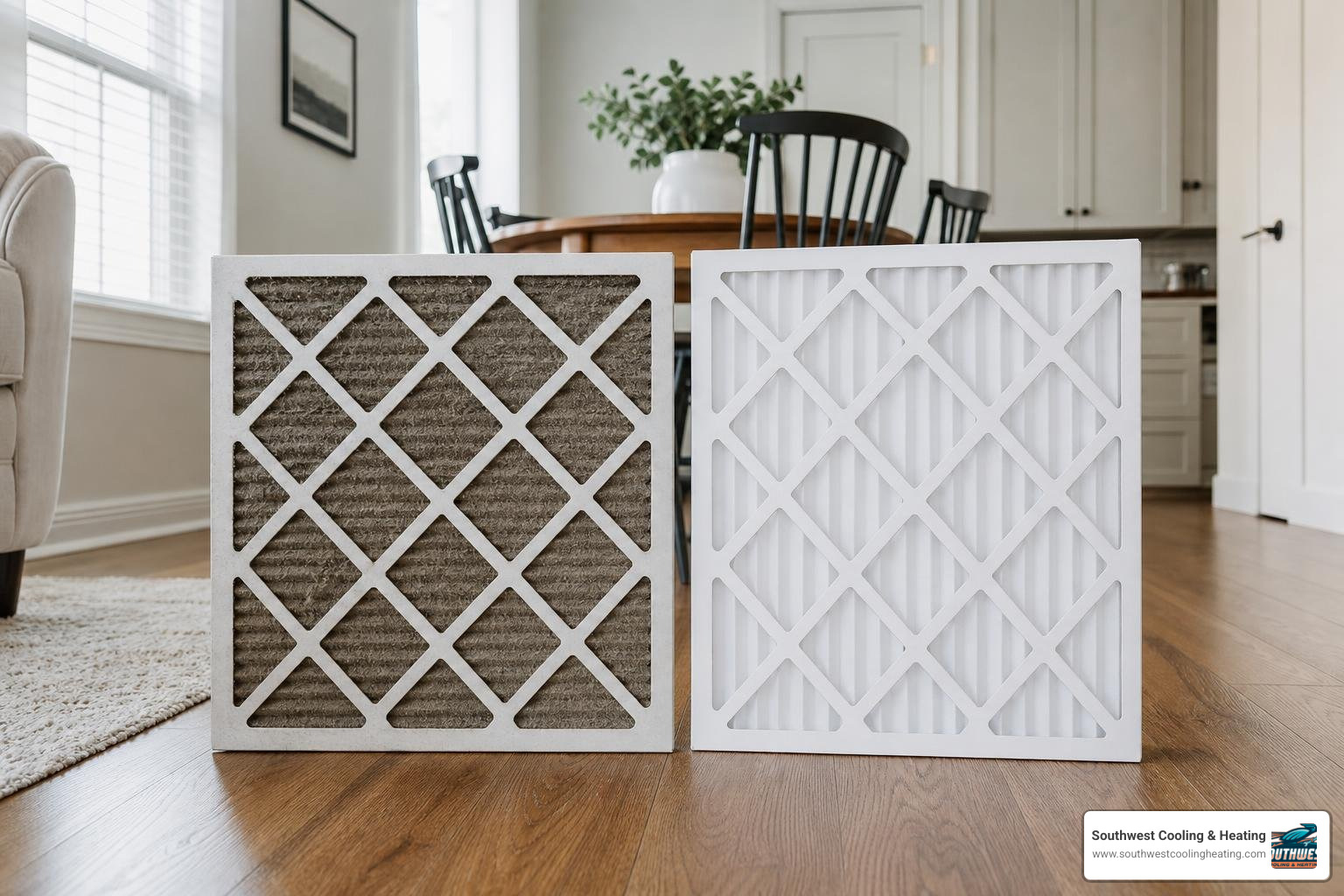
- Slide the filter out and inspect its color. A fresh, healthy filter is bright white. A dirty filter will appear gray, brown, or black, and you may see visible dust clumps, pet hair, or lint wedged between the pleats.
- Perform the “Light Test”: Hold the filter up to a bright light source or the sun. If the light passes through the filter easily, it still has life left in it. If the light is completely blocked by a thick layer of gray grime, the filter is clogged and needs to be replaced immediately.
Quick DIY Checks to Confirm the signs your air filter needs changing
If you suspect your air filter is causing performance issues but want to be sure before buying a replacement, you can run a couple of quick diagnostics:
- The Airflow Test: Feel the air coming out of your vents with the filter installed. Then, turn off the system, temporarily remove the filter, turn the system back on for just a minute, and feel the airflow again. If the air coming out of the vents is noticeably stronger without the filter, your old filter is definitely restricting your system’s breathing. (Note: Never run your system without a filter for more than a few minutes).
- The Thermostat Check: If your home is taking hours to drop just one or two degrees, check the air filter. A clean filter allows the system to reach your target temperature quickly, while a dirty filter forces the system to run continuously without ever hitting the mark.
Understanding How Arid Conditions Accelerate the signs your air filter needs changing
Living in the high-desert climate of Southern Utah means our homes are subjected to environmental challenges that homeowners in wetter climates never have to worry about. In St. George, Hurricane, Ivins, and Santa Clara, dry desert winds and seasonal dust storms carry fine, powdery soil that easily finds its way indoors.
During dry spells, this airborne dust settles into our HVAC systems at an accelerated rate. Additionally, local construction projects in expanding areas like Washington and La Verkin kick up heavy amounts of fine drywall and concrete dust, which can clog a standard fiberglass filter in as little as 30 days.
Because of these unique local factors, it is crucial to understand How High Desert Arid Conditions Affect Filter Replacement Frequency so you can adjust your maintenance schedule accordingly.
Frequently Asked Questions About Air Filter Maintenance
What happens if I ignore a dirty air filter for too long?
Ignoring a dirty air filter can lead to catastrophic system damage and expensive repairs. Over time, restricted airflow causes the blower motor to overheat and burn out. It also places immense stress on the compressor — the “heart” of your air conditioner.
In fact, a Texas-based repair study tracking 500 AC replacements over three years revealed that a staggering 68% of those systems had been running with unchanged filters for over a year. Neglecting this simple $10 task can cut your system’s lifespan in half and result in premature compressor failure.
How often should I replace my home air filter in St. George?
While standard industry advice suggests changing filters every 90 days, our local desert environment demands a more proactive approach:
- Standard 1-inch pleated filters: Should be checked every 30 days and replaced at least every 60 to 90 days.
- Pet-friendly homes: If you have dogs or cats that shed, we recommend replacing your filter every 30 to 45 days to keep pet dander from overwhelming the system.
- High-allergy seasons: During spring and fall when pollen counts soar, changing your filter every 30 days will keep your indoor air clean.
Can I run my HVAC system without a filter for a short time?
No, you should never run your HVAC system without an air filter, even for a single day. Operating the system without a filter allows raw dust, hair, and outdoor debris to pull directly into the indoor unit.
These particles will quickly coat the wet evaporator coils, blocking heat transfer and potentially causing the system to freeze up. Dust will also invade the blower motor’s electrical components, leading to friction, overheating, and eventual motor failure.
Conclusion
Your air filter may be a simple, inexpensive component, but it plays a massive role in protecting your home’s comfort, your family’s health, and your pocketbook. By keeping an eye out for the common signs your air filter needs changing — and replacing it regularly — you can keep your system running at peak efficiency all year long.
If you have changed your filter and are still experiencing weak airflow, strange noises, or rising utility bills, there may be a deeper issue at play, such as leaky ductwork or a failing blower motor. Our team at Southwest Cooling & Heating has been helping Southern Utah families stay comfortable since 1980 with reliable, high-quality service backed by our satisfaction guarantees.
Don’t let a clogged filter compromise your summer comfort. Contact us today to schedule professional AC maintenance and ensure your system is ready to beat the desert heat!