


The Science Behind How a Heat Pump Works — And Why It Matters for Your Home
Understanding how does a heat pump work is simpler than most homeowners expect — and knowing the basics can help you make smarter decisions about your home’s comfort system.
Quick Answer: How Does a Heat Pump Work?
A heat pump moves heat from one place to another using electricity and a refrigerant — it does not burn fuel to create heat. Here is how it works at a glance:
- In summer (cooling mode): The heat pump pulls heat out of your indoor air and releases it outside, cooling your home.
- In winter (heating mode): It reverses the process — pulling heat from outdoor air and moving it inside to warm your home.
- The key component: A reversing valve switches the direction of refrigerant flow, allowing the same system to both heat and cool.
- Why it is efficient: Because it moves existing heat rather than generating it, a heat pump can deliver 2 to 4 times more energy as heat than it uses in electricity.
Here is the thing most people do not realize at first: your home’s air — even on a cold winter day — contains usable heat energy. A heat pump is engineered to capture that energy and put it to work for you. It is the same basic technology found in your refrigerator or air conditioner, just applied to your whole home and designed to run in both directions.
That dual capability — cooling in summer, heating in winter — from a single all-electric system is what makes heat pumps one of the most talked-about upgrades in home comfort right now. And unlike a gas furnace, a heat pump never burns fuel inside your home. It simply relocates heat, which is why it can reach efficiency levels of 300% to 400% — something no combustion-based system can match.
Whether you are trying to understand what the technician is telling you, weighing a replacement for your aging AC or furnace, or just curious about what that unit outside your neighbor’s house actually does — this guide walks you through all of it in plain language.
I am Bruce Hymas, owner of Southwest Cooling and Heating, and I have spent my career working alongside the HVAC systems — including heat pumps — that keep homes comfortable across Southern Utah. Understanding how does a heat pump work has been central to helping homeowners here make confident, informed decisions about their comfort systems.
How does a heat pump work?
At the most basic level, a heat pump works by transferring heat instead of creating it. That one idea explains almost everything.
A furnace creates heat through combustion. Electric resistance heat creates heat the way a toaster does. A heat pump does something smarter: it uses electricity to move heat from one place to another through a closed refrigerant loop. The process is based on the vapor-compression cycle, and the reversing valve lets the system run in either direction depending on the season.
In other words, it is basically an air conditioner with a passport and a winter coat.
What is a heat pump in simple terms?
In simple terms, a heat pump is a heat mover.
- In summer, it moves heat out of your house
- In winter, it moves heat into your house
- It can do both with the same core equipment
If you already understand a refrigerator, you are halfway there. A refrigerator removes heat from inside the box and dumps it into the room. A heat pump does the same kind of job for your home, just on a much larger scale.
Most homes use air-source heat pumps, which gather heat from outdoor air and move it where needed. Some systems are ducted like a traditional central system, while others are ductless mini-splits.
How does a heat pump work compared to an air conditioner or furnace?
A heat pump and an air conditioner are very similar in cooling mode. Both use refrigerant, coils, a compressor, and fans to move indoor heat outside.
The big difference is that a heat pump has a reversing valve. That valve allows the refrigerant flow to switch directions, so the system can heat in winter and cool in summer.
A furnace is different because it does not transfer heat from outdoors. It creates heat directly, usually through combustion or electric resistance.
| System | Main job | How it works | Can it cool? | Can it heat? |
|---|---|---|---|---|
| Heat pump | Heating and cooling | Moves heat with refrigerant and electricity | Yes | Yes |
| Air conditioner | Cooling only | Moves indoor heat outside | Yes | No |
| Furnace | Heating only | Generates heat by burning fuel or using electric resistance | No | Yes |
That is why many homeowners replacing both an AC and a heating system look closely at a heat pump. One system can handle both roles.
Why can a heat pump pull heat from cold outdoor air?
This is the question that makes people squint at the outdoor unit and suspect witchcraft.
The short answer: cold air still contains heat energy. Anything above absolute zero has thermal energy. So even when outdoor air feels freezing to us, there is still heat available to extract.
A heat pump makes this possible by using refrigerant with a very low boiling point. When the refrigerant pressure drops, its temperature drops too. That allows it to become colder than the outdoor air, so heat naturally flows into it. Then the compressor raises the refrigerant pressure and temperature, making it hot enough to release that heat indoors.
So the system is not creating heat from nothing. It is collecting low-grade heat outdoors, concentrating it, and delivering it where you want it.
The four parts that make the cycle happen
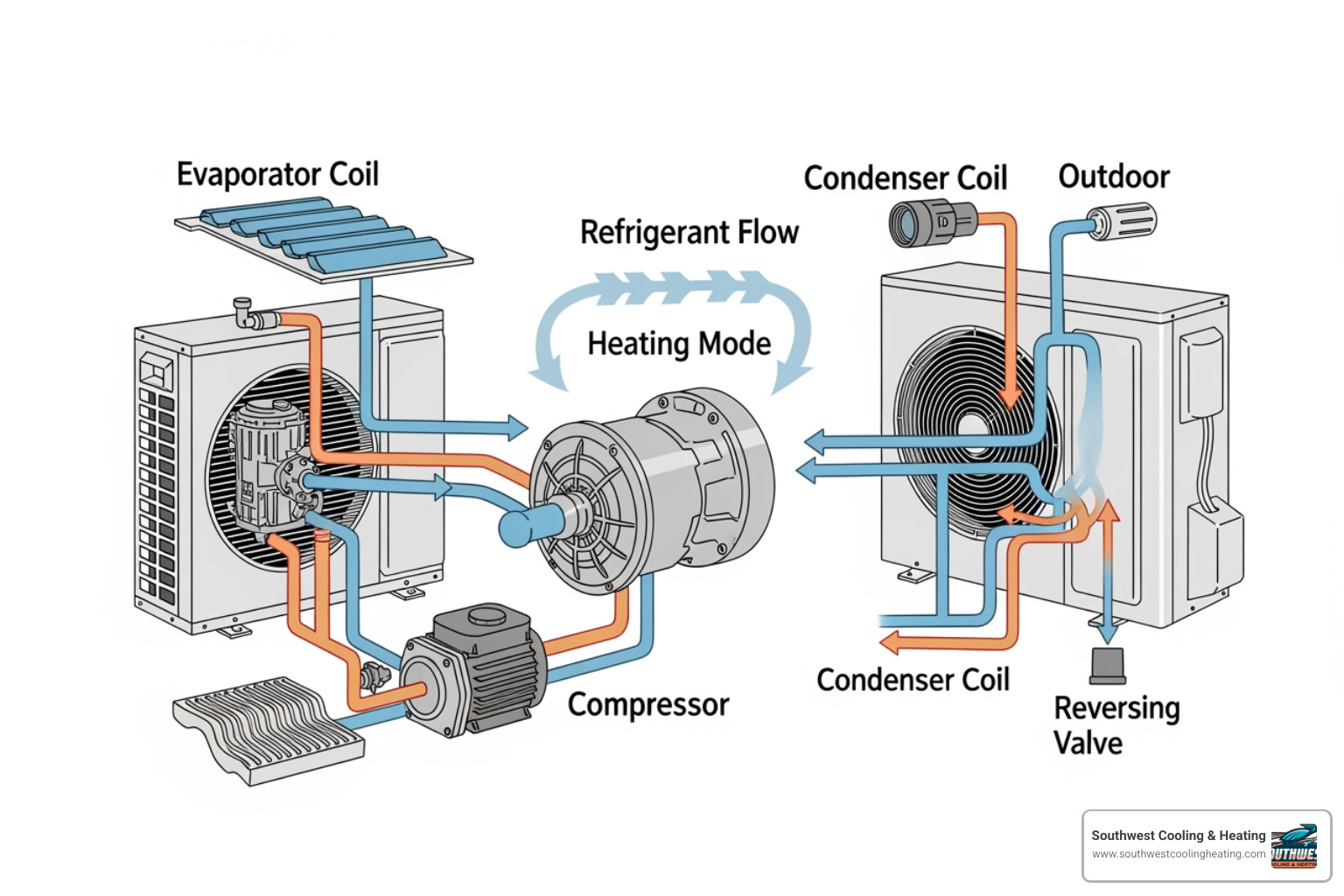
Most residential heat pumps rely on four core components:
- Evaporator
- Compressor
- Condenser
- Expansion valve
These parts work together in a closed loop, with refrigerant constantly changing pressure, temperature, and state.
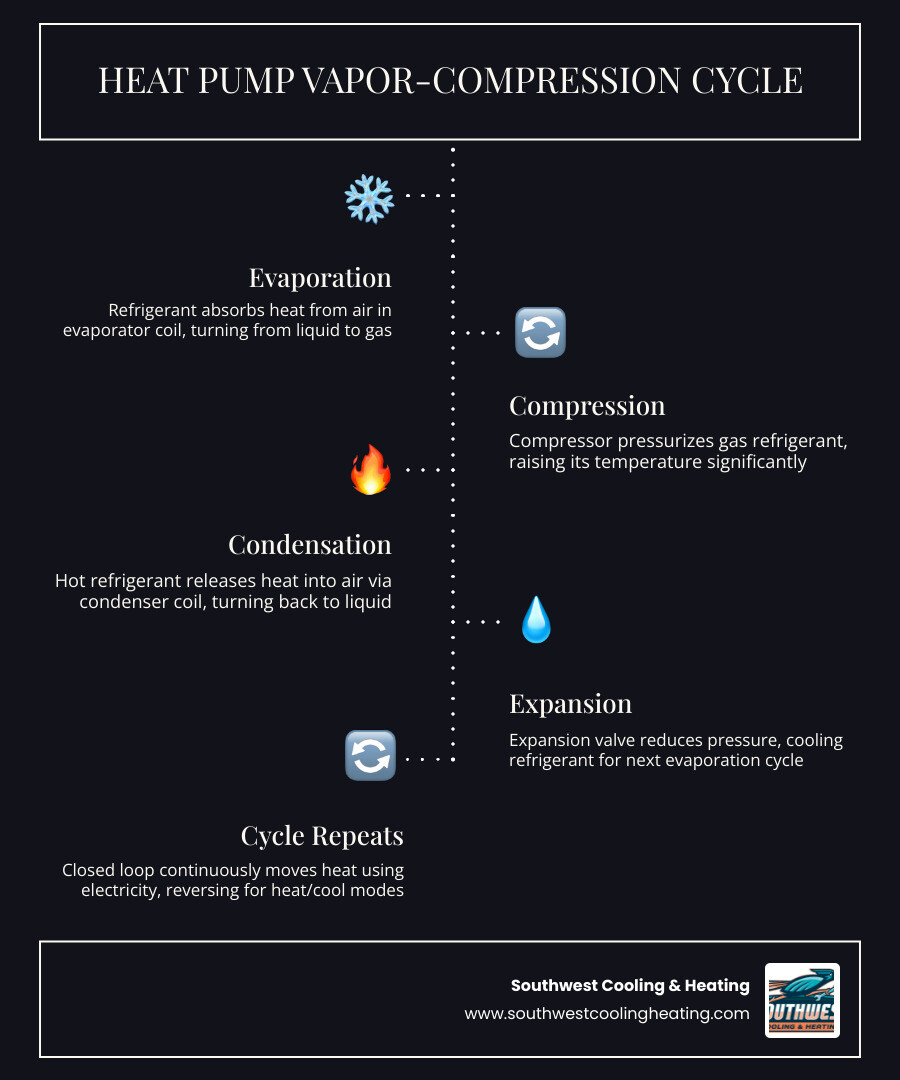
How does a heat pump work through the vapor-compression cycle?
The vapor-compression cycle is the heart of heat pump operation.
-
Evaporation
- Cold, low-pressure refrigerant enters the evaporator coil
- It absorbs heat from the surrounding air
- As it absorbs heat, it boils and becomes vapor
-
Compression
- The compressor squeezes that vapor
- Pressure rises
- Temperature rises with it
-
Condensation
- The hot, high-pressure refrigerant moves to the condenser coil
- It releases heat to the air on the other side of the coil
- As it loses heat, it condenses back into a liquid
-
Expansion
- The liquid refrigerant passes through the expansion valve
- Pressure drops suddenly
- Temperature drops too
- The cycle starts again
This phase-change process matters because refrigerant can absorb and release a lot of heat during evaporation and condensation. That is one reason heat pumps are so effective.
What the reversing valve, refrigerant, and fans do
The reversing valve is what turns a cooling system into a heating-and-cooling system. It changes the path of the refrigerant so the indoor and outdoor coils swap jobs.
The refrigerant is the heat-carrying fluid in the loop. It is chosen specifically because it can absorb and release heat efficiently at practical operating temperatures.
The fans keep air moving across the coils:
- The indoor blower moves conditioned air through your home
- The outdoor fan helps the system exchange heat with outside air
In winter, the outdoor coil can develop frost because it is operating very cold. When that happens, the system may enter a defrost cycle to melt the buildup and keep heat transfer efficient.
How does a heat pump work step by step inside your home?
Here is what happens during a normal call for heating or cooling:
- Your thermostat senses that indoor temperature needs to change
- It tells the heat pump to turn on
- The compressor starts moving refrigerant through the system
- The appropriate coil absorbs heat while the other coil releases it
- The indoor blower circulates conditioned air through ducts or into a room
- The system modulates or cycles off when the thermostat is satisfied
In a ducted home, that comfort travels through your existing ductwork. In a ductless setup, wall-mounted or ceiling-mounted indoor units deliver air directly into specific zones.
If you want to see how this applies to real residential systems, visit our heat pump service page.
How heat pumps cool in summer and heat in winter
The same machine can act as both heat source and heat sink. The season just changes the direction.
How does a heat pump work in cooling mode?
In cooling mode, a heat pump works like a standard central air conditioner.
- The indoor coil acts as the evaporator
- Refrigerant absorbs heat from indoor air
- The indoor air loses heat and feels cooler
- Moisture also condenses on the indoor coil, helping dehumidify the home
- The refrigerant carries that heat outdoors
- The outdoor coil releases the heat outside
So when summer settles over St. George, Santa Clara, Hurricane, Ivins, or La Verkin, the system is not “making cold.” It is removing heat from indoors.
How does a heat pump work in heating mode?
In heating mode, the reversing valve flips the cycle.
- The outdoor coil becomes the evaporator
- Refrigerant absorbs heat from outdoor air
- The compressor raises the refrigerant temperature
- The indoor coil releases that heat into your home
- The indoor blower distributes warm air through the house
This is why a heat pump can provide heating without burning fuel. It is using electricity to run the compressor and fans, but much of the heat delivered to your home comes from outside air.
Typical household heat pumps can often provide 2 to 3 times more heat output than the electricity they consume, and many systems can reach 300% to 400% efficiency or higher under the right conditions. Research also shows that, for every 1 kWh of electricity used, a heat pump may transfer about 1 to 4.5 kWh of thermal energy into a building.
What happens during defrost mode in winter?
In winter heating mode, frost can accumulate on the outdoor coil. That frost acts like a blanket, making heat transfer harder.
During defrost mode, the heat pump briefly reverses operation to warm the outdoor coil and melt the frost. You may notice:
- Steam rising from the outdoor unit
- A temporary pause in warm airflow
- A soft whooshing or clicking sound
That can look dramatic, but it is usually normal. Many systems use auxiliary heat during defrost so indoor comfort stays steady.
Heat pump types and efficiency explained
Not all heat pumps are identical. The source of heat and the delivery method can vary.
The main types of heat pumps for homes
The most common options include:
-
Air-source heat pumps
- The most common residential type
- Move heat between your home and outdoor air
-
Ground-source or geothermal heat pumps
- Pull heat from the ground
- Very efficient because underground temperatures are more stable
-
Water-source heat pumps
- Use a body of water as the heat source or sink in suitable applications
-
Hybrid or dual-fuel systems
- Pair a heat pump with another heat source
- Can switch based on outdoor conditions for best performance
-
Ductless mini-split heat pumps
- Great for homes without ducts, room additions, and zoning
- Learn more in How Ductless Heat Pumps Master Every Season and our ductless heat pump service page
For most homeowners in our Southern Utah service areas, air-source systems and ductless mini-splits are the most practical choices.
What COP means and why heat pumps can be 2 to 4 times as efficient
COP stands for coefficient of performance. It is a simple ratio:
- Heat output divided by electricity input
So if a heat pump delivers 4 units of heat for every 1 unit of electricity it uses, its COP is 4.
That is why people sometimes say heat pumps are 300% or 400% efficient. It sounds impossible until you remember the system is moving heat, not creating all of it from electricity alone.
Key numbers from current research include:
- Typical household COP is often around 4
- Heat pumps can transfer 1 to 4.5 kWh of thermal energy per 1 kWh of electricity
- Current models are often 3 to 5 times more energy efficient than gas boilers
- Many deliver 2 to 3 times more heat than the electrical energy they consume
For seasonal ratings, homeowners may also see:
- SEER2 for cooling efficiency
- HSPF2 for heating efficiency
And yes, ENERGY STAR certification is worth watching for when comparing systems.
Do heat pumps work well in cold climates?
Yes, modern heat pumps can work very well in cold climates, but performance depends on the equipment and the home.
Important points:
- Efficiency drops as outdoor temperatures fall
- Cold-climate heat pumps are designed to keep operating in very low temperatures
- Some models can work in temperatures down to about -22 degrees Fahrenheit
- Backup or auxiliary heat may still be used during extreme cold or defrost cycles
- Good insulation and air sealing make a major difference
That last point is easy to overlook. A high-performance heat pump in a drafty home has to work much harder than the same unit in a well-insulated one.
Benefits, installation factors, and what homeowners should consider
A heat pump can be a great upgrade, but the right fit depends on more than the equipment alone.
Energy-saving and environmental benefits of heat pumps
Because heat pumps move heat instead of generating it through combustion, they can reduce energy use significantly compared to many conventional systems.
Benefits include:
- Lower energy use than electric resistance heating
- Potentially lower heating demand compared to older systems
- Heating and cooling from one all-electric system
- Reduced on-site emissions because there is no fuel burned inside the home
- Better compatibility with renewable electricity
- Good humidity control in cooling mode
Buildings are a major source of global emissions, and heating is a large part of that picture. Heat pumps matter because they offer a more efficient path to year-round comfort.
What to check before choosing a heat pump
Before installing any heat pump, we recommend looking at the whole comfort system, not just the outdoor unit.
Here is a practical checklist:
- Proper load calculation, such as Manual J sizing
- Ductwork condition and airflow performance
- Home insulation and air sealing
- Thermostat compatibility
- Indoor and outdoor unit placement
- Sound considerations near bedrooms or patios
- Cold-climate performance if winter temperatures demand it
- Efficiency ratings such as SEER2 and HSPF2
- Whether you want single-stage, two-stage, or inverter-driven performance
- Maintenance access for future service
Correct sizing is especially important. An oversized system can short cycle, waste energy, and struggle with humidity. An undersized system can run too long and may not keep up on peak days.
Ducted vs ductless: which setup fits your home?
A ducted heat pump can be a great fit if your home already has well-designed ductwork. It can often replace or upgrade a central AC system while providing heating too.
A ductless mini-split may make more sense if:
- Your home has no ducts
- You are conditioning a garage conversion or room addition
- You want zoning control by room or area
- You have hot or cold spots in specific spaces
If you are comparing options, explore our mini-split installation service and heat pump installation page.
Incentives and upgrade planning for Utah homeowners
Timing matters. Many homeowners start researching heat pumps only after an old system fails, which is not always the easiest moment to make a calm decision.
Planning ahead gives you time to think about:
- Whether you want to replace both heating and cooling equipment at once
- Whether your ductwork needs upgrades
- Whether a ductless option fits better
- Which efficiency tier makes sense for your home
- What tax credits or incentive programs may apply
For Utah-specific planning, see our guide to Heat Pump Conversion Utah HVAC Credits.
Frequently Asked Questions About How Does a Heat Pump Work
Does a heat pump bring outside air into the house?
Usually, no. A standard heat pump does not pull outdoor air into your living space the way a ventilation system does.
Instead, it transfers heat through refrigerant and coils. Your indoor air is generally recirculated across the indoor coil, conditioned, and sent back into the home.
At what temperature does a heat pump become less effective?
A heat pump becomes less efficient as the gap between outdoor and indoor temperature gets larger. That point varies by system design, insulation quality, and local climate.
Some older or standard systems lose efficiency more noticeably somewhere in the 25 to 40 degree Fahrenheit range. Modern cold-climate models can continue operating well below that, though backup heat may help during extreme cold.
The key idea is not that heat pumps “stop working” at one magic temperature. It is that capacity and efficiency change with conditions.
Do heat pumps use a lot of electricity?
They use electricity, yes, but very efficiently.
Compared with electric resistance heat, a heat pump usually provides much more usable heat for the same electrical input because it is moving heat rather than generating it directly. Actual usage depends on:
- Home size
- Insulation and air leakage
- Thermostat settings
- Outdoor weather
- System efficiency
- Duct leakage or airflow problems
So the better question is not “Does it use electricity?” It is “How much comfort does it deliver per unit of electricity?” That is where heat pumps shine.
Conclusion
If you have been wondering how does a heat pump work, the answer comes down to one elegant idea: it moves heat where you need it. In summer, it sends indoor heat outside. In winter, it captures outdoor heat and brings it in. Thanks to the vapor-compression cycle, a reversing valve, and the right refrigerant, one system can handle year-round comfort with impressive efficiency.
For homeowners in St. George, Santa Clara, Bloomington Hills, Bloomington, Hidden Valley, Coral Canyon, Diamond Valley, Winchester Hills, Hurricane, Ivins, Toquerville, and La Verkin, choosing the right heat pump is about more than just the equipment. It is about proper sizing, strong airflow, good installation, and a setup that matches your home.
If you are exploring your options, our team at Southwest Cooling & Heating is here to help you make sense of it all. Learn more about our heat pump services and take the next step toward a more efficient, comfortable home.