


Is Your HVAC System Living on Borrowed Time?
Knowing how old is too old for an HVAC system could be the difference between a planned, budget-friendly upgrade and an emergency replacement on the hottest day of a St. George summer. As a general rule, most systems are considered past their prime somewhere between 12 and 20 years old — but the right answer depends on your equipment type, maintenance history, and how the system is performing right now.
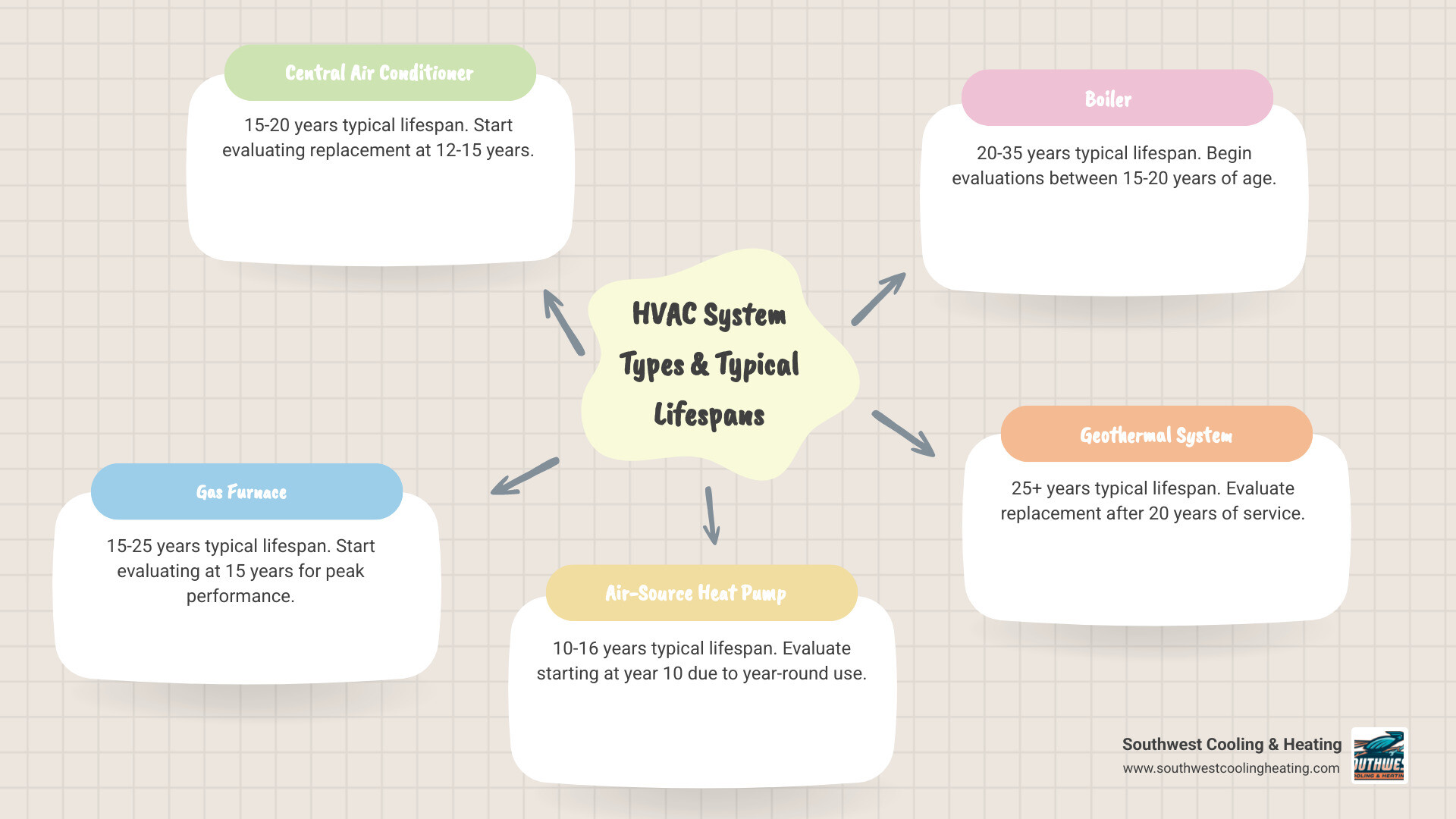
Here is a quick reference by system type:
| System Type | Typical Lifespan | Start Evaluating At |
|---|---|---|
| Central Air Conditioner | 15-20 years | 12-15 years |
| Gas Furnace | 15-25 years | 15 years |
| Air-Source Heat Pump | 10-16 years | 10 years |
| Boiler | 20-35 years | 15-20 years |
| Ductless Mini-Split | 15-20 years | 12-15 years |
| Geothermal System | 25+ years | 20 years |
The tricky part is that age alone does not tell the whole story. A neglected 12-year-old system can be more worn out than a well-maintained 18-year-old one. And nearly one in three homeowners faces a major HVAC breakdown before their system even reaches its expected lifespan — meaning the clock is often ticking faster than most people realize.
This guide walks you through everything you need to make a confident, informed decision: from lifespan benchmarks and warning signs to refrigerant changes, repair-vs-replace rules, and safety risks you cannot afford to ignore.
I’m Bruce Hymas, owner of Southwest Cooling & Heating, a family business serving the St. George area since 1980 — and one thing I have seen over and over is homeowners surprised by how old is too old for an HVAC system when a breakdown finally forces the conversation. Let’s make sure that doesn’t happen to you.
Typical Lifespans of Heating and Cooling Equipment
When evaluating your home comfort system, it helps to understand that your HVAC system is actually a collection of different components, each with its own mechanical limits. In our dry, high-desert climate across Southern Utah—from the hot summers of Santa Clara to the chilly winter nights in Diamond Valley—different systems wear out at different rates.
Central Air Conditioners
A standard central air conditioner in our service area typically lasts between 15 and 20 years, provided it has been cared for properly. However, because our cooling season is long and intense, systems in places like Bloomington and Hidden Valley work exceptionally hard. By year 10, many central air conditioners begin to operate at only 80% to 85% of their original efficiency due to normal wear and tear on the compressor and fan motors.
Gas Furnaces
Gas furnaces generally enjoy a longer lifespan than air conditioners because they only run during our shorter winter months. A high-quality gas furnace can easily last 15 to 25 years. Because they do not face the constant moisture and high-pressure demands of a refrigeration cycle, their primary failure points are electrical components, blower motors, and eventually, the heat exchanger.
Air-Source Heat Pumps
Heat pumps are the workhorses of many modern homes in Coral Canyon and Hurricane. Because they provide both heating in the winter and cooling in the summer, they accumulate operating hours much faster than standalone units. A typical heat pump logs between 2,000 and 3,500 operating hours every single year. Because of this continuous, year-round operation, their expected lifespan is slightly shorter, averaging 10 to 16 years.
Boilers and Ductless Mini-Splits
Boilers are less common in our region but are incredibly durable, often lasting 20 to 35 years—especially cast-iron models. Ductless mini-splits, which have become highly popular for home additions and zoned comfort in Winchester Hills and Toquerville, generally last 15 to 20 years. Their longevity is highly dependent on keeping the indoor filters clean and ensuring the outdoor condenser is free of debris.
Geothermal Systems
Geothermal systems represent the gold standard of longevity. The indoor heat pump components last about 25 years, while the underground loop system can easily last 50 years or more.
No matter what type of system you have, its efficiency and performance are heavily tied to how well it was matched to your home when it was first installed. To understand why proper design is so critical, take a look at our guide on The Ultimate Guide to Getting the Right Size HVAC for Southern Utah Homes.
Maximizing Longevity: When Maintenance Is No Longer Enough
We are firm believers that regular preventative maintenance is the single best way to protect your investment. Simple actions like changing your air filters monthly during peak seasons can prevent your blower motor from overheating and failing prematurely. Keeping at least two feet of clear space around your outdoor condenser unit ensures adequate airflow, preventing the compressor from running too hot.
However, there comes a point where even the most meticulous maintenance cannot turn back the clock. While regular tune-ups reduce friction, clean away corrosive dust, and catch small issues before they spiral into major failures, they cannot restore worn-out compressor valves or fix metal fatigue in a heat exchanger.
If you are wondering whether your current service plan is still delivering value on an aging system, check out our insights on Is Annual HVAC Maintenance Worth It in St. George? and explore how to keep your system running safely in An Ounce of Prevention: Keeping Your HVAC Out of the ER.
How Old Is Too Old for an HVAC System? The Key Warning Signs

As your heating and cooling equipment enters its golden years, it will start dropping hints that its retirement is around the corner. Recognizing these warning signs early gives you the power to plan a replacement on your own terms, rather than reacting to a sudden system failure during a July heatwave.
- Uneven Temperatures: Do you notice that your living room is ice-cold while your back bedroom feels like a sauna? As compressors and blowers age, they lose their ability to distribute air evenly throughout your home.
- Skyrocketing Energy Bills: If your utility bills are creeping upward year after year, but your comfort habits haven’t changed, your system is working harder and running longer to achieve the same results.
- Frequent Breakdowns: If you find yourself on a first-name basis with our service technicians, it’s a clear sign of systemic wear. A system that requires multiple interventions over a short period is telling you that its components are failing in a domino effect.
- Strange Noises: Squealing, banging, rattling, or grinding noises are never a good sign. They usually point to loose belts, failing motor bearings, or an unbalanced blower wheel.
- Excessive Dust and Poor Air Quality: Older systems struggle to manage humidity and filter out airborne particles, leading to dry air, static electricity, and a constant layer of dust on your furniture.
To learn more about the surprising advantages of upgrading before your system fails completely, read The Ultimate Guide to New HVAC Benefits Beyond Comfort.
How Do I Know If My Unit Has Reached the Point of Being How Old Is Too Old for an HVAC System?
Over time, a phenomenon known as coil fouling occurs. Dust, pollen, and microscopic debris bind to the outdoor condenser coils and indoor evaporator coils. Even with professional cleanings, decades of exposure cause the metal to degrade and lose its heat-transfer efficiency.
A system that was rated at 13 SEER when it was installed back in 2010 might only be performing at a SEER of 9 or 10 today. When you couple this physical degradation with the massive technological leaps in modern SEER2 standards, the economic gap between keeping an old unit and upgrading becomes substantial. Variable-speed compressors and two-stage heating systems in modern units allow them to run at lower, highly efficient speeds, maintaining a perfectly steady temperature.
For a detailed look at the math behind utility savings, check out our article: Will a New HVAC System Actually Save You Money?.
Safety Risks That Prove Your Heating System Is Too Old
While an air conditioner failure is incredibly inconvenient, an aging heating system can pose genuine safety hazards to your household.
The most significant risk associated with an old gas furnace is a cracked heat exchanger. The heat exchanger is the metal chamber that prevents combustion gases—including deadly carbon monoxide—from mixing with the air distributed throughout your home. Decades of heating up and cooling down cause the metal to expand and contract constantly. Eventually, this thermal stress leads to microscopic cracks.
If a system has a cracked heat exchanger, it is immediately “too old” and must be decommissioned. Other safety risks in aging systems include brittle electrical wiring that can present fire hazards, and failing safety limit switches that are designed to shut the system down if it overheats.
The Decision Framework: Repair vs. Replace Rules of Thumb
When a major component fails on an older system, you are faced with a tough choice: do you sink more money into a repair, or do you invest in a new system? To take the emotion out of the decision, we recommend using two widely accepted industry rules of thumb.
The Fifty Percent Rule
This rule is simple: if the cost of a single repair exceeds 50% of the value of a brand-new system, replacement is almost always the smarter financial move. Investing significant capital into a system that is already past its midpoint of service life rarely yields a good return, as other aging components are likely to fail soon after.
The Age-Multiplied Repair Rule (The $5,000 Rule)
This mathematical formula helps you weigh the repair cost against the age of your equipment.
System Age (in years) × Repair Cost = Decision Score
If your Decision Score is under 5,000, proceeding with the repair is generally a reasonable choice. If the score is over 5,000, you have reached the reliability inflection point where your money is better spent on a replacement.
For example:
- An 8-year-old system needing a minor electrical repair easily scores well below the threshold, making a repair the obvious choice.
- A 14-year-old system facing a major blower motor or compressor failure will score far above 5,000, signaling that it is time to retire the unit.
For a deeper dive into this decision-making process, explore our comprehensive guide: Should I Repair or Replace My HVAC System?.
How the Refrigerant Transition Affects an Older System
Environmental regulations have a massive impact on the long-term viability of older air conditioners. If your system was manufactured before 2010, it almost certainly uses R-22 refrigerant (commonly known as Freon). The production and import of R-22 was completely banned in 2020. While we can still service these systems using reclaimed stocks, the limited supply means that any repair requiring a refrigerant recharge is exceptionally costly.
Furthermore, the industry is currently navigating a phasedown of R-410A (the refrigerant that replaced R-22) under the AIM Act. This means that even systems installed in the 2010s are beginning to see rising service costs for refrigerant-related repairs. If your older system has a significant refrigerant leak, attempting to patch the leak and recharge the system is often a short-term, expensive band-aid on a system that is already nearing the end of its useful life.
Determining the Age of Your Heating and Cooling Unit
If you bought your home recently and aren’t sure how old your equipment is, finding out is relatively easy.
First, locate the metal nameplate on the cabinet of your outdoor condenser or your indoor furnace. This plate contains technical specifications, including the model number, serial number, and often the manufacture date clearly printed near the top.
If the manufacture date is not explicitly listed, you can decode it using the serial number. For most major brands, the first four digits of the serial number represent the week and year the unit was built. For example, a serial number starting with “2212” often indicates the unit was manufactured in the 22nd week of 2012.
Knowing the exact age of your system also helps ensure that any future replacement is sized correctly for your home’s current needs, especially if you have added insulation, upgraded windows, or remodeled. To learn why this matters, read Why Correct System Sizing Matters for Your Home.
Frequently Asked Questions About HVAC Lifespan
Why Is 15 Years Often Considered How Old Is Too Old for an HVAC System?
By the time an air conditioner or heat pump reaches the 15-year mark, it has completed thousands of heating and cooling cycles. The constant friction wears down the internal valves of the compressor, the fan motor bearings lose their lubrication, and the electrical contactors experience pitting. Additionally, the technology gap between a 15-year-old system and a modern variable-speed unit is massive, meaning you are paying significantly more on your monthly utility bills to keep an outdated, less comfortable system running.
Can a Well-Maintained Furnace Actually Last 30 Years?
While it is technically possible for a high-quality gas furnace or cast-iron boiler to reach 30 years under perfect conditions, it is incredibly rare. Even if a furnace survives three decades, it will likely operate at an AFUE (Annual Fuel Utilization Efficiency) rating of only 60% compared to modern condensing furnaces that boast efficiencies of 96% or higher. Additionally, finding replacement parts for a 30-year-old system becomes nearly impossible as manufacturers phase out support for obsolete designs.
Does a Heat Pump Last as Long as a Standard Air Conditioner?
Generally, no. Because a standard air conditioner only runs during the warm spring and summer months in Southern Utah, it gets a long break during the winter. A heat pump, however, runs year-round to provide both heating and cooling. Because it accumulates double the run-hours of a seasonal system, a heat pump typically has a lifespan that is 25% to 30% shorter than a standalone central air conditioner.
Conclusion
Deciding how old is too old for an HVAC system doesn’t have to be a stressful guessing game. By understanding the typical lifespans of your equipment, keeping an eye out for warning signs like uneven comfort or rising bills, and using clear decision frameworks like the Fifty Percent Rule, you can make a choice that protects both your home’s comfort and your financial peace of mind.
If you are planning to put your home on the market soon, a proactive replacement can also be a massive selling point for future buyers. To see how a new system impacts your property value, read Will a New HVAC Help Sell Your Home Faster?.
At Southwest Cooling & Heating, we’ve been helping our neighbors in St. George, Santa Clara, Bloomington, Hurricane, Ivins, and the surrounding communities stay comfortable in every season since 1980. We believe in pairing advanced home comfort technology with honest, old-school values.
If you suspect your heating and cooling system is living on borrowed time, don’t wait for a complete system breakdown to force your hand. Schedule Professional HVAC Services Today and let our expert team provide a clear, honest assessment of your system’s health.