


Why Oversized HVAC Systems Waste Energy: The Mechanics of Short Cycling
Why oversized HVAC systems waste energy comes down to one core problem: they do too much, too fast, then shut off before finishing the job. The result is a cycle of wasted electricity, poor humidity control, and unnecessary wear on equipment that should last 15 to 20 years.
Here is a quick summary of the main reasons oversized HVAC systems waste energy:
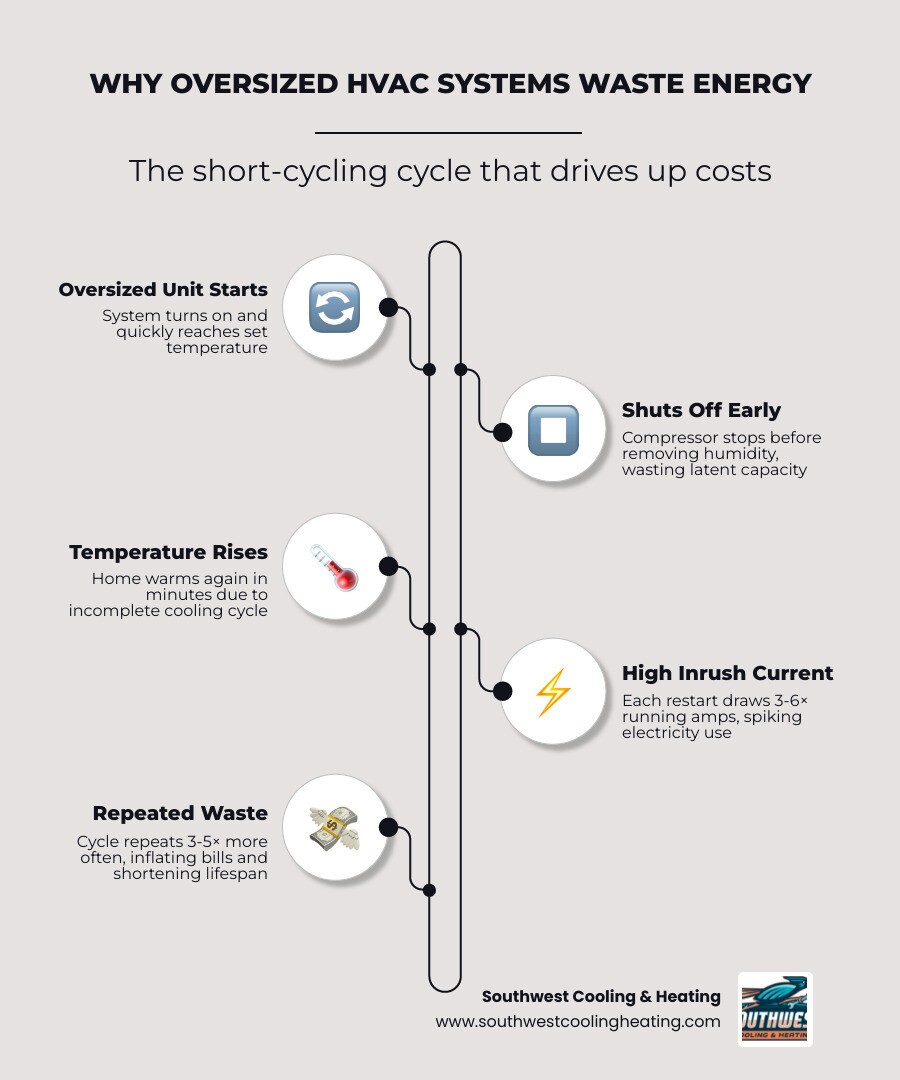
- Short cycling – The system reaches the set temperature too quickly and shuts off, then restarts minutes later, repeating the least efficient part of its operation over and over
- Startup power spikes – Every time the system starts, it draws 3 to 6 times its normal running current, and oversized systems start far more often than they should
- Poor dehumidification – The system shuts off before the evaporator coil has time to pull moisture from the air, leaving the home feeling clammy even when it is cool
- Parasitic power losses – Components like crankcase heaters continue drawing power even when the system is off, and the more time the system spends off, the larger this penalty becomes
- Accelerated wear – More startups mean more stress on the compressor and other components, cutting equipment lifespan from 15 to 20 years down to as few as 8 to 10
More than half of U.S. homes have HVAC systems that are the wrong size, and many are two or even three times larger than what the home actually needs. A properly sized system can use up to 30% less energy than an oversized one — a significant difference that adds up on every utility bill.
I’m Bruce Hymas, owner of Southwest Cooling and Heating, and I’ve spent years seeing how oversized equipment quietly drives up energy bills and shortens system life for homeowners across St. George and Southern Utah — understanding why oversized HVAC systems waste energy is one of the most practical things a homeowner can learn before making any equipment decision. In this guide, I’ll walk you through the exact mechanics behind the waste, what proper sizing looks like, and how to tell if your current system is working against you.
Simple guide to why oversized hvac systems waste energy:
- how hvac load calculations work
- how improperly sized systems shorten equipment life
- why correct system sizing matters for your home
To understand why a larger system isn’t a better system, we have to look at how these units operate. When an air conditioner or heat pump is far too large for a home, it behaves like a sports car trying to drive through a crowded school zone. It accelerates rapidly, hits the target speed almost instantly, and then has to slam on the brakes.
In the HVAC world, this rapid starting and stopping is known as “short cycling.” Instead of running in smooth, steady cycles, an oversized unit blasts a massive volume of conditioned air into your home, satisfies the thermostat in a matter of minutes, and abruptly shuts down. A few minutes later, as the air settles and the thermostat registers a slight change, the system repeats the process.
According to Department of Energy data, over 60% of residential HVAC systems in the United States are incorrectly sized, with many operating at double or triple the capacity the home actually requires. This miscalculation directly triggers chronic short cycling, which is the primary reason Oversized AC St. George AC Service issues are so common and costly.
How Short Cycling Explains Why Oversized HVAC Systems Waste Energy
An air conditioner does not operate at peak efficiency the moment it clicks on. In fact, standard residential cooling systems require roughly 10 minutes of continuous run time to stabilize internal refrigerant pressures, establish proper airflow patterns, and reach their rated operating efficiency.
When a system is properly sized, it will run for a stable, continuous stretch of 15 to 30 minutes during a typical cycle. This allows the equipment to spend the vast majority of its operating runtime at peak efficiency.
Conversely, an oversized system might only run for 5 minutes before shutting off. Because it never completes that crucial 10-minute stabilization threshold, it operates almost entirely within its startup phase—the most energy-intensive and least efficient portion of the cycle.
Industry data shows that when average operating runtimes increase from a brief 5 minutes to a more stable 9 minutes, overall system efficiency improves by roughly 17 percent, raising the Energy Efficiency Ratio (EER) from 6 to 7. Short cycling prevents this efficiency gain, imposing a severe and continuous energy penalty on your household.
Startup Power Spikes and Inrush Current
Every time your air conditioner’s compressor and outdoor fan motor start up, they experience a phenomenon known as inrush current. This is the initial surge of electricity required to overcome mechanical inertia and get the heavy internal components spinning.
This startup electrical draw is incredibly intense, typically pulling 3 to 6 times the normal running current of the system. If you have ever noticed your home’s lights flicker slightly when the air conditioner kicks on, you have seen this power spike in action.
A properly sized system might cycle 2 to 3 times per hour, meaning it only experiences these heavy power draws a few times a day. An oversized system, however, can cycle 10 to 15 times per hour. This means your home is subjected to hundreds of massive electrical spikes every single day. This constant surge of inrush current is a direct driver of sky-high electricity bills, consuming far more power than a smaller system running a single, continuous, low-draw cycle.
The Humidity Problem: Sensible vs. Latent Cooling
True indoor comfort relies on two distinct forms of cooling: sensible cooling and latent cooling.
- Sensible cooling is the reduction of actual air temperature, which is what you see reflected on your thermostat’s digital display.
- Latent cooling is the removal of moisture (humidity) from the air.
To feel comfortable, we need our HVAC systems to balance both. When a system is oversized, it focuses almost entirely on sensible cooling while neglecting latent cooling. This mismatch is a core reason Why Correct System Sizing Matters for Your Home, as it directly degrades your indoor air quality and overall comfort.
Why Oversized HVAC Systems Waste Energy and Fail to Dehumidify
For an air conditioner to remove humidity, warm, moist indoor air must blow across a cold evaporator coil. As the air cools, the moisture in it condenses on the cold metal of the coil—much like water droplets forming on the outside of a cold glass of iced tea on a warm afternoon. This water then drips into a condensate pan and is drained safely outside.
However, this process takes time. The evaporator coil must get cold enough to reach the dew point, and the system must run long enough to circulate your home’s air volume across the coil multiple times.
Because an oversized system shuts off after just a few minutes, the evaporator coil never has enough time to pull significant moisture from the air. When the system shuts down prematurely, any water that did manage to condense on the coil simply evaporates back into the ductwork and living spaces.
This leaves your home with a cool but incredibly clammy atmosphere. When the indoor relative humidity climbs above the EPA-recommended guidelines of 30% to 50%, homeowners typically react by lowering the thermostat even further to find relief. This forces the oversized system to run more frequently, wasting even more energy. Furthermore, high indoor humidity creates a breeding ground for mold growth, musty odors, and dust mites, threatening your home’s structural integrity and your family’s health.
Long-Term Consequences: Wear, Tear, and System Lifespan
The financial damage of an oversized system isn’t limited to monthly utility bills. The mechanical toll of short cycling drastically shortens the lifespan of your equipment.
An HVAC compressor is designed to handle a finite number of start-up cycles over its operating life. By forcing the system to start up to five times more frequently than necessary, you are rapidly accelerating the mechanical wear on the compressor, blower motors, and electrical contactors.
While a properly sized system should easily last 15 to 20 years with routine maintenance, an oversized unit suffering from chronic short cycling often experiences catastrophic failure in just 8 to 10 years. For a deeper look at this mechanical strain, check out The Ultimate Guide to Improperly Sized Systems Shortening Equipment Life.
Additionally, short cycles create severe lubrication issues. The compressor relies on specialized oil that circulates alongside the refrigerant to keep its moving parts lubricated. When a cycle is cut short, the oil does not have enough time to travel through the system and return to the compressor. This leads to “dry starts,” where the compressor runs without adequate lubrication, causing internal friction, overheating, and eventual motor burnout.
Parasitic Power Losses and Off-Cycle Waste
Many homeowners are surprised to learn that an air conditioner draws electrical power even when it is completely idle. Outdoor condensing units often feature crankcase heaters designed to keep the compressor warm, preventing refrigerant from migrating and mixing with the compressor oil while the system is off.
This continuous electrical draw is known as a parasitic power loss. National Renewable Energy Laboratory (NREL) research reveals that when these off-cycle parasitic power losses are present (such as a typical 20-watt-per-ton crankcase heater draw), oversizing an air conditioner can result in a substantial annual energy penalty of up to 14%.
Because an oversized system spends the vast majority of its life sitting idle in the “off” state, these parasitic losses represent a much larger percentage of its total annual energy consumption compared to a right-sized system that runs longer, more efficient cycles.
Sizing It Right: Manual J Calculations vs. Rules of Thumb
For decades, many contractors relied on outdated “rules of thumb” to size residential heating and cooling systems. The most common was the “1 ton of cooling per 400 square feet” rule.
These lazy estimations completely ignore modern building practices, insulation quality, and local climates. Sizing a system solely on square footage almost always results in massive oversizing, especially in newer, tighter homes.
| Sizing Method | Factors Evaluated | Accuracy | Risk of Oversizing |
|---|---|---|---|
| Rule of Thumb (e.g., 1 ton per 400 sq. ft.) | Square footage only | Extremely low | Very High (often 2x to 3x too large) |
| ACCA Manual J Calculation | Insulation, windows, layout, climate, airtightness, occupancy | Extremely high | Very Low (matches actual thermal loads) |
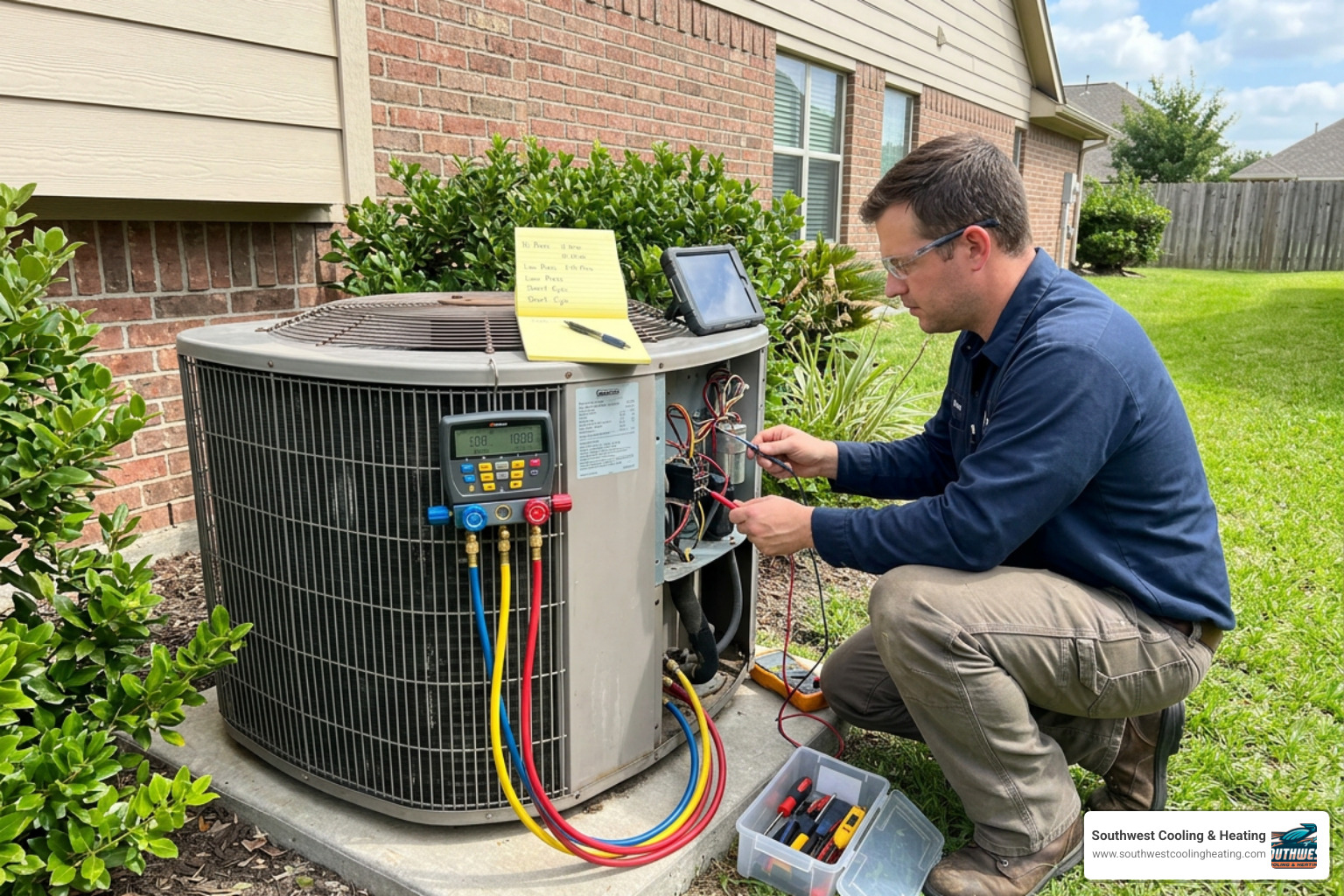
To avoid these costly mistakes, we perform a comprehensive load calculation using the Air Conditioning Contractors of America (ACCA) Manual J protocol. This industry-standard calculation determines the exact amount of heat your home gains in the summer and loses in the winter.
We then pair this with Manual S equipment selection to ensure the selected unit matches those precise calculations. To understand why this detailed engineering matters, read about The Heavy Lifting Behind HVAC Load Calculations.
Home-Specific Factors in Southern Utah Sizing
Sizing an HVAC system in Southern Utah requires a deep understanding of our unique desert climate. In communities like Santa Clara, Hurricane, Ivins, and La Verkin, we experience extreme summer heat paired with intense sunlight.
A proper Manual J calculation must account for several local factors:
- Insulation Levels: The R-value of your attic and wall insulation dictates how much heat enters your living spaces.
- Window Orientation: Homes with large, west-facing windows receive a massive amount of solar heat gain during hot summer afternoons.
- Building Airtightness: Modern homes in areas like Bloomington Hills or Coral Canyon are built much tighter than older homes in central St. George, requiring smaller systems to maintain comfort.
- Ceiling Heights: Vaulted ceilings increase the volume of air that must be conditioned, even if the floor square footage remains the same.
By evaluating these specific details, we prevent the “bigger is better” trap. For a comprehensive look at how we tailor systems to our local climate, refer to The Ultimate Guide to Getting the Right Size HVAC for Southern Utah Homes.
Frequently Asked Questions about HVAC Sizing
How do I know if my current HVAC system is oversized?
There are several telltale signs that your system is too large for your home:
- Short runtimes: Your system turns on, blasts cold air, and shuts off in less than 10 minutes.
- High indoor humidity: Your home feels cool but clammy, and the indoor relative humidity consistently stays above 50% to 60%.
- Temperature swings: You notice dramatic hot and cold spots throughout your home, or the temperature fluctuates rapidly between cycles.
- Loud operation: The system makes a loud rushing noise through the registers or rattles your ductwork when it kicks on, indicating it is pushing too much air through a duct system that wasn’t designed for that volume.
What is a Manual J load calculation?
A Manual J load calculation is the official industry-standard protocol developed by the ACCA to determine the precise heating and cooling loads of a building. Rather than guessing based on square footage, a professional technician uses specialized software to analyze your home’s entire thermal envelope. This includes measuring walls, ceilings, floors, windows, insulation values, duct leakage, local climate data, and even the orientation of your home relative to the sun. This ensures your new HVAC system is sized to handle your home’s actual peak loads without wasting energy.
Can a variable-speed system prevent oversizing issues?
To some extent, yes. Modern systems featuring inverter technology and variable-speed compressors can modulate their cooling capacity up or down to match the real-time demands of your home. Instead of running at 100% capacity all the time, they can throttle down to run longer, highly efficient cycles at lower speeds.
However, variable-speed technology is not a magic fix for extreme oversizing. If a system’s maximum capacity is drastically oversized for the home, even its lowest operating speed may still be too powerful, leading to short cycling and efficiency losses in mild weather. Proper sizing remains critical, regardless of the system type.
Conclusion
Investing in a new heating and cooling system is one of the most significant decisions you will make for your home. Falling into the trap of installing an oversized unit will only lead to decades of high energy bills, inconsistent comfort, humid indoor air, and premature equipment failure.
At Southwest Cooling & Heating, we are committed to helping homeowners throughout St. George, Santa Clara, Bloomington, Winchester Hills, and surrounding Southern Utah communities find the perfect fit for their homes. Our team uses precise, professional load calculations to ensure your system is right-sized for maximum energy savings, whisper-quiet operation, and perfect indoor comfort.
Ready to stop wasting energy and start enjoying true home comfort? Schedule an HVAC Sizing Consultation with us today, and let our experienced team design a custom, high-efficiency solution tailored to your home.