


Why Improperly Sized HVAC Systems Shorten Equipment Life — And What St. George Homeowners Need to Know
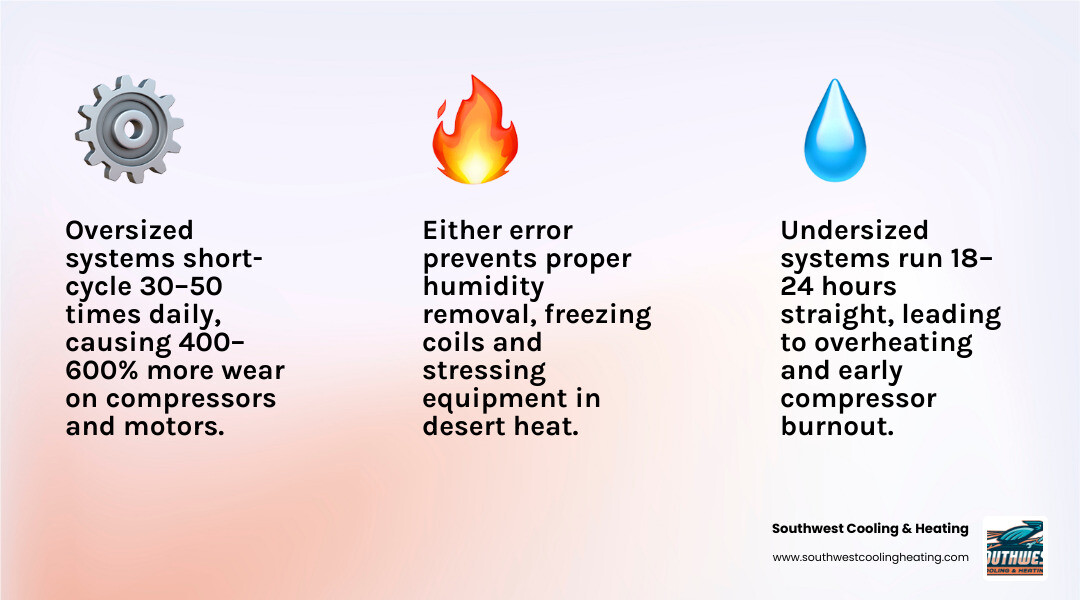
How improperly sized systems shorten equipment life comes down to two relentless mechanical problems: oversized systems cycle on and off dozens of times per day, and undersized systems run almost nonstop. Both extremes hammer components far harder than they were designed to handle — and both can cut your system’s expected lifespan from 15–20 years down to as few as 8–10.
Here’s a quick summary of how sizing errors damage your HVAC equipment:
| Sizing Problem | What Happens | Equipment Impact |
|---|---|---|
| Oversized system | Short cycles 30–50 times per day (normal is 6–8) | 400–600% more wear on compressors, contactors, and motors |
| Undersized system | Runs 18–24 hours continuously | Overheating, lubrication failure, compressor burnout |
| Either problem | Humidity never properly controlled | Coil stress, frozen evaporator, indoor air quality issues |
| Long-term result | Premature component failure | System fails at 8–10 years instead of 15–20 |
According to Department of Energy data, more than 60% of residential HVAC systems are incorrectly sized — meaning the odds are not in your favor if a proper load calculation was never done on your home.
St. George’s desert climate makes this even more unforgiving. When summer temperatures push past 110°F, an undersized system never catches up, and an oversized one never runs long enough to pull humidity out of your air. Either way, your equipment pays the price.
I’m Bruce Hymas, owner of Southwest Cooling & Heating, and after decades of working alongside HVAC systems across Southern Utah, I’ve seen how how improperly sized systems shorten equipment life — often long before homeowners ever realize the original installation was the problem. Let’s walk through exactly what’s happening inside your system, how to spot the warning signs, and what actually fixes it.
Handy how improperly sized systems shorten equipment life terms:
What HVAC System Size Really Means for Equipment Longevity
When we talk about the “size” of an HVAC system, we are not talking about how much physical space the outdoor metal cabinet takes up on your concrete pad. Instead, we are talking about capacity.
Understanding this distinction is the first step in protecting your home’s comfort and your financial investment. In Southern Utah, where we experience intense summer heat and crisp winter desert nights, having a system with the exact capacity required to handle your home’s unique thermal envelope is the difference between a system that lasts 20 years and one that breaks down in 8.
HVAC Size Is Capacity, Not Cabinet Dimensions
HVAC capacity is measured in British Thermal Units (BTUs) or “tons.” One ton of cooling capacity equals 12,000 BTUs per hour. This rating represents the system’s ability to remove heat from your home.
Whether you are looking at a central air conditioner, a gas furnace, or a year-round heat pump, the capacity must be perfectly matched to your home’s heating and cooling load. This mechanical ecosystem includes:
- The outdoor condenser unit and its compressor.
- The indoor evaporator coil, which must match the condenser’s capacity to maintain proper pressure.
- The blower motor and air handler, which must push the exact volume of air (measured in Cubic Feet per Minute, or CFM) required to transfer heat effectively.
If any of these parts are mismatched or if the overall capacity is wrong, the system will not operate within its designed parameters, accelerating wear on every single moving part.
Why Sizing Matters More Than “Bigger Is Better”
There is a persistent myth in the home services industry that “bigger is always better.” Some believe that installing a 5-ton air conditioner in a home that only requires a 3-ton unit will cool the house faster and work less. In reality, the exact opposite is true.
An air conditioner is designed to run in steady, efficient cycles. It needs to run long enough to establish a balanced thermodynamic state, which allows the compressor to lubricate itself properly and the evaporator coil to remove moisture from the air. When a system is too large, it blasts the home with cold air, satisfies the thermostat in a few minutes, and shuts off. This cycle prevents the system from ever reaching its peak operating efficiency, driving up your energy bills while subjecting the compressor and electrical components to constant, destructive starting stress.
To learn more about why capacity matching is so critical, check out our detailed guide on Why Correct System Sizing Matters for Your Home.
Typical Lifespan Difference Between Right-Sized and Wrong-Sized Systems
Under normal conditions, a properly sized and professionally installed central air conditioner or heat pump should easily last 15 to 20 years with regular maintenance. Gas furnaces can often last up to 20 years.
However, when a system is improperly sized, that expected lifespan is cut nearly in half. It is incredibly common for we at Southwest Cooling & Heating to see oversized or undersized units in neighborhoods across Hurricane, Santa Clara, and Ivins completely fail between years 8 and 10. The mechanical and thermal fatigue of running under constant strain or starting up five times more often than designed simply wears out the compressor—the “heart” of the system—long before its time.
how improperly sized systems shorten equipment life: Oversized vs. Undersized Stress
To understand exactly how these sizing errors destroy your equipment, we have to look at the physical forces at play. Both oversizing and undersizing subject your HVAC system to extreme mechanical stress, but they do so in completely different ways.
| Mechanical Factor | Oversized System Stress (The “Sprinter”) | Undersized System Stress (The “Marathon Runner”) |
|---|---|---|
| Primary Cycle Pattern | Short cycling (rapid on/off cycles) | Continuous running (rarely or never shuts off) |
| Electrical Strain | Constant high-amp startup draws | High heat buildup in wiring and motors |
| Lubrication Flow | Oil never fully circulates; pools in coils | Oil overheats, loses viscosity, creates metal friction |
| Airflow & Pressure | High static pressure (clogged artery effect) | Low airflow velocities or frozen evaporator coils |
| Major Component At Risk | Contactors, capacitors, compressor valves | Blower motors, compressor windings, fan bearings |
how improperly sized systems shorten equipment life in oversized systems
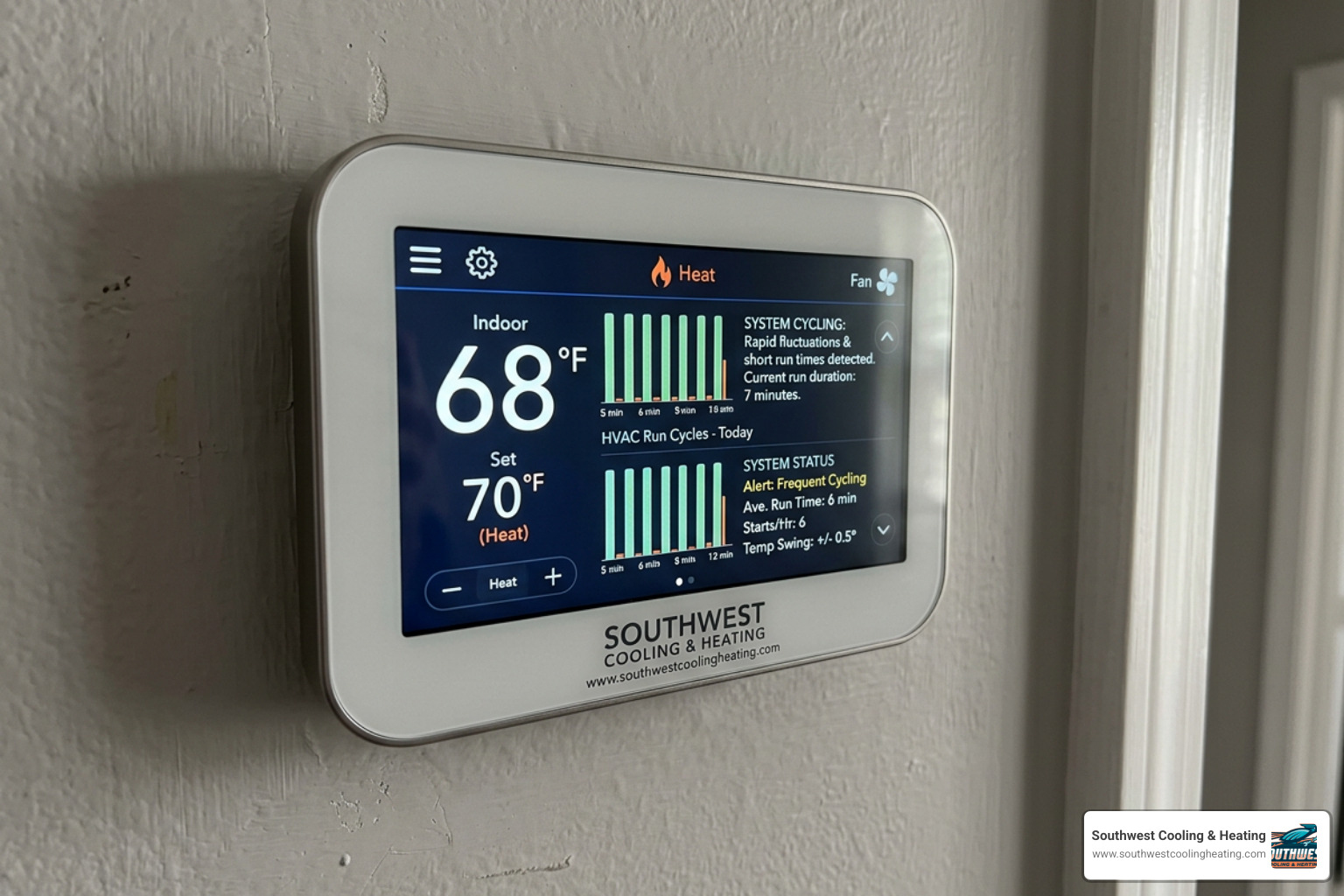
The primary mechanism of destruction for an oversized system is short cycling. A properly sized system should run for 10 to 20 minutes per cycle, completing 2 to 3 cycles per hour during peak outdoor temperatures. An oversized system, however, will blast the home with cold air and shut down within 3 to 7 minutes, starting up 30 to 50 times a day.
This frequent cycling creates up to a 600% increase in wear events on your system’s most expensive components:
- The Compressor: The compressor draws 6 to 10 times its normal operating current during the first few seconds of startup. This massive electrical surge generates intense heat in the motor windings. When this happens dozens of times a day, the insulation around the windings degrades, leading to electrical shorts and total compressor burnout.
- Electrical Contactors and Capacitors: Your system’s contactors act as mechanical switches, and start capacitors provide the extra electrical boost needed to get the motors running. Constant cycling causes the contactor points to arc, pit, and eventually weld shut or fail to close. Capacitors, subjected to constant high-amp starts, overheat and fail prematurely.
- Lubrication Starvation: When a compressor starts, oil is pumped out into the refrigerant lines. The system must run for at least 10 to 12 minutes to establish the velocity needed to carry that oil all the way through the coils and back to the compressor. During short cycles, the oil never returns, leaving the compressor’s internal pistons and bearings to grind together without lubrication.
If you suspect your system is suffering from these rapid cycles, you can read more about the specific symptoms in our post on Oversized AC St George AC Service.
how improperly sized systems shorten equipment life in undersized systems
While an oversized system acts like a sprinter repeatedly running 100-meter dashes with no warm-up, an undersized system is a marathon runner forced to run indefinitely in 110-degree St. George heat.
When a system is too small for the home, it will run continuously for 18 to 24 hours a day on hot summer days, struggling to lower the temperature to the thermostat’s setpoint. This constant operation causes:
- Extreme Thermal Overload: Electric motors and compressors rely on the flow of cool refrigerant returning from the indoor coil to keep their internal operating temperatures down. When an undersized system runs nonstop in extreme heat, the returning refrigerant is warm, and the compressor cannot cool itself. This extreme heat causes the compressor oil to break down and lose its viscosity.
- Internal Metal Shavings and Slugging: As the overheated oil loses its protective qualities, metal-on-metal contact occurs inside the compressor. This creates microscopic metal shavings that contaminate the entire refrigerant circuit, leading to mechanical lockups.
- Frozen Evaporator Coils: Continuous operation without adequate downtime can cause the indoor evaporator coil’s temperature to drop below freezing. Condensation on the coil freezes solid, completely blocking airflow. This ice block can cause liquid refrigerant to flood back into the compressor. Because liquids cannot be compressed, this “liquid slugging” instantly destroys the compressor’s internal valves.
Why Humidity, Airflow, and Static Pressure Make the Damage Worse
In addition to direct motor and compressor wear, improper sizing creates severe airflow and pressure imbalances.
Air conditioners need at least 10 to 15 minutes of continuous runtime before the indoor evaporator coil becomes cold enough to condense water vapor out of the air effectively. Because oversized systems shut off so quickly, they never dehumidify. Your home is left feeling cold and clammy, with relative humidity levels often climbing above 60%. This excess moisture can condense inside your ductwork and on your supply registers, creating a breeding ground for mold and mildew.
Furthermore, many oversized systems are installed on existing ductwork that is too small for the new unit’s airflow requirements (for example, installing a 5-ton system on a duct network designed for a 3-ton system). This creates incredibly high static pressure—the HVAC equivalent of high blood pressure or “clogged arteries.” The blower motor has to work twice as hard to push air through restricted pathways, leading to premature motor failure and excessive noise throughout the home.
Warning Signs Your HVAC System Is Too Big or Too Small
Recognizing the warning signs of an improperly sized system early can save you from an unexpected, expensive system failure in the middle of a triple-digit summer.
Common Signs of an Oversized HVAC System
If your system is too large for your home, you will likely notice several of these red flags:
- Very short runtimes: The system turns on, runs for 5 minutes or less, and shuts off.
- High indoor humidity: The air feels cold but clammy, and your skin feels sticky indoors.
- Frequent electrical repairs: You find yourself replacing capacitors, contactors, or fuses every couple of summers.
- Uneven temperatures: Some rooms are freezing cold while others remain warm because the system shuts off before air can circulate evenly.
- Loud operation: You hear a loud rush of air or a deep rumble every time the system starts up.
Common Signs of an Undersized HVAC System
If your system is too small to handle your home’s heat load, look for these indicators:
- Nonstop running: The system runs continuously from morning until late at night without ever shutting down.
- Struggling on hot days: The thermostat is set to 75°F, but the indoor temperature keeps climbing to 80°F or higher during the afternoon.
- Weak airflow: The air coming out of the registers feels cool, but there isn’t enough volume to keep the space comfortable.
- Frozen outdoor lines: You notice ice forming on the copper refrigerant lines or on the indoor coil.
- Unusually high utility bills: Because the system never stops running, your electric bills skyrocket during peak months.
Problems That Can Look Like Bad Sizing but Aren’t
Before assuming your system is sized incorrectly, it is important to rule out common maintenance and installation issues that mimic sizing problems.
If you are experiencing poor cooling or long runtimes, perform these basic checks first:
- Check the air filter: A heavily clogged air filter restricts airflow, causing long runtimes, poor cooling, and frozen coils—symptoms that look exactly like an undersized system.
- Inspect your registers: Ensure that at least 80% of your supply vents are completely open and unblocked by furniture or drapes. Closing too many vents creates high static pressure and short cycling, mimicking an oversized unit.
- Check the outdoor unit: A condenser coil blocked by dirt, grass clippings, or overgrown bushes cannot release heat. This causes the system to run constantly or shut down on thermal overload.
- Look for duct leaks: Damaged or disconnected ductwork in your attic or crawlspace can lose up to 30% of your conditioned air, making a perfectly sized system perform like an undersized one.
Manual J, Manual S, and Installation Checks That Prevent Sizing Errors
The only way to ensure your home has a perfectly sized heating and cooling system is to rely on scientific engineering calculations, rather than outdated rules of thumb.
At Southwest Cooling & Heating, we never guess. We use the industry-standard protocols established by the Air Conditioning Contractors of America (ACCA) to design systems that last.
What Manual J Load Calculations Measure
A Manual J load calculation is a detailed mathematical assessment of your home’s precise heating and cooling needs. It does not simply look at your square footage. Instead, a true Manual J calculation factors in:
- The exact insulation values (R-value) in your attic, walls, and floors.
- The type, size, and orientation of your windows (e.g., double-pane, low-E windows facing south receive massive solar heat gain in Southern Utah).
- Local climate design conditions (using historical weather data for St. George, Santa Clara, and Hurricane).
- Air infiltration rates (how much outside air leaks into the house).
- The height of your ceilings and total volume of air in the home.
- Heat generated by indoor appliances, lighting, and the number of regular occupants.
By calculating exactly how many BTUs of heat enter your home on a 110°F summer afternoon, we can pinpoint the exact capacity your system needs. You can learn more about this engineering process in our deep dive, The Heavy Lifting Behind HVAC Load Calculations.
Why Manual S Equipment Selection Comes After Manual J
Once the Manual J calculation tells us how many BTUs your home needs, we cannot just grab any unit off the shelf with that rating. We must use Manual S, which is the industry standard for selecting the specific equipment.
Manual S compares the calculated load of your home against the manufacturer’s actual performance data under our specific local design conditions. Standard rating conditions (like those on an AHRI certificate) are calculated at 95°F outdoor temperatures. However, during a hot afternoon in Toquerville or La Verkin, outdoor temperatures can easily exceed 105°F or 110°F. Manual S ensures that the system we select will deliver the necessary cooling capacity at our actual local extremes without being oversized for the rest of the year.
The ACCA guidelines recommend strict sizing limits:
- Cooling equipment should be sized at no more than 115% of the calculated cooling load.
- Heat pumps should be sized at no more than 125% of the calculated load.
- Heating equipment should be sized at no more than 140% of the calculated heating load.
Why Sizing Errors Still Happen
If the science behind proper sizing is so well-established, why are over 60% of systems still incorrectly sized?
- The “Square-Foot” Shortcut: Many contractors still use outdated rules of thumb, such as “one ton of cooling for every 500 square feet.” This completely ignores modern building materials, insulation, and window efficiency.
- Fear of Callbacks: Some installers are afraid of getting a call on an extremely hot day saying the house isn’t cool enough. To protect themselves, they intentionally install a system that is one or two sizes too large. While this keeps the house cold, it quietly destroys the equipment through short cycling.
- Replacing Like with Like: Homeowners often assume that if they have a 4-ton system, they should replace it with a 4-ton system. However, if you have upgraded your windows, added insulation, or sealed duct leaks since the original system was installed, your home’s heat load has decreased, and a 4-ton system may now be severely oversized.
Post-Installation Checks That Protect Equipment Life
Proper design is only half the battle; the system must also be commissioned correctly. A thorough post-installation commissioning process includes:
- Measuring Static Pressure: Verifying that the duct system can handle the airflow volume without creating excessive resistance.
- Checking Temperature Split: Ensuring the temperature difference between the return air and supply air is within the optimal 16°F to 20°F range.
- Verifying Refrigerant Charge: Using subcooling and superheat measurements to ensure the system has the exact amount of refrigerant needed for peak efficiency and compressor cooling.
Can Maintenance, Smart Thermostats, or Adjustments Fix Incorrect Sizing?
If you suspect your current HVAC system is improperly sized, you might wonder if there is a quick fix, like installing a smart thermostat or scheduling a tune-up, to solve the problem.
What Maintenance Can Improve
Regular professional maintenance is essential for keeping a properly sized system running efficiently, and it can help mitigate some of the symptoms of a slightly oversized or undersized unit. During a maintenance visit, an experienced technician can:
- Adjust the indoor blower motor speed to better match your ductwork’s capacity.
- Clean the evaporator and condenser coils to maximize heat transfer.
- Ensure the refrigerant charge is exact, preventing further strain on an already overworked compressor.
- Inspect electrical contactors and capacitors, replacing worn parts before they cause a total system breakdown.
What Maintenance and Smart Thermostats Cannot Change
While maintenance can keep a struggling system on life support, it cannot change the laws of physics.
No amount of maintenance or smart thermostat programming can alter the physical capacity of your compressor or the surface area of your coils. A smart thermostat with “cycle rate protection” can force a minimum off-time to prevent rapid short cycling, but this is only a temporary band-aid. If a system is 50% too large or too small for your home’s actual heat load, the underlying mechanical stress, energy waste, and shortened lifespan will continue until the unit is replaced with a correctly sized system.
What Homeowners Should Do If They Suspect Wrong Sizing
If you are constantly dealing with uneven temperatures, high energy bills, or frequent breakdowns, it is time to make an informed decision.
- Track your cycle times: On a warm afternoon, sit near your thermostat and note how long the system runs and how long it stays off.
- Monitor indoor humidity: Use a simple hygrometer to see if your indoor relative humidity stays above 55–60% during the summer.
- Schedule a professional evaluation: Have a trusted technician perform a comprehensive load calculation on your home.
If your system is nearing the end of its shortened lifespan, replacing it with a correctly sized unit is often the most cost-effective decision. To help weigh your options, read our guide on Should I Repair or Replace My HVAC System. If you are planning to put your home on the market soon, a brand-new, energy-efficient system can also be a major selling point—find out more in our post, Will a New HVAC Help Sell Your Home Faster.
Conclusion: Protect Equipment Life With Correct HVAC Sizing
Since 1980, Southwest Cooling & Heating has been helping homeowners across St. George, Santa Clara, Bloomington Hills, Bloomington, Hidden Valley, Coral Canyon, Diamond Valley, Winchester Hills, Hurricane, Ivins, Toquerville, and La Verkin stay comfortable. We combine modern technical expertise with old-school values, and we back all of our work with strong performance and satisfaction guarantees.
How Much Can Improper Sizing Reduce HVAC Lifespan?
To recap, installing an improperly sized HVAC system is a direct path to premature equipment failure. An oversized system will short cycle relentlessly, destroying its compressor and electrical components through constant high-amp startups and lubrication starvation. An undersized system will run continuously, causing extreme thermal overload, oil breakdown, and eventual motor burnout.
Instead of enjoying 15 to 20 years of reliable comfort, homeowners with improperly sized systems are often forced to replace their entire system after just 8 to 10 years.
Can an Improperly Sized HVAC System Void Warranty Coverage?
Yes, it can. Most major HVAC manufacturers require documented proof that the system was installed according to industry standards, including Manual J load calculations and matched AHRI certified component pairings. If a compressor fails prematurely due to chronic short cycling or liquid slugging caused by severe oversizing or restricted airflow, the manufacturer may deny your warranty claim, leaving you to pay for a replacement out of pocket.
What Is the Best Way to Avoid Sizing Problems?
The only way to guarantee long equipment life, low energy bills, and perfect indoor comfort is to insist on a professional Manual J load calculation and Manual S equipment selection before any new installation.
If you are ready to ensure your home’s system is perfectly balanced for our unique Southern Utah climate, we are here to help. Explore our full range of HVAC services or contact Southwest Cooling & Heating today to schedule a professional sizing and comfort assessment.