


How Ductless Heat Pumps Handle Heating and Cooling in Every Season
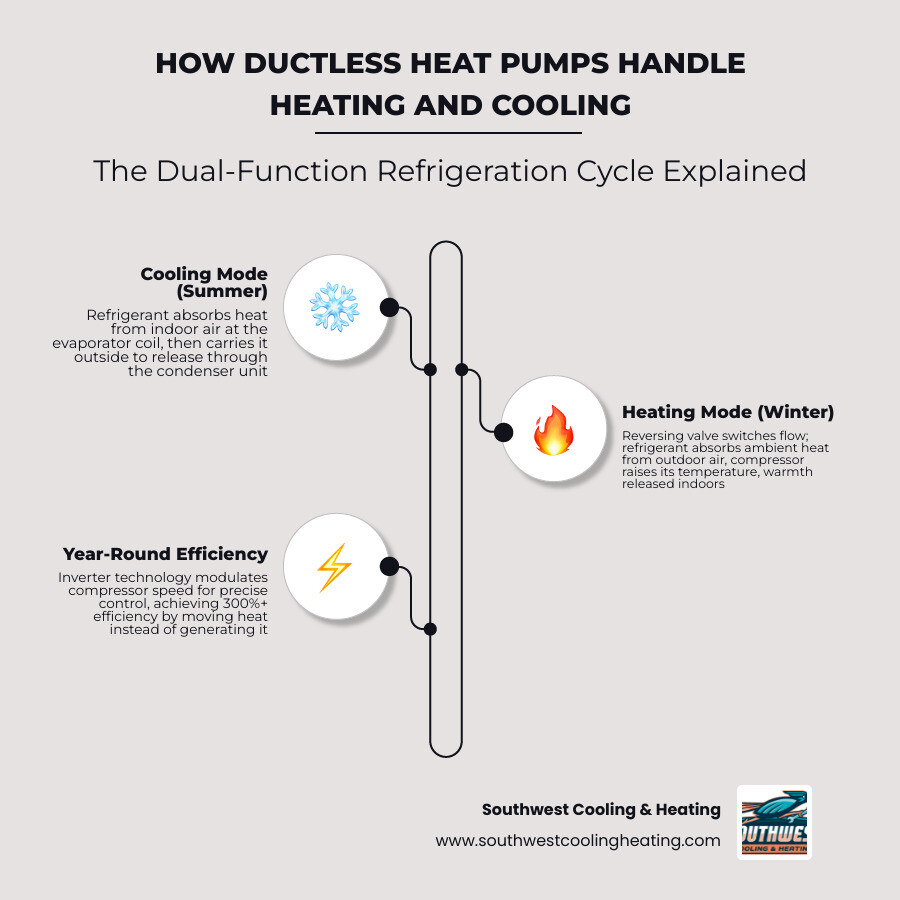
How ductless heat pumps handle heating and cooling comes down to one elegant process: moving heat rather than generating it. In summer, the system pulls heat out of your home and releases it outside. In winter, it reverses that flow — pulling heat from outdoor air and delivering it inside. No furnace. No ductwork. Just efficient, year-round comfort.
Here’s a quick overview of how it works in both modes:
| Season | What the System Does |
|---|---|
| Summer (Cooling) | Refrigerant absorbs indoor heat at the indoor coil, carries it outside, and releases it through the outdoor unit |
| Winter (Heating) | Refrigerant absorbs heat from outdoor air, compresses it to raise the temperature, then releases warmth indoors |
| Year-Round | Inverter technology adjusts compressor speed continuously to match your comfort needs without wasting energy |
For homeowners in St. George, Utah — where summer temperatures can punish and winter nights can surprise — this dual-function design is especially practical. A single compact system handles both seasons without the energy losses that come with traditional ducted setups. And because ductless systems can achieve efficiency ratings between 15.2 and 35 SEER2, they consistently outperform conventional alternatives.
I’m Bruce Hymas, owner of Southwest Cooling & Heating, and with over four decades of hands-on HVAC experience serving Southern Utah homes, I’ve seen how ductless heat pumps handle heating and cooling challenges that traditional systems simply can’t match. In this guide, I’ll walk you through exactly how these systems work — season by season — so you can make a confident, informed decision for your home.
Understanding the Mechanics: How Ductless Heat Pumps Handle Heating and Cooling
To understand how ductless heat pumps handle heating and cooling, we have to look at the science of thermodynamics. Many people assume that “cold” is its own force, but scientifically, cold is simply the absence of heat. A Heat Pump works by manipulating pressure to move that heat energy from one place to another using a specialized fluid called refrigerant.
Unlike a traditional furnace that burns gas or uses electric resistance to create heat, a ductless HVAC Ductless Heat Pump uses electricity only to power the compressor and fans that move the refrigerant. This is why they are so much more efficient — often over 300% efficient, meaning they deliver three units of heat for every one unit of electricity consumed.
The “secret sauce” in modern ductless systems is inverter technology. Traditional HVAC systems are like a light switch: they are either 100% on or 100% off. This leads to uncomfortable temperature swings and high energy bills. In contrast, an inverter-driven compressor acts more like a dimmer switch. It slows down or speeds up based on the exact needs of the room, maintaining a steady temperature while using up to 30% less energy than conventional forced-air systems.

The Cooling Cycle: Beating the St. George Summer Heat
When the July sun is beating down on Bloomington or Hidden Valley, your ductless system shifts into cooling mode. In this state, the indoor unit (the air handler) acts as an evaporator. A fan pulls warm air from your room across a cold evaporator coil filled with liquid refrigerant.
The refrigerant absorbs the heat from your indoor air, causing the liquid to evaporate into a gas. This chilled air is then blown back into your room. Meanwhile, the now-warm gaseous refrigerant is pumped through small copper lines to the outdoor unit. The outdoor compressor squeezes the gas, raising its temperature even higher, and then a fan blows outdoor air across the coils to release that heat into the environment.
This process also helps with dehumidification. As warm air hits the cold indoor coil, moisture condenses and is safely carried away through a condensate drain. This is vital for maintaining comfort during our occasional monsoon humidity. If you are looking for local expertise, Finding the Best Ductless Heat Pump Services Near St. George Without Breaking a Sweat can help you find the right professionals to ensure your cooling cycle is optimized for our desert climate.
The Heating Cycle: How Ductless Heat Pumps Handle Heating and Cooling in Winter
The real magic happens when the seasons change. In the winter, a component called a reversing valve changes the direction of the refrigerant flow. Now, the outdoor unit acts as the evaporator, and the indoor unit acts as the condenser.
Even when it feels “cold” outside in Winchester Hills or Diamond Valley, there is still heat energy in the air. The system makes the refrigerant extremely cold — colder than the outdoor air — so that it can absorb whatever heat is available. Once that heat is captured, the compressor pressurizes the refrigerant, which causes its temperature to spike. This intense heat is then carried indoors and released through the air handler to warm your home.
Because this process moves heat rather than creating it, ductless mini-splits use less than half the energy of electric resistance heat over a typical heating season. If you’re ready to switch, a professional Heat Pump Installation ensures the reversing valve and compression process are perfectly calibrated. Many residents find that a Ductless Heat Pump St. George Upgrade is the most cost-effective way to stay warm without the high costs of propane or older electric baseboards.
Key Components and System Types for Southern Utah Homes
A ductless system is relatively simple in its physical makeup, consisting of three main parts:
- The Outdoor Unit: Houses the compressor, condenser coil, and reversing valve.
- The Indoor Air Handler: Mounted inside the room to deliver conditioned air.
- The Conduit: A small bundle containing the power cable, refrigerant tubing, suction tubing, and a condensate drain. This only requires a three-inch hole in the wall to connect the two units.
Depending on your home’s layout, you’ll choose between a single-zone or a multi-zone setup.
| System Type | Best For | Max Indoor Units |
|---|---|---|
| Single-Zone | Sunrooms, garages, or single room additions | 1 |
| Multi-Zone | Entire homes or multiple rooms | Up to 8 |
Multi-Zone Flexibility for Larger Santa Clara and Bloomington Hills Residences
For larger homes in Santa Clara or Bloomington Hills, a multi-zone system is often the best choice. This allows you to connect multiple indoor air handlers to a single outdoor compressor. Each indoor unit has its own thermostat, allowing for true “zoned comfort.”
Imagine being able to keep your living room at a perfect 72 degrees while keeping an unoccupied guest room at 65 to save energy. This independence is a game-changer for families with different temperature preferences. You can learn more about these localized options by Discovering Ductless Heat Pump Solutions for Santa Clara Homes or checking out Who Are the Top Ductless Heat Pump Contractors in Bloomington Hills? for expert advice on multi-zone design.
Discreet Design Options for Modern Interiors
Gone are the days of bulky window units or industrial-looking vents. Modern ductless systems offer sleek, low-profile designs that blend into any decor.
- Wall-Mounted: The most common and cost-effective option, placed high on the wall for optimal air distribution.
- Ceiling Cassettes: These fit flush with the ceiling, with only a decorative grille showing.
- Floor-Standing Units: Ideal for rooms with limited wall space or where you want the air delivered at a lower level.
Finding Top Rated and Affordable Ductless Heat Pumps for Your Bloomington Hills Home is easier than ever with these versatile mounting options that respect your home’s aesthetic.
Why Homeowners are Switching: Efficiency and Performance
The primary reason we see homeowners in Coral Canyon and Ivins making the switch is the sheer efficiency. Ductless mini-splits use up to 60% less energy than standard home electric radiators. In an era where energy costs are a constant concern, these savings add up quickly.
When shopping, look for the SEER2 (Seasonal Energy Efficiency Ratio) and HSPF2 (Heating Seasonal Performance Factor) ratings. High-performance ductless systems can achieve SEER2 ratings up to 35, while traditional ducted heat pumps usually max out around 25. Choosing an Energy Star certified unit ensures you are getting the pinnacle of modern HVAC technology. For those in the market, reviewing Top Rated Ductless Heat Pumps for St. George Residents provides a great starting point, and it’s clear Why Bloomington Hills Homes Are Going Ductless This Season.
Performance in Cold Climates: How Ductless Heat Pumps Handle Heating and Cooling During Winter Snaps
A common myth is that heat pumps don’t work in the cold. While basic models can lose efficiency as temperatures drop below 35°F, high-performance “Hyper-Heat” systems are built for extremes. These units can maintain 100% heating capacity even when it’s 5°F outside and continue to operate down to -13°F.
During winter snaps in Ivins or Toquerville, the system will occasionally enter a “defrost cycle” to melt any frost buildup on the outdoor coils. This is a normal part of operation and ensures the unit remains efficient. For a deep dive into cold-weather reliability, see Ivins Top Picks for Ductless Heat Pump Services: A Comprehensive Guide.
Eliminating Energy Waste from Leaky Ducts
One of the biggest culprits of high energy bills isn’t the HVAC unit itself — it’s the ductwork. According to the Department of Energy, duct losses can account for more than 30% of energy consumption for space conditioning. When air travels through leaky, uninsulated ducts in an attic or crawlspace, you lose a massive amount of the heating or cooling you paid for.
Ductless systems eliminate this waste entirely by delivering air directly into the room. This “direct delivery” is why a ductless system can reduce energy consumption by up to 40% over a conventional system. Consult Your Local Experts: Finding the Best Ductless Heat Pump Specialists in Santa Clara to see how much you could save by cutting out the middleman (the ducts).
Professional Installation and Maintenance for Long-Term Reliability
Properly installing a ductless system requires more than just hanging a unit on the wall. We use the “Manual J” load calculation to determine the exact BTU needs of each room, taking into account insulation, window sizes, and sun exposure. An oversized unit will “short cycle,” turning on and off too quickly and failing to dehumidify, while an undersized unit will run constantly without reaching the set temperature.
The installation process is minimally invasive. We only need to drill a small 3-inch hole for the conduit. Most Mini-Split Installation projects can be completed in a single day. For those in Hurricane, checking out Affordable Expert Ductless Heat Pump Services in Hurricane, UT: A Local’s Guide can help you find the right team for the job.
Keeping Your System Efficient in Hurricane and La Verkin
Once installed, maintenance is simple but essential. Homeowners should clean the air filters every 1 to 3 months — it’s as easy as popping the cover, rinsing the plastic filters with soapy water, and letting them dry.
However, annual professional service is critical. We check refrigerant levels, inspect electrical connections, and deep-clean the coils to prevent bacterial growth and maintain efficiency. If you’re in the area, Ductless Heat Pumps in La Verkin, UT: How to Choose the Best Local Experts highlights why professional care is the key to a system that lasts 20 years or more.
Frequently Asked Questions about How Ductless Heat Pumps Handle Heating and Cooling
Are ductless systems quieter than traditional central HVAC?
Yes, significantly. Indoor air handlers typically operate between 20 and 30 decibels — which is the volume of a loud whisper. Outdoor units are also impressively quiet, often operating at 46 decibels, which is about the level of a normal conversation. You won’t have to deal with the “clunk” and “ping” of metal ducts expanding and contracting.
Can I use a ductless system for a garage or home addition?
Absolutely. This is one of the most popular uses for mini-splits. Instead of trying to extend your existing ductwork (which often overloads the main system), a ductless unit provides independent climate control for that specific space. It’s a perfect solution for workshops, man caves, or “she-sheds.”
Do ductless heat pumps improve indoor air quality?
They do. Because there are no ducts to collect dust, mold, and allergens, the air stays cleaner. Most ductless units feature multi-stage air purification and self-cleaning functions that prevent the growth of bacteria and mildew on the coils, providing a healthier environment for your family.
Conclusion
At Southwest Cooling & Heating, we’ve been the trusted choice for St. George HVAC services since 1980. We pride ourselves on combining modern technology with the “old-school” values of honesty, reliability, and expert craftsmanship. Whether you are in La Verkin, Hurricane, or downtown St. George, we are here to ensure your home stays comfortable regardless of what the Utah weather throws your way.
If you’re ready to experience the quiet efficiency of a HVAC Ductless Heat Pump, we’re ready to help. Our performance and satisfaction guarantees mean you can invest in your home’s comfort with total peace of mind. Give us a call today to see how we can master the seasons together.