


What You Need to Know About Emergency HVAC Services Before a Crisis Hits
When it comes to emergency HVAC services what to know, the most important thing is understanding which situations demand a call right now — and which ones can wait until morning.
Here’s a quick breakdown:
| Situation | Emergency? |
|---|---|
| Total system failure during extreme heat (90°F+) or cold (40°F or below) | Yes — call immediately |
| Burning smell, smoke, or electrical sparks from unit | Yes — shut off system and call now |
| Gas smell (rotten egg odor) near furnace | Yes — evacuate and call 911 first |
| Carbon monoxide alarm triggered | Yes — leave home immediately |
| Frozen coils with system shutdown | Yes — turn off AC, call for service |
| Uneven temperatures between rooms | No — schedule standard appointment |
| Minor airflow reduction | No — can wait for regular hours |
| Thermostat acting up but system still runs | No — routine service call |
| Slightly higher energy bills | No — schedule a maintenance visit |
Your HVAC system is one of the hardest-working systems in your home. And like most things that work hard, it tends to fail at the worst possible moment — a summer heat wave, a freezing winter night, or right before a holiday weekend. In fact, over 60% of HVAC emergencies happen during peak seasons, when systems are under the most stress.
The problem most homeowners face isn’t just the breakdown itself. It’s not knowing what to do next. Do you shut the system off? Call someone right away? Try a quick fix yourself? That uncertainty — especially at 2 AM — makes a stressful situation even worse.
This guide walks you through everything you need to know: how to spot a true HVAC emergency, what to do before the technician arrives, and how to protect your system so you’re less likely to face this situation in the first place.
I’m Bruce Hymas, owner of Southwest Cooling and Heating, and with over four decades of family history serving St. George homeowners, I’ve seen how the right knowledge about emergency HVAC services — what to know and when to act — can protect both your family and your equipment. My goal here is to give you the clear, honest information you need to make smart decisions under pressure.
Emergency HVAC Services: What to Know About Identifying a True Crisis

It is 10 PM on a sweltering July night in Hurricane, Utah. The indoor temperature is steadily climbing, and your air conditioner has stopped blowing cold air. Is this a minor inconvenience, or is it a full-blown emergency?
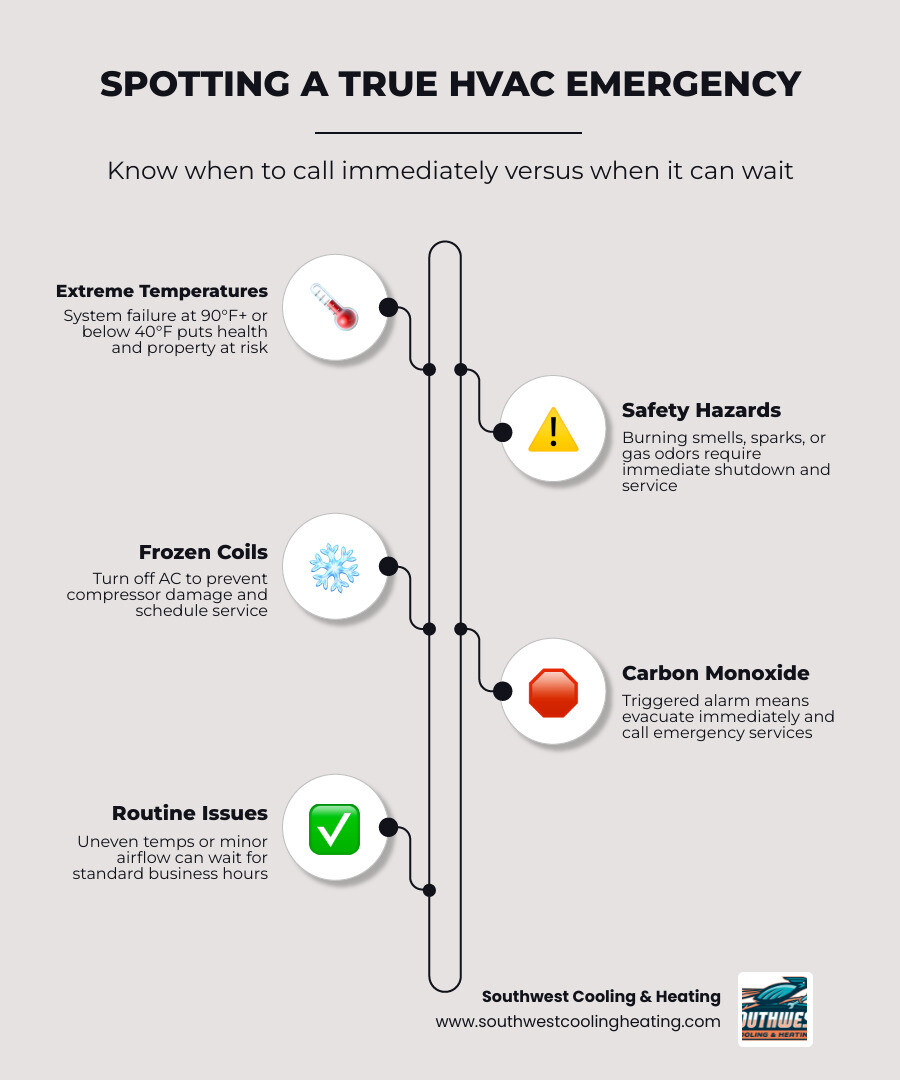
Understanding the difference is key to keeping your family safe and preventing unnecessary damage to your home. When we talk about emergency HVAC services what to know, we always start with the safety-first rule. A situation qualifies as a true emergency if it poses an immediate threat to your health, your safety, or your property.
There are several critical warning signs that require you to shut down your system immediately and call for professional help. To learn more about these warning signs, you can read our guide on Red Alerts and Cold Comforts: Signs Your HVAC Needs Help ASAP.
The most common emergency hazards include:
- Gas Leaks: If you smell rotten eggs near your furnace, this indicates a natural gas leak. Natural gas is highly combustible. You must evacuate your home immediately, call 911 or your gas provider from outside, and then contact us for an emergency safety inspection.
- Carbon Monoxide: Carbon monoxide is a colorless, odorless gas that can be lethal. If your carbon monoxide detector goes off, or if you notice soot buildup around your furnace vents, evacuate the house immediately and call emergency services.
- Electrical Hazards: If you see sparks, smell burning plastic or a sharp electrical odor, or if your system repeatedly trips the circuit breaker, shut the power off at the electrical panel immediately. Never attempt to reset a repeatedly tripped breaker, as this can cause an electrical fire.
- Frozen Evaporator Coils: If you notice ice building up on your indoor or outdoor unit, your system is suffering from restricted airflow or a refrigerant leak. Running a frozen system can cause total compressor failure, which is one of the most severe mechanical failures your system can experience.
Emergency HVAC Services: What to Know About True Emergencies vs. Routine Issues
When deciding whether to call for Emergency HVAC Services, we use a simple “90/40 rule” based on the extreme climate here in Southwest Utah.
If the outdoor temperature is above 90°F (which is a daily occurrence during summer in St. George, Santa Clara, and Ivins) or below 40°F (common during winter nights in Diamond Valley and Winchester Hills), a complete system failure is a true emergency. Without heating or cooling, indoor temperatures can quickly reach dangerous levels, putting vulnerable residents—such as infants, the elderly, or those with chronic medical conditions—at serious risk of heat stroke or hypothermia.
Furthermore, during deep winter freezes in Toquerville or La Verkin, a complete loss of heating can cause your water pipes to freeze and burst, leading to catastrophic water damage to your property.
Minor Issues That Can Wait for Standard Business Hours
Not every HVAC malfunction requires an immediate late-night service call. In fact, about 15% to 20% of emergency calls could easily be handled during regular business hours, saving homeowners from after-hours dispatch stress.
If your system is still running but exhibiting any of the following symptoms, we recommend scheduling standard HVAC Services during regular hours:
- Uneven Temperatures: If one bedroom is slightly warmer than the rest of the house, it is usually a minor ductwork or balancing issue, not a system-wide emergency.
- Minor Airflow Issues: Slightly reduced airflow often points to a dirty filter or a blower fan that needs cleaning, which can wait for a scheduled appointment.
- Thermostat Calibration Problems: If your thermostat is off by a couple of degrees but the system still cycles on and off, it is a routine maintenance issue.
- Unusual but Non-Disruptive Noises: A slight rattle or hum while the system is operating is worth addressing, but it does not require a midnight dispatch unless it turns into loud clanging, screeching, or grinding.
Your Immediate Action Plan When Your HVAC Quits
When your heating or cooling system suddenly stops working, don’t panic. Taking a few systematic steps can help you stay safe, protect your equipment, and potentially resolve the issue without needing a service call.
We always recommend following a quick troubleshooting checklist before calling for emergency help. In fact, about 40% of HVAC emergencies actually trace back to simple thermostat malfunctions or power issues rather than mechanical failures.
To help you navigate this stressful situation, we have put together Don’t Sweat It: Your Immediate HVAC Breakdown Action Plan. Here are the immediate steps you should take:
- Check the Thermostat: Ensure the thermostat is set to the correct mode (“Cool” for summer, “Heat” for winter) and that the temperature setting is active. If the screen is blank, replace the batteries. A dead battery or a loose wire can make your entire system appear completely dead.
- Inspect the Air Filter: A severely clogged air filter restricts airflow, which can cause your air conditioner’s coils to freeze or your furnace to overheat and shut down via its safety limit switch. If the filter is dirty, replace it immediately.
- Check the Circuit Breaker: Go to your electrical panel and look for the breaker labeled for your HVAC system. If it has tripped, reset it once. If it trips again immediately, do not reset it a second time. This indicates a serious electrical short or a failing component, and continuing to reset it poses a severe fire risk.
- Verify the Furnace Switch: Many homeowners accidentally flip the furnace power switch (which looks like a standard light switch near the indoor unit) to the “Off” position while retrieving items from a closet or attic. Make sure this switch is turned “On.”
- Clear Debris: Walk outside and ensure your outdoor condenser unit is clear of weeds, leaves, and debris. Restricted airflow around the outdoor coil can cause the system to overheat and shut down.
Temporary Comfort Measures While Waiting for a Technician
If your system is truly broken and you are waiting for our technician to arrive at your home in Bloomington, Bloomington Hills, or Hidden Valley, your priority should be keeping your family comfortable and safe.
We recommend reading The Ultimate Survival Guide for When Your HVAC Quits for comprehensive coping strategies. In the meantime, here are some quick temporary measures you can use:
- In Extreme Heat: Close all blinds, drapes, and window coverings to block out the intense Southern Utah sun. Keep your family hydrated, limit physical activity, and use portable fans to create a breeze. If indoor temperatures climb past safe levels, consider spending a few hours at a local air-conditioned library, mall, or community center.
- In Extreme Cold: Keep the heat inside by sealing drafts around doors and windows with towels. Gather your family into a single central room to preserve body heat, and wear layers of warm clothing. If you use portable space heaters, ensure they are kept at least three feet away from combustible materials and are never left unattended.
What to Expect During an Emergency Service Call
When you call us for emergency service, you aren’t just getting a quick patch-up; you are getting a dedicated, professional process designed to restore safety and comfort to your home as fast as possible.
To help demystify the process, we have outlined exactly what happens behind the scenes in our guide, What to Expect When Your AC Expects the Unexpected.
Here is the step-by-step process of our professional service call:
- Rapid Dispatch: Our live dispatch team triages calls based on severity, ensuring that vulnerable residents in extreme weather receive immediate priority. We will provide you with a clear arrival window.
- Initial Assessment and Safety Check: Upon arrival, our technician’s first priority is safety. We perform a comprehensive check for gas leaks, carbon monoxide, and electrical hazards before touching your equipment.
- Diagnostic Process: Using advanced diagnostic tools—including digital manifold gauges and thermal imaging cameras—our technician will inspect your system’s electrical connections, refrigerant levels, capacitors, and thermostat calibration. This diagnostic examination typically takes 45 to 60 minutes.
- Transparent Explanation: Once we identify the root cause, our technician will explain the diagnosis clearly, outline your repair options, and answer any questions you have.
- Repair or Temporary Stabilization: If we have the necessary parts on our service vehicle, we will perform the repair immediately. If a specialized part must be ordered, we will perform a temporary stabilization to ensure your home remains safe until the permanent fix can be completed.
- Final Testing and Quality Assurance: After completing the repair, we perform a full system test, measuring temperature differentials, airflow rates, and electrical consumption to ensure your system is operating safely and efficiently.
Emergency HVAC Services: What to Know About Response Times and Repair Timelines
We know that every minute counts when your home’s climate control fails. That is why we maintain a highly responsive dispatch system.
Our technicians drive fully stocked service vehicles carrying over 200 different parts and components. This extensive mobile inventory allows us to complete the vast majority of repairs on our very first visit.
The duration of your repair depends heavily on the specific component that failed:
- Capacitor Replacement: 30 to 45 minutes. Capacitors are the most common failure point in modern AC systems due to the intense start-stop cycles during hot weather.
- Thermostat Replacement: 45 to 60 minutes.
- Refrigerant Recharge: 1 to 2 hours (including leak detection).
- Blower Motor Replacement: 2 to 4 hours.
- Evaporator Coil Thawing: 3 to 24 hours. If your system is frozen solid, we must turn the cooling off and run the fan to allow the ice to melt completely before we can diagnose or repair the underlying issue.
Preventing Future Breakdowns with Proactive Maintenance
The absolute best way to handle an HVAC emergency is to prevent it from happening in the first place. Studies show that regular professional maintenance can reduce emergency breakdowns by about 95%.
When you invest in routine tune-ups, you are 50% less likely to experience a sudden system failure during peak seasons.
| System Aspect | Well-Maintained System | Neglected System |
|---|---|---|
| Average Lifespan | 15 to 20 years | 8 to 10 years |
| Operating Efficiency | 15% to 20% more efficient | Rapidly declining efficiency |
| Emergency Breakdown Risk | Extremely low (95% reduction) | High, especially during peak seasons |
| Indoor Air Quality | Excellent (clean filters and coils) | Poor (dust, allergen, and mold buildup) |
| Safety Risks | Negligible (regular safety checks) | Elevated (unnoticed electrical/gas issues) |
During a seasonal tune-up, our technicians perform critical preventive tasks that keep your system running smoothly. We clean the condenser coils, check electrical connections for tightness, test safety controls, lubricate moving parts, and measure refrigerant levels.
This proactive care allows us to catch small, inexpensive issues—like a slightly worn belt or a weakening capacitor—before they put stress on major components and turn into expensive midnight disasters.
Frequently Asked Questions about Emergency HVAC Services
What temperature is considered an HVAC emergency?
Generally, we consider any indoor temperature above 90°F in the summer or below 40°F in the winter to be a true emergency threshold.
However, these thresholds are much tighter if you have vulnerable residents in your home, such as infants, elderly family members, or individuals with medical conditions that affect their body temperature regulation. In those cases, any loss of heating or cooling during extreme weather is an immediate emergency.
Can I run my AC if the coils are frozen?
No. If you see ice on your indoor or outdoor unit, you must turn the air conditioner off immediately. You can, however, set your thermostat’s fan setting to “On” (not “Auto”). This keeps the blower running to help melt the ice without running the compressor.
Running an air conditioner with frozen coils can cause liquid refrigerant to flood back into the compressor, causing permanent mechanical failure.
How does emergency service differ from standard repair?
Standard repairs are scheduled appointments during normal business hours for non-critical issues, such as uneven cooling or minor system noises.
Emergency service is a reactive, high-priority dispatch system available 24/7. When you call for emergency service, we triage your call based on safety and health risks, sending a technician to your home as quickly as possible to restore essential heating or cooling.
Conclusion
Facing an HVAC breakdown is stressful, but knowing what to expect can help you handle the situation with confidence. By understanding what qualifies as a true emergency, taking immediate safety steps, and keeping your system well-maintained, you can protect your home, your family, and your peace of mind.
Since 1980, Southwest Cooling & Heating has provided reliable, high-quality HVAC services to homeowners in St. George, Santa Clara, Bloomington Hills, Bloomington, Hidden Valley, Coral Canyon, Diamond Valley, Winchester Hills, Hurricane, Ivins, Toquerville, and La Verkin. We combine modern technical expertise with old-school values, backed by strong performance and satisfaction guarantees.
If you are experiencing a heating or cooling crisis right now, do not wait in discomfort. Contact us immediately for prompt, professional Emergency HVAC Services, and let our family take care of yours.