


Why Getting the Right Size HVAC for Southern Utah Homes Is More Complex Than You Think
Getting the right size HVAC for Southern Utah homes is not as simple as matching a unit to your square footage — and choosing wrong can mean years of high power bills, uneven comfort, and equipment that wears out too soon. Here is a quick answer to help you understand what sizing actually involves in this climate:
How to get the right HVAC size for a Southern Utah home:
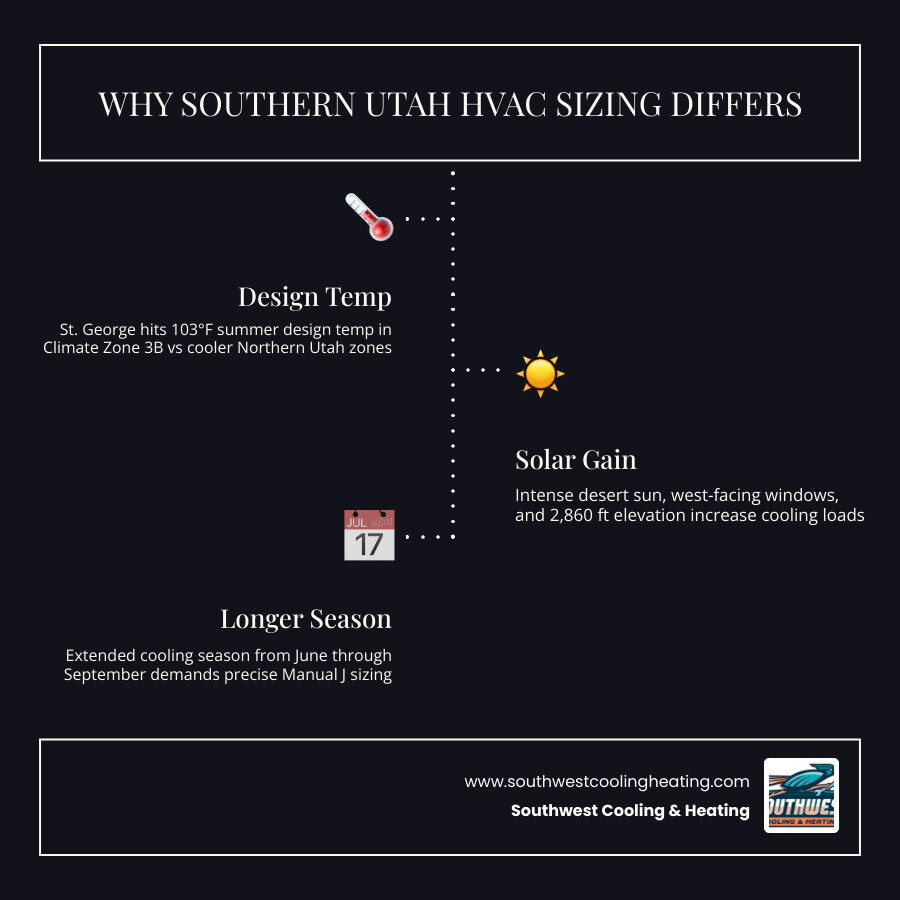
- Start with climate, not square footage. St. George sits in Climate Zone 3B with a 1% summer design temperature of 103°F — far more demanding than Salt Lake City or Park City.
- Account for solar gain. West-facing rooms, vaulted ceilings, and large windows all add cooling load beyond what square footage alone captures.
- Get a Manual J load calculation. This room-by-room analysis is the only reliable way to determine the correct tonnage for your specific home.
- Avoid oversizing. A unit that is too large will short-cycle, leaving rooms uncomfortable and driving up energy costs.
- Factor in your home’s age and efficiency. Tighter, well-insulated homes often need less capacity than homeowners expect.
Southern Utah is one of the most demanding HVAC environments in the state. Temperatures in St. George regularly climb past 105°F from June through September, and the intense desert sun loads your home with heat in ways that a simple square-footage estimate will never catch. Whether you just moved here from California or Nevada, or you have lived in the area for years and are replacing an aging system, the stakes for getting sizing right are real — your comfort, your energy bills, and the lifespan of your equipment all depend on it.
I’m Bruce Hymas, owner of Southwest Cooling and Heating, and I’ve spent my career serving Southern Utah homeowners who face exactly these challenges — getting the right size HVAC for Southern Utah homes is one of the most common and consequential decisions I help families navigate. In this guide, I’ll walk you through everything that actually drives sizing in our desert climate, so you can make a confident, informed decision.
What Makes Getting the Right Size HVAC for Southern Utah Homes Different?
When people think of Utah, they often think of snow-capped mountains and the “Greatest Snow on Earth.” But for those of us in Santa Clara, Ivins, or Hurricane, the reality is much different. Utah spans several climate zones, ranging from Zone 6B in high-altitude Park City to Zone 3B here in St. George. This geographic diversity means that an HVAC system sized for a home on the Wasatch Front will likely fail miserably when faced with a 107°F July afternoon in Bloomington.
The primary difference lies in the design temperature. In Northern Utah (Zone 5B), systems are often sized with a focus on heavy heating loads. In Southern Utah, our cooling season is significantly longer and more intense. We aren’t just fighting the air temperature; we are fighting the intense solar radiation of the high desert and an elevation of approximately 2,860 feet, which actually changes how your equipment performs.
| Factor | St. George (Zone 3B) | Wasatch Front (Zone 5B) |
|---|---|---|
| Summer Design Temp (1%) | 103°F – 105°F | 95°F – 97°F |
| Elevation | ~2,860 ft | ~4,200 – 4,500 ft |
| Primary Demand | High-Efficiency Cooling | Heavy Heating / Moderate Cooling |
| Humidity | Very Low (Dry Heat) | Low to Moderate |
Why getting the right size HVAC for Southern Utah homes starts with climate, not square footage
The old “rule of thumb” that says you need one ton of AC for every 500 or 600 square feet is arguably the worst rule still in use in the industry. Square footage is only one input variable among more than 20 that we consider in a professional load calculation. If you rely solely on square footage, you ignore the home’s layout, air leakage rates, and insulation quality.
A 2,000-square-foot home built in the 1970s in downtown St. George has a vastly different “heat appetite” than a 2,000-square-foot modern ENERGY STAR home in Washington or Toquerville. The older home might have infiltration rates of 10-15 air changes per hour (ACH), while the new home might be as tight as 3 ACH. Using the same square-footage rule for both would result in one being miserably hot and the other being wastefully oversized.
How St. George’s desert heat changes cooling load and equipment selection
In Southern Utah, our air conditioners aren’t just a luxury; they are survival equipment. Because our summers regularly climb past 105°F, the cooling load is relentless. This desert environment is arguably why the Southern Utah desert is your HVAC system’s toughest opponent.
Low humidity is a double-edged sword. While it makes the heat feel more bearable to humans, it means the air doesn’t hold onto coolness well. As soon as the sun hits a window, the temperature inside can spike. We often recommend high-efficiency systems with a SEER2 rating of 14.3 or higher. Furthermore, many homeowners are discovering that modern heat pumps are an incredible fit for our climate. Because our winters are relatively mild compared to the rest of the state, heat pumps can provide highly efficient heating without the need for a massive furnace, while still delivering the high-performance cooling required for our summers.
Why moving from California, Nevada, or Northern Utah can throw off your HVAC expectations
We see many new residents relocating to Coral Canyon or Winchester Hills from places like Southern California or the Salt Lake Valley. If you’re coming from a coastal climate, you might be used to an AC unit that only runs for a few hours in the afternoon. In St. George, your system might need to run for 12 to 15 hours a day during a heatwave.
Relocating homeowners are often shocked by their first summer utility bill. They may also notice that their second-story rooms feel like a sauna compared to the downstairs, a common issue in desert homes with vaulted ceilings or insufficient zoning. Preparing your expectations means understanding that the desert sun is a physical weight on your roof and walls. Proper filter maintenance and smart thermostat habits become essential survival skills here, not just suggestions.
Why Oversizing Is One of the Biggest HVAC Mistakes in Southern Utah
It is a common human instinct to think that “bigger is better.” If a 3-ton unit keeps the house cool, a 4-ton unit must do it faster and better, right? In HVAC, that logic is actually dangerous. Oversized AC in St. George is one of the most frequent causes of premature system failure and homeowner dissatisfaction.
Bigger is not better: what an oversized AC actually does in a St. George home
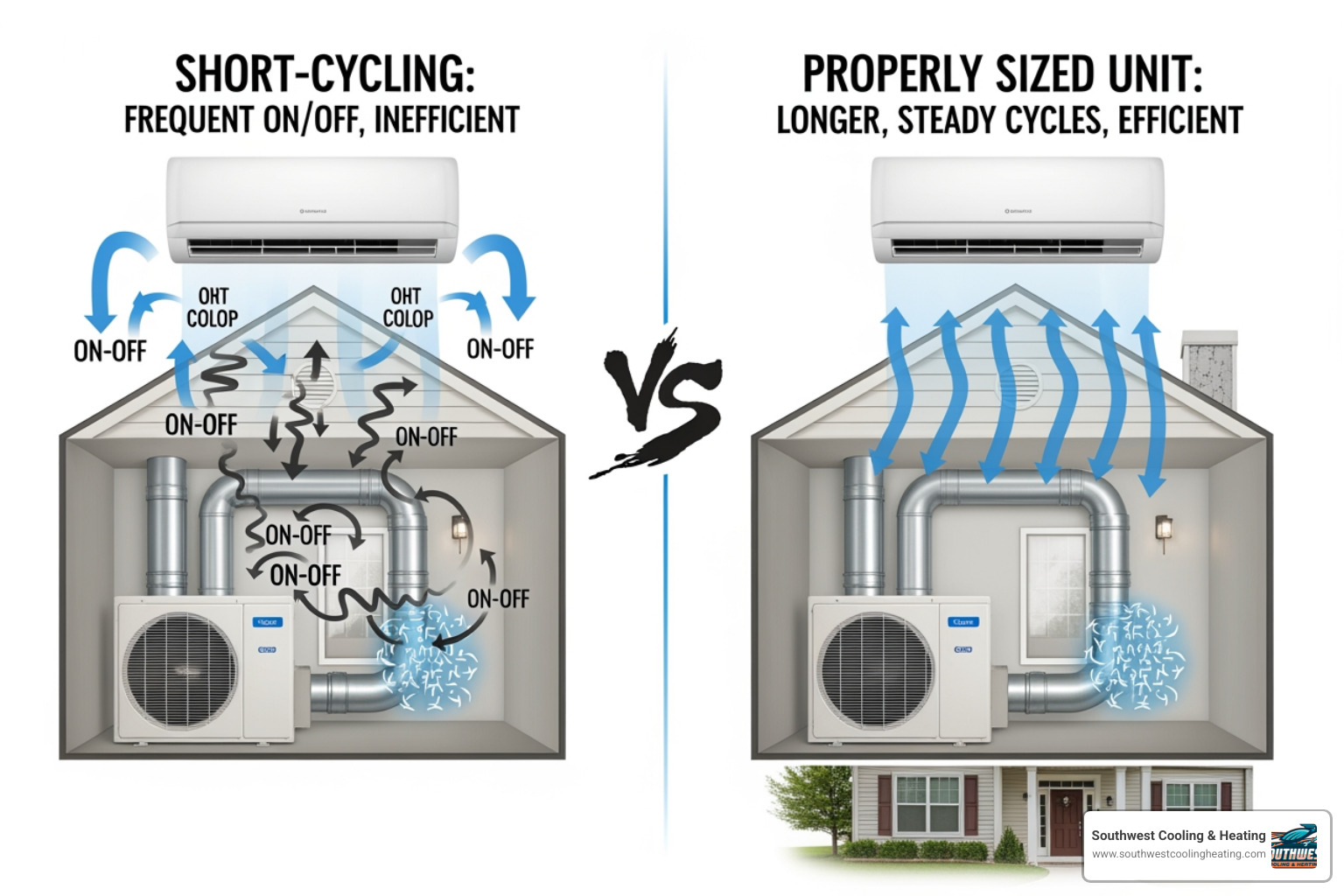
When an air conditioner is too large for the space it serves, it engages in what we call “short-cycling.” The unit turns on, blasts the house with frigid air, reaches the thermostat setting in five minutes, and shuts off. This sounds efficient, but it’s the opposite.
Most of the wear and tear on a compressor happens during the startup phase. An oversized unit might start up 20 times a day, whereas a properly sized unit might start up 5 times and run for longer, steadier intervals. Short-cycling also prevents the system from ever reaching its peak operating efficiency, leading to higher power bills. Furthermore, even though our air is dry, an AC unit still needs to run long enough to balance the temperature throughout the home; short bursts of air leave “hot spots” in corners and near windows.
The hidden comfort problem: why one big system can leave upstairs rooms too hot
In many two-story homes in areas like Bloomington Hills or Hidden Valley, builders often installed a single, large HVAC system to cover both floors. The logic was that a 5-ton unit has enough “muscle” to push air everywhere. The reality is that heat rises, and the cool air from a single system often dumps into the downstairs, leaving the upstairs lofts and bedrooms struggling.
An oversized system makes this worse because it satisfies the downstairs thermostat so quickly that it never has time to push enough cool air to the upper floor. The solution isn’t a bigger unit; it’s often a zoned system or even a ductless mini-split for the upstairs. These solutions allow for directed cooling where it’s actually needed, rather than trying to brute-force the entire house with one oversized “hammer.”
When replacing old equipment, why you should not copy the existing tonnage
One of the most important things to remember when correct system sizing matters for your home is that your home is not the same structure it was 20 years ago. Perhaps you’ve upgraded to dual-pane low-E windows, added blown-in attic insulation, or sealed up leaky ducts.
If your home has become more energy-efficient, the 4-ton unit that was “just right” in 2005 might be drastically oversized for the home in 2026. Replacing “like for like” without a new load calculation is a missed opportunity to downsize to a more efficient, quieter, and more comfortable system that matches the modern state of your home’s envelope.
The Home Factors That Really Determine the Right HVAC Size
To get the sizing right, we look at the home as a complete system. We aren’t just measuring floor space; we are measuring the “thermal envelope.”
Beyond square footage: the factors that change tonnage the most
There are several “tonnage drivers” that can swing a calculation by an entire ton or more:
- Window Orientation: A home with massive west-facing windows in the great room will require significantly more cooling than an identical home with north-facing glass.
- Air Infiltration: Leaky older homes in La Verkin or downtown St. George allow hot desert air to seep in through outlets, baseboards, and can lights.
- Internal Heat Gains: Do you have a “chef’s kitchen” that gets used daily? High-end appliances and frequent cooking add BTUs that the AC must remove.
- Ductwork Location: If your ducts are running through a 140°F attic without proper insulation, you’re losing a massive percentage of your cooling before it ever reaches your vents.
How elevation, sun exposure, vaulted ceilings, and insulation affect sizing
Elevation is a factor many overlook. At our elevation of nearly 3,000 feet, the air is less dense than at sea level. This means the air can’t carry as much heat, which effectively derates the capacity of the equipment. A unit rated for 36,000 BTUs at sea level might only deliver 34,000 BTUs in Diamond Valley.
Vaulted ceilings also add a unique challenge. For every foot above a standard 8-foot ceiling, you generally need to add about 10% more cooling capacity for that room. A room with 12-foot ceilings has 50% more air volume to cool than a standard room, even if the square footage is identical.
Why newer efficient homes often need smaller systems than homeowners expect
We often work with homeowners in new developments in Ivins or Santa Clara who are surprised when we recommend a 3-ton unit for a house where they expected a 4-ton. Modern building codes and ENERGY STAR standards have made homes incredibly tight. With high-performance insulation and advanced window coatings, the heat from the desert sun simply doesn’t penetrate the home as fast. In these cases, a smaller, more efficient system that runs longer cycles is the gold standard for comfort.
How a Manual J Load Calculation Prevents Guesswork
The only way to move from “guessing” to “knowing” is through an ACCA Manual J load calculation. This is the industry-standard method for determining exactly how much heat a building gains in the summer and loses in the winter.
What a real Manual J includes for getting the right size HVAC for Southern Utah homes
A proper Manual J isn’t something that can be done in two minutes on a napkin. It involves:
- Measuring every wall, ceiling, and floor.
- Identifying the R-value of all insulation.
- Checking the U-value and Solar Heat Gain Coefficient (SHGC) of the windows.
- Accounting for the home’s orientation (which way does the front door face?).
- Factoring in the number of occupants and even the type of lighting used.
Once we have the Manual J “load,” we use Manual S to select equipment that matches that load and Manual D to ensure the ductwork can actually handle the airflow the equipment requires.
Why online calculators and rules of thumb miss Southern Utah homes
If you use an online calculator, it might ask for your zip code and square footage. But it doesn’t know that you have a 15-foot vaulted ceiling in your living room or that your neighbor’s house shades your west wall in the afternoon. Rules of thumb like “one ton per 500 square feet” are dangerous because they are usually designed to “fail safe”—meaning they almost always result in an oversized unit just to make sure the contractor doesn’t get a “hot call” in July. But as we’ve discussed, that “safety” comes at a high cost to your equipment’s health and your wallet.
Why duct design matters almost as much as equipment size
You can have the most perfectly sized, high-tech AC unit in the world, but if your ducts are too small or poorly laid out, you will never be comfortable. Ductwork must be sized to handle the “static pressure” of the system. In Southern Utah, we often find that “hot rooms” aren’t a result of a small AC, but rather a result of a “choked” duct that isn’t allowing enough air to reach that specific space.
Real Summer Bill Patterns, Filter Maintenance, and Daily Performance
Understanding how a properly sized system behaves in the St. George heat can help you manage your expectations and your budget.
What real St. George summer power bills reflect about HVAC sizing and run time
In the peak of summer, a properly sized system should run for long periods. If it’s 108°F outside and your AC is turning off every 10 minutes, it’s likely oversized. A correctly sized unit is designed to run almost continuously during the hottest part of the day to maintain a steady temperature. This is actually more efficient than the “stop and start” alternative.
The $12 filter hack: how clean filters can help lower summer energy use
One of the simplest ways to support your HVAC system is the “filter hack.” In our dusty desert environment, filters clog quickly. A dirty filter acts like a wall, forcing your blower motor to work twice as hard to pull air through. This restriction can reduce system efficiency by up to 20%. Changing a simple $12 pleated filter every 1 to 3 months (or even monthly during the monsoon dust season) is the best return on investment you can get for your home comfort.
Simple habits that support a properly sized system in extreme desert heat
To help your system keep up when the mercury hits triple digits:
- Set it to 78°F: Every degree you lower the thermostat can increase your energy use by 6-8%.
- Manage the Shade: Keep west-facing blinds closed from 2:00 PM until sunset.
- Seal the Leaks: Use weatherstripping on doors leading to the garage or patio.
- Clear the Area: Ensure your outdoor condenser unit has at least two feet of clearance from bushes or storage items so it can “breathe.”
- Schedule Tune-ups: A clean coil transfers heat much more effectively than one covered in desert caliche and dust.
Frequently Asked Questions About Getting the Right Size HVAC for Southern Utah Homes
Is 3 tons enough for a 2,000-square-foot home in St. George?
It depends entirely on the home’s age and construction. In a brand-new, tightly sealed home with great insulation, 3 tons might be perfect. In a 1985 ranch-style home with original windows and vaulted ceilings, you might need 3.5 or 4 tons. This is exactly why we perform a Manual J instead of guessing.
Do I need zoning if my upstairs is always hotter than downstairs?
If you have a significant temperature imbalance, zoning is often the best answer. Zoning uses motorized dampers in your ducts to direct air specifically to the upstairs when it gets too warm, rather than over-cooling the downstairs just to make the bedrooms tolerable.
Is a heat pump a good fit for Southern Utah homes?
Absolutely. In fact, heat pumps love Southern Utah because our winters rarely stay below freezing for long. Modern heat pumps provide incredibly efficient cooling in the summer and can handle our winters with ease, often providing a more consistent and comfortable heat than a traditional gas furnace.
Conclusion
Getting the right size HVAC for your home is the foundation of your comfort in the desert. A system that is correctly matched to your home’s unique thermal needs will provide better airflow, lower energy waste, and a much longer lifespan. At Southwest Cooling & Heating, we’ve been helping our neighbors in Santa Clara, Bloomington, and throughout the St. George area since 1980. We don’t believe in rules of thumb; we believe in doing the math to make sure you get exactly what you need.
If you are wondering will a new HVAC system actually save you money, or if you are trying to decide if you should repair or replace your HVAC system, we are here to help. Explore our HVAC services today and let’s make sure your home is ready for the next Southern Utah summer.