


Is a Ductless Heat Pump Worth It in the Desert? Here’s the Short Answer
Is a ductless heat pump worth it in the desert — and for most St. George homeowners, the answer is yes. Here’s a quick breakdown:
| Your Situation | Worth It? |
|---|---|
| Home without existing ductwork | Yes — strong fit |
| Room addition, casita, or garage | Yes — ideal application |
| Want zone-by-zone temperature control | Yes — built for this |
| Whole-home replacement in a large home | Depends — needs proper sizing |
| Home with well-insulated existing ducts | Maybe — central upgrade may compete |
| Concerned about desert dust and maintenance | Yes, with monthly filter cleaning |
If you’re a St. George homeowner trying to stay cool when temperatures push past 110°F without watching your energy bill climb, you already know the stakes. Southern Utah’s desert climate is relentless — long, scorching summers, fine red dust that gets into everything, and the kind of dry heat that tests any HVAC system. At the same time, energy efficiency matters more than ever, and older ducted systems quietly lose 20% to 30% of conditioned air through leaky ductwork before it ever reaches a single room. Ductless heat pumps promise to solve several of these problems at once — but do they actually deliver in an arid climate like ours?
I’m Bruce Hymas, owner of Southwest Cooling & Heating, and with over four decades of family HVAC experience serving the St. George area, I’ve seen what systems hold up — and which ones struggle — when the desert turns up the heat. Understanding is a ductless heat pump worth it in the desert is something I get asked constantly, and this guide gives you a straight, honest answer based on real-world performance in our climate.
Understanding the Technology: Is a Ductless Heat Pump Worth It in the Desert?
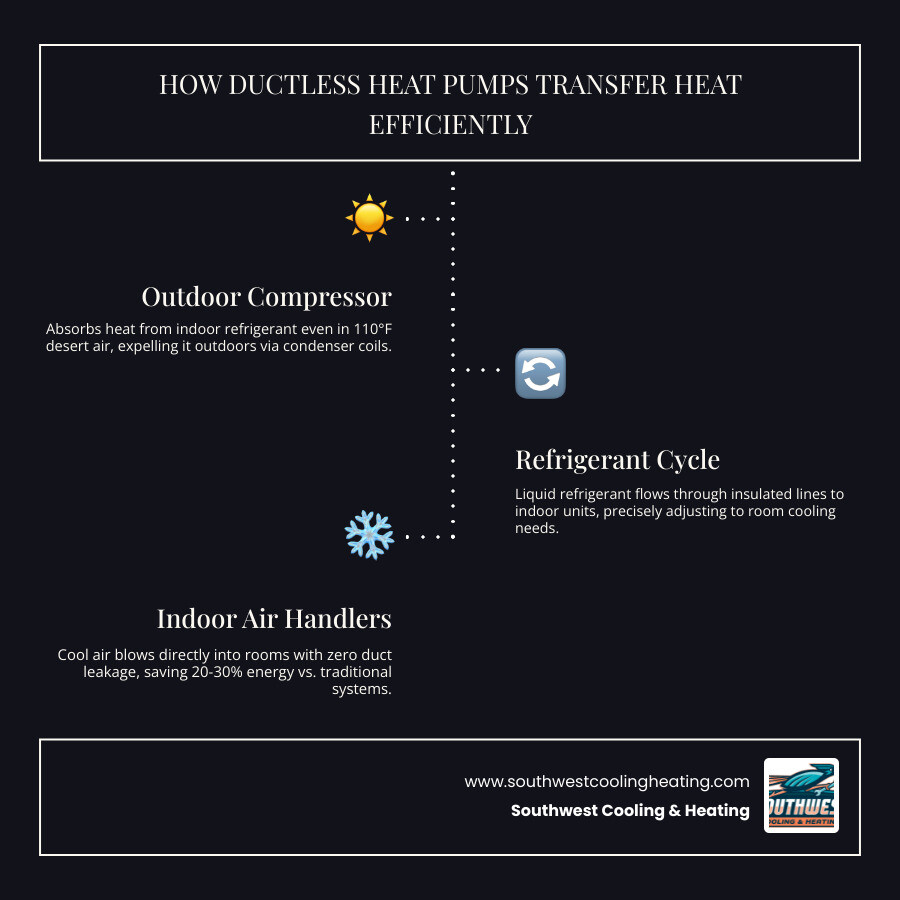
To understand if this system is right for your home in Hurricane or Ivins, we first need to look at how it differs from the big central unit you’re likely used to. A ductless heat pump, often called a “mini-split,” consists of two main parts: an outdoor compressor/condenser and one or more indoor air-handling units. These are connected by a small conduit housing the power cable, refrigerant tubing, and a condensate drain.
The “magic” happens through inverter-driven technology. While traditional systems are either “all on” or “all off,” an inverter-driven compressor acts more like a dimmer switch. It ramps up or down to meet the exact cooling demand of the room. This precision is vital in our climate because it prevents the massive energy surges that happen every time a standard AC kicks on during a 110°F afternoon.
When we provide HVAC Ductless Heat Pump Services, we focus on this efficiency. Because there are no ducts, you aren’t paying to cool the air that leaks into your attic or crawlspace. If you’re curious about the broader category of these systems, our Heat Pump Services page explains how they move heat rather than creating it, which is the secret to their high efficiency.
Performance During Extreme Summer Heat
One of the biggest myths we hear in Santa Clara and La Verkin is that heat pumps “give up” once it gets too hot. While that might have been true in the 1990s, modern technology has changed the game. Quality ductless heat pumps are now designed to maintain full cooling capacity even when outdoor temperatures hit 115°F to 125°F.
In the desert, thermal stress is real. Your HVAC system has to fight the sun hitting your roof and walls all day. Ductless systems excel here because they provide “point-of-use” cooling. Instead of one giant fan trying to push air through 50 feet of hot ductwork, the indoor unit is right there in the room, delivering cold air directly to you. This makes it the Best Way to Cool Your Southern Utah Home This Summer, especially in sun-drenched rooms that your central AC always seems to struggle with.
Efficiency and Heating in Mild Desert Winters
We all know St. George winters aren’t exactly the Arctic, but those 35°F mornings in Winchester Hills can feel pretty crisp! This is where the ductless heat pump really shines. Modern heat pumps can deliver up to three times more heating energy than the electricity they consume. Compare that to a traditional gas furnace, which is usually only about 80% to 95% efficient.
Because our desert winters are relatively mild and rarely stay below freezing for long, a heat pump is in its “sweet spot.” It extracts the ambient heat from the outside air (yes, even 40°F air has heat in it!) and moves it indoors. For more details on how this works specifically for our local area, check out The Ivins Heat Pump Handbook. You’ll find that for year-round comfort, the efficiency gains in winter often rival the savings you see in summer.
Key Advantages for Arid Environments

The primary reason is a ductless heat pump worth it in the desert comes down to one word: ducts. Or rather, the lack of them. In a typical home in Bloomington or Hidden Valley, the ductwork is located in the attic. During a July afternoon, your attic can easily reach 140°F. Even with insulation, those ducts are sitting in an oven.
Research shows that duct systems lose 20% to 30% of air due to leaks, holes, and poor connections. In a desert climate, that’s like leaving a window wide open while the AC is running. Ductless systems eliminate this 20-30% energy loss entirely. This is a major reason Why Desert Homeowners Are Switching to Ductless Systems; you are essentially recovering a third of your energy budget just by removing the “middleman” (the ducts).
Then there’s zoned comfort. We’ve all had the “thermostat wars” where one person is freezing in the living room while another is sweating in the bedroom. With a ductless system, each room has its own controller. You can keep the guest room at 78°F while your master suite stays a crisp 70°F.
Why a ductless heat pump is worth it in the desert for air quality
If you live in Toquerville or Diamond Valley, you know the “Red Dust” struggle. It gets everywhere. In a traditional central system, dust often accumulates inside the ductwork, where it can grow mold or simply get blown back into your living space every time the fan starts.
Ductless mini-splits offer a cleaner alternative. Each indoor unit has its own multi-stage filtration system. Because there are no ducts to trap and recirculate allergens, the air quality is often significantly higher. These units are excellent at trapping fine desert dust and pollen before it reaches your lungs. When we perform Mini-Split Installation Services, we often see homeowners with allergies notice an immediate difference in their indoor environment.
Potential Drawbacks and Maintenance in Dusty Conditions
We believe in being 100% honest with our neighbors. While ductless systems are fantastic, they aren’t perfect for every single scenario.
| Feature | Ductless Mini-Split | Central HVAC |
|---|---|---|
| Maintenance | Monthly filter cleaning (DIY) | Filter change every 1-3 months |
| Aesthetics | Visible wall/ceiling units | Hidden vents |
| Installation | Minimal (3-inch hole) | Extensive (if adding ducts) |
| Lifespan | 15–20 years | 12–15 years |
| Dust Impact | High (requires frequent cleaning) | Moderate (ducts hide dust) |
The biggest “con” in the desert is the dust itself. Because the indoor units are smaller and more compact, their filters can clog quickly during a windy Southern Utah spring. You must be diligent about cleaning the reusable filters every few weeks. If you don’t, the airflow drops, and the system has to work twice as hard.
UV exposure is another factor. The outdoor units in St. George are hit by 300+ days of intense sunlight. At Southwest Cooling & Heating, we ensure outdoor units are placed in areas with proper airflow but protected from the worst of the direct afternoon sun when possible. We also use UV-resistant materials for the line set covers to prevent the desert sun from “cooking” your refrigerant lines.
Determining if a ductless heat pump is worth it in the desert for your home layout
The “worth it” factor often depends on what your house looks like. If you have a 4,000-square-foot home in Coral Canyon with perfectly good, insulated ducts, a full ductless conversion might be a significant undertaking. However, if you are building a casita, converting a garage into a workshop, or adding a sunroom, ductless is almost always the winner.
It’s also a lifesaver for older homes in places like downtown St. George that were built without central air. Instead of tearing out walls to install bulky ducts, we can simply mount a sleek unit on the wall. If you’re debating between the two, read our guide: Is a Mini-Split Better Than Central Air for Your Home?
Financial Incentives and Long-Term Value in 2026
As of April 2026, the financial landscape for heat pumps has never been better. Because ductless mini-splits are so efficient — often achieving SEER2 ratings of 18 to 28 (the highest category available) — they qualify for significant incentives.
Under current federal guidelines, homeowners can often claim tax credits up to $2,000 for qualified heat pump installations. Additionally, there are Utah-specific credits and utility rebates that can help offset the initial investment. Over a 15-year period, the total cost of ownership for a multi-zone ductless system is often lower than a traditional system because of the massive monthly energy savings.
For a deep dive into the current savings available for our local customers, check out Heat Pump Conversion & Utah HVAC Credits. We also highlight real-world examples of these savings on our Ductless Heat Pump Upgrade in St. George page.
Frequently Asked Questions about Desert HVAC
Do ductless systems work in 115°F temperatures?
Yes! Quality systems are rated to maintain cooling capacity in extreme heat. The key is the inverter compressor, which allows the system to run continuously at a lower, more efficient speed rather than constantly cycling on and off in the heat.
How does desert dust affect mini-split performance?
Dust is the “kryptonite” of any HVAC system. In a mini-split, it can coat the indoor coils and clog the filters. However, because the filters are so easy to access (usually just a “click and pull” from the front of the unit), keeping them clean is much easier than crawling into a dark closet or attic to change a central filter.
Can I use a ductless system for a whole-home application?
Absolutely. We often design “multi-zone” systems where one outdoor unit powers four or five indoor units. This allows for total control over the climate in every corner of your home. For a 2,000-square-foot home, this is often one of the most efficient ways to achieve total comfort.
Conclusion
So, is a ductless heat pump worth it in the desert? If you value lower energy bills, better air quality, and the ability to control the temperature of every room individually, the answer is a resounding yes. While the “Red Dust” of Southern Utah requires you to be a bit more proactive with filter cleaning, the 20% to 30% energy savings from eliminating ductwork is a benefit that pays for itself year after year.
At Southwest Cooling & Heating, we’ve been helping our neighbors in Hurricane, Ivins, Santa Clara, and across the St. George area since 1980. We combine modern technology with old-school values to make sure your home stays a sanctuary, no matter how high the mercury climbs.
If you’re ready to see how a ductless system could work in your specific home layout, we’d love to help. Our team can provide a professional evaluation and show you exactly what kind of efficiency gains you can expect.
Ready to upgrade your comfort? Learn more about our Heat Pump Installation Services or Contact our experts for a ductless evaluation today. We’ll help you beat the heat without breaking the bank.