


What Does an HVAC Maintenance Plan Include? (Quick Answer)
What does an HVAC maintenance plan include is one of the most practical questions a homeowner can ask before signing up for a service agreement — and the answer matters a lot for your comfort, your budget, and the life of your system.
Here’s a quick overview of what a comprehensive plan typically covers:
| Service Category | What’s Included |
|---|---|
| Seasonal Visits | Two professional visits per year (spring + fall) |
| Cooling System Check | Refrigerant levels, coil cleaning, condensate drain flush, electrical connections |
| Heating System Check | Heat exchanger inspection, carbon monoxide testing, burner cleaning, flue inspection |
| Electrical & Safety | Capacitor testing, voltage checks, amperage draw, connection tightening |
| Airflow & Filtration | Filter inspection or replacement, static pressure check, blower motor test |
| Thermostat & Controls | Calibration, safety control verification |
| Member Perks | Priority scheduling, repair discounts, documented service records |
Most professional visits cover around 30 separate procedures and take 60 to 90 minutes per system. Think of it like a regular checkup for your home — catching small problems before they turn into expensive ones.
Without regular maintenance, HVAC systems can lose roughly 5% of their efficiency every year. Over just a few seasons, that adds up to noticeably higher energy bills and a system that wears out years too soon.
I’m Bruce Hymas, owner of Southwest Cooling and Heating, and after years of running operations across multiple industries — and growing up in a family HVAC business serving St. George, Utah since 1980 — I’ve seen how understanding what does an HVAC maintenance plan include can be the difference between a system that lasts 15+ years and one that fails at the worst possible moment. Read on and I’ll walk you through everything you need to know to make a confident, informed decision.
What Does an HVAC Maintenance Plan Include for Your Home?
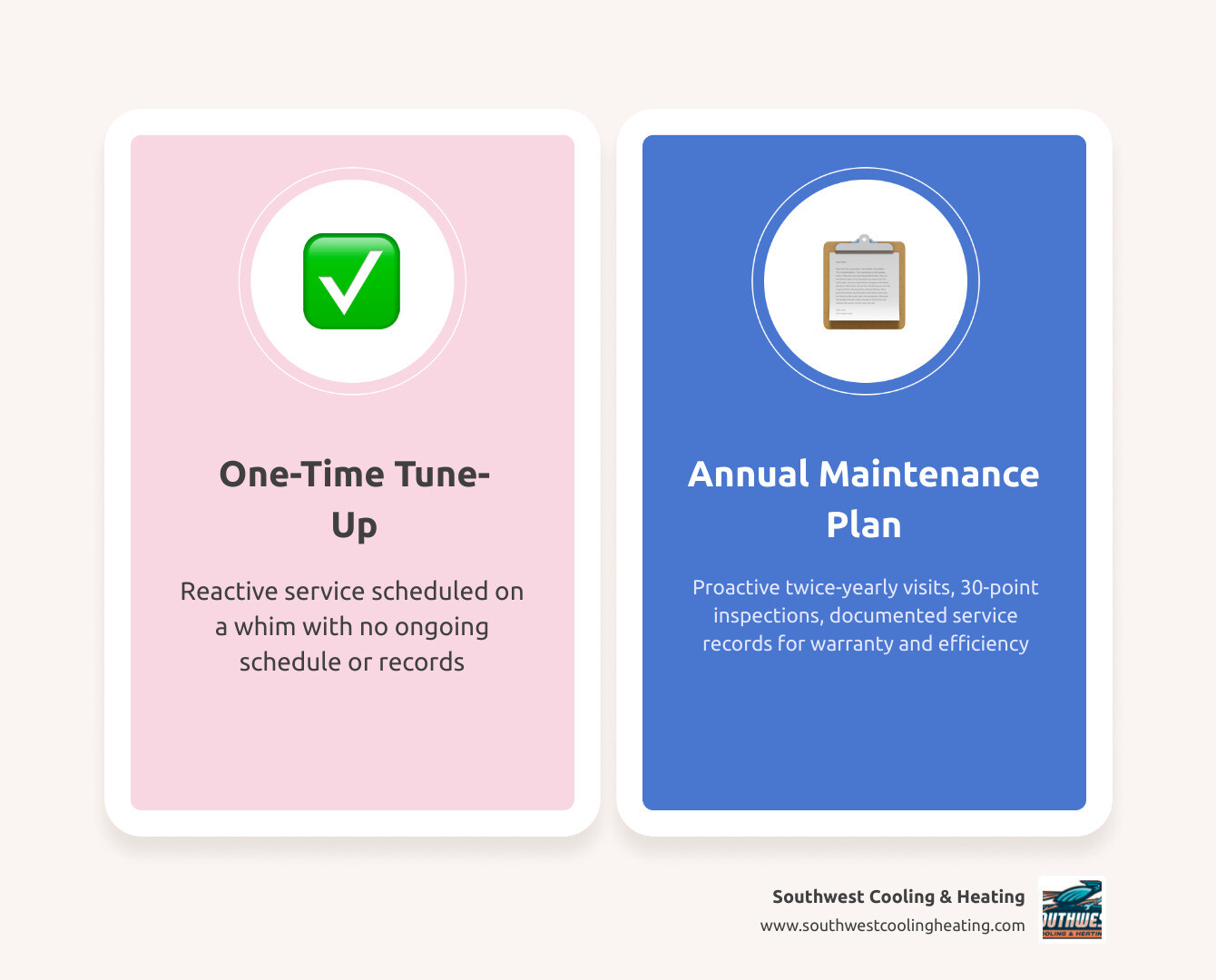
Many homeowners wonder how a formal maintenance plan differs from a standard, one-time tune-up. While a one-time tune-up is a reactive service scheduled on a whim, a comprehensive maintenance plan is a proactive, long-term partnership. It is designed to take the guesswork out of caring for your heating and cooling equipment by establishing a scheduled routine of preventive care.
When you enroll in a plan, you are securing peace of mind. It ensures your home comfort systems receive regular, structured attention before the extreme summer heat or winter chill sets in.

During these visits, certified technicians do not just glance at your thermostat and swap a filter. They execute a highly detailed, multi-point inspection and deep cleaning protocol. This process involves testing the physical integrity of your system, measuring electrical performance, assessing airflow, and chemically cleaning delicate components.
By keeping your system free of dirt and optimizing its mechanical performance, we can help you prevent emergency breakdowns and maintain peak system efficiency year-round. If you want to keep your air conditioning system running flawlessly through our blazing Southern Utah summers, scheduling regular AC Maintenance is the most reliable way to do it.
Cooling Season Checklist: What Does an HVAC Maintenance Plan Include for Air Conditioning?
When our technicians arrive at your home in places like Santa Clara, Ivins, or Coral Canyon for your spring cooling visit, they focus on preparing your air conditioner to handle the relentless desert heat. A standard cooling checklist includes several vital procedures:
- Condenser and Evaporator Coil Inspection: Dirt acts as an insulator on your outdoor condenser and indoor evaporator coils. If your coils are covered in dust, your system cannot release heat efficiently, forcing it to run longer and work harder. We inspect and clean these coils to restore optimal heat transfer.
- Refrigerant Level and Pressure Checks: We measure refrigerant pressures to ensure your system is operating with the precise charge specified by the manufacturer. Low refrigerant often indicates a hidden leak, which can freeze your evaporator coil and eventually destroy your compressor if left unaddressed.
- Condensate Drain Line Flushing: As your air conditioner cools your home, it extracts moisture from the air. This moisture drains through a condensate line. Over time, algae and dust can clog this line, leading to water backups that can cause severe water damage to your ceiling or drywall. We flush and clear these lines to ensure smooth drainage.
- Electrical Contacts and Control Testing: We inspect and tighten all electrical connections. Technicians test the system’s capacitors—which store electrical energy to start the motors—and check contactors for pitting or wear. Identifying a failing capacitor during a routine visit prevents your system from suddenly quitting on a scorching July afternoon.
- Blower Motor and Fan Alignment: We evaluate the blower motor’s amperage draw and lubricate moving parts where applicable. Ensuring the fan blade and blower wheel are clean and balanced prevents unnecessary strain on the motor.
Heating Season Checklist: What Does an HVAC Maintenance Plan Include for Furnaces?
As the autumn air cools down in Winchester Hills, Diamond Valley, and Toquerville, your maintenance plan shifts focus to your heating system. A winter heating tune-up is highly centered on safety, ventilation, and combustion efficiency. Our comprehensive checklist includes:
- Heat Exchanger Integrity Inspection: This is the most critical safety check on a gas furnace. The heat exchanger keeps dangerous combustion gases, like carbon monoxide, separate from the clean air circulating through your home. We inspect the heat exchanger cells for any hairline cracks or signs of corrosion that could allow toxic gases to leak into your living space.
- Carbon Monoxide Testing: We utilize specialized electronic equipment to monitor and test for the presence of carbon monoxide. This ensures that your system is burning fuel safely and venting all exhaust cleanly out of your home.
- Burner Assembly and Pilot Cleaning: Over the off-season, dust and debris can collect on your burners, leading to poor combustion, delayed ignition, or inefficient fuel use. We clean and adjust the burners to guarantee a clean, blue flame.
- Flue Pipe and Venting System Audit: We check the entire venting system to ensure it is clear of obstructions, properly sealed, and drafted correctly so that all exhaust gases safely exit your property. To keep your heating system running safely and efficiently, we recommend scheduling regular Furnace Maintenance every autumn.
The Core Benefits and Timing of Professional HVAC Maintenance
Skipping professional maintenance is easy to do when your system seems to be running fine, but the long-term consequences can be incredibly costly. The benefits of routine care go far beyond preventing immediate breakdowns.
First and foremost, regular maintenance preserves your system’s energy efficiency. A dirty or neglected system can easily lose about 5% of its operating efficiency every single year. When motors struggle against dirty coils and clogged filters, they draw more power, directly inflating your monthly utility bills. Keeping your system clean can reduce energy use by 15% or more compared to a neglected system.
Additionally, routine maintenance dramatically extends your system’s lifespan. While a well-maintained HVAC system is designed to last 10 to 15 years (or even longer), a neglected system’s lifespan can easily be cut in half due to premature component failure. To understand why preventive care is so crucial for avoiding sudden system emergencies, check out our guide on An Ounce of Prevention: Keeping Your HVAC Out of the ER.
| Maintenance Phase | Best Timing | Primary Focus | Key Benefit |
|---|---|---|---|
| Spring Cooling Prep | March to May | Coils, refrigerant, condensate lines, electrical capacitors | Preps system for extreme summer heat; lowers AC electric bills |
| Fall Heating Prep | September to November | Heat exchanger, burners, carbon monoxide safety, venting | Ensures safe combustion; prevents winter heating failures |
How Maintenance Keeps Your Manufacturer Warranty Valid
Many homeowners do not realize that their HVAC manufacturer’s warranty comes with strings attached. Major brands explicitly state in their warranty terms that the system must be professionally maintained on an annual basis to keep the parts warranty valid.
If a major component like your compressor or heat exchanger fails, the manufacturer will often require documented proof of regular professional service before they will honor a warranty claim.
Without written service reports and receipts showing that a licensed technician has inspected and maintained the system annually, you could find yourself paying out of pocket for an expensive replacement part that should have been covered. Enrolling in a maintenance plan provides you with a clear, automated paper trail of professional service, acting as your insurance policy to keep your warranty fully intact.
How Often to Schedule Professional Service Visits
For standard split systems consisting of an air conditioner and a furnace, as well as year-round heat pumps, twice-a-year maintenance is the industry standard. We recommend scheduling one visit in the spring to prepare for the cooling season, and one visit in the fall to prepare for the heating season.
Because heat pumps run continuously throughout both the summer and winter without a season off, they are especially prone to wear and tear and benefit immensely from this bi-annual schedule.
Consistent, timely visits ensure that your system is never forced to start up after months of sitting idle without a professional eye making sure it is safe and ready to run. If you are wondering whether your system is overdue for a checkup, read our helpful article: Is Your HVAC Crying for Help? Here Is How Often You Should Service It.
DIY Maintenance Tasks vs. What Requires a Professional Technician
While a professional maintenance plan is essential for the heavy lifting, there are several simple tasks homeowners can—and should—perform to keep their systems running smoothly between scheduled visits.
The most important DIY task is changing your air filter regularly. A clogged filter chokes off airflow, forcing your system to work significantly harder to pull air through, which can cause the system to overheat or cause your AC coils to freeze up.
Homeowners should also inspect their outdoor condenser unit regularly to ensure that grass, weeds, leaves, and shrubs are cleared away, maintaining at least a two-foot clearance around the cabinet to allow proper heat release.
However, anything beyond basic filter changes and external cleaning should always be left to a licensed professional. Tasks involving high-voltage electrical testing, refrigerant pressure adjustments, gas line leak checks, and combustion analysis require specialized tools, extensive training, and federal certifications (such as EPA Section 608 certification for handling refrigerants).
Attempting to perform these tasks yourself can result in severe personal injury, system damage, and voided warranties. For a step-by-step breakdown of how to handle filtration on your own, see our guide on How Often to Change Your HVAC Air Filter: A Simple Guide.
How Pets and Desert Dust Impact Your Air Filters
If you share your home with furry family members, your air filters have to work twice as hard. Pet dander, hair, and outdoor dust quickly accumulate on the filter fibers, restricting airflow much faster than in pet-free households.
In areas like Bloomington, Hidden Valley, and La Verkin, keeping a close eye on your filtration is key to maintaining healthy indoor air quality. To learn more about how your pets affect your heating and cooling system’s breathing, read How Pets Affect How Often You Change Your Filter.
High Desert Arid Conditions and Filter Replacement Frequency
Living in the high desert of Southern Utah means dealing with unique environmental challenges. Our dry, windy conditions kick up fine desert dust and sand, which can settle into your HVAC system’s outdoor components and quickly clog indoor filters.
During windy seasons, filters that might normally last three months in other parts of the country can become completely choked in as little as 30 days. Understanding these local climate factors is crucial for keeping your energy bills low and your air clean. Explore this topic in detail in our article on How High Desert Arid Conditions Affect Filter Replacement Frequency.
Frequently Asked Questions About HVAC Maintenance Plans
Does a maintenance plan cover both heating and cooling systems?
Yes, a comprehensive maintenance plan is designed to protect your entire HVAC system. Rather than treating your heating and cooling systems as separate entities, a complete plan schedules seasonal visits to address each component when it is needed most.
During the spring visit, the technician’s focus is heavily directed toward the air conditioning components, such as the condenser coils, refrigerant levels, and condensate lines.
In the fall, the focus shifts to your furnace or heating elements, inspecting the heat exchanger, testing gas valves, and ensuring safe combustion. For homeowners with heat pumps, which handle both heating and cooling duties, these bi-annual checkups are equally critical to ensure the reversing valve and defrost cycles function perfectly during seasonal transitions.
What common HVAC problems are prevented by regular maintenance?
Regular maintenance acts as an early warning system that catches minor component wear before it escalates into a catastrophic failure. Some of the most common issues prevented include:
- Frozen Evaporator Coils: Dirty air filters or low refrigerant levels restrict heat absorption, causing the indoor coil’s temperature to drop below freezing, turning your AC into a block of ice.
- Carbon Monoxide and Gas Leaks: Annual safety checks identify cracked heat exchangers or loose gas connections before dangerous, odorless carbon monoxide gas can enter your living spaces.
- Water Damage from Clogged Drains: Regularly flushing the condensate drain line prevents algae build-up from clogging the pipe and backing up water into your home’s ceilings, walls, or mechanical closets.
- Electrical Failures: Tightening loose electrical terminals and replacing weakened capacitors prevents motor burnouts and electrical fires caused by thermal expansion and vibration.
How long does a professional maintenance visit typically take?
A thorough, professional maintenance visit typically takes between 60 and 90 minutes per system. During this window, a technician performs a rigorous 30-point inspection and cleaning process.
Any service that claims to perform a “tune-up” in under 30 minutes is likely just a superficial visual check rather than a true, comprehensive maintenance service. A proper visit requires time to carefully measure electrical draws, test safety controls, clean the outdoor cabinet, and document system performance.
Conclusion
Investing in your heating and cooling system should not be a matter of waiting for things to break down. By understanding what does an HVAC maintenance plan include, you can make a smart, proactive choice that keeps your home comfortable, your indoor air clean, and your utility bills manageable.
At Southwest Cooling & Heating, we have been bringing reliable, high-quality HVAC service to St. George, Hurricane, Ivins, Toquerville, La Verkin, and the surrounding communities since 1980. We combine modern technical expertise with old-school customer service values to give you true peace of mind.
If you are ready to protect your home’s heating and cooling investment, don’t wait for the next extreme weather cycle. Contact our friendly team today to learn more about our maintenance plans or to schedule your professional furnace maintenance services.