


The Simple Answer to How Often Should You Change Your HVAC Air Filter
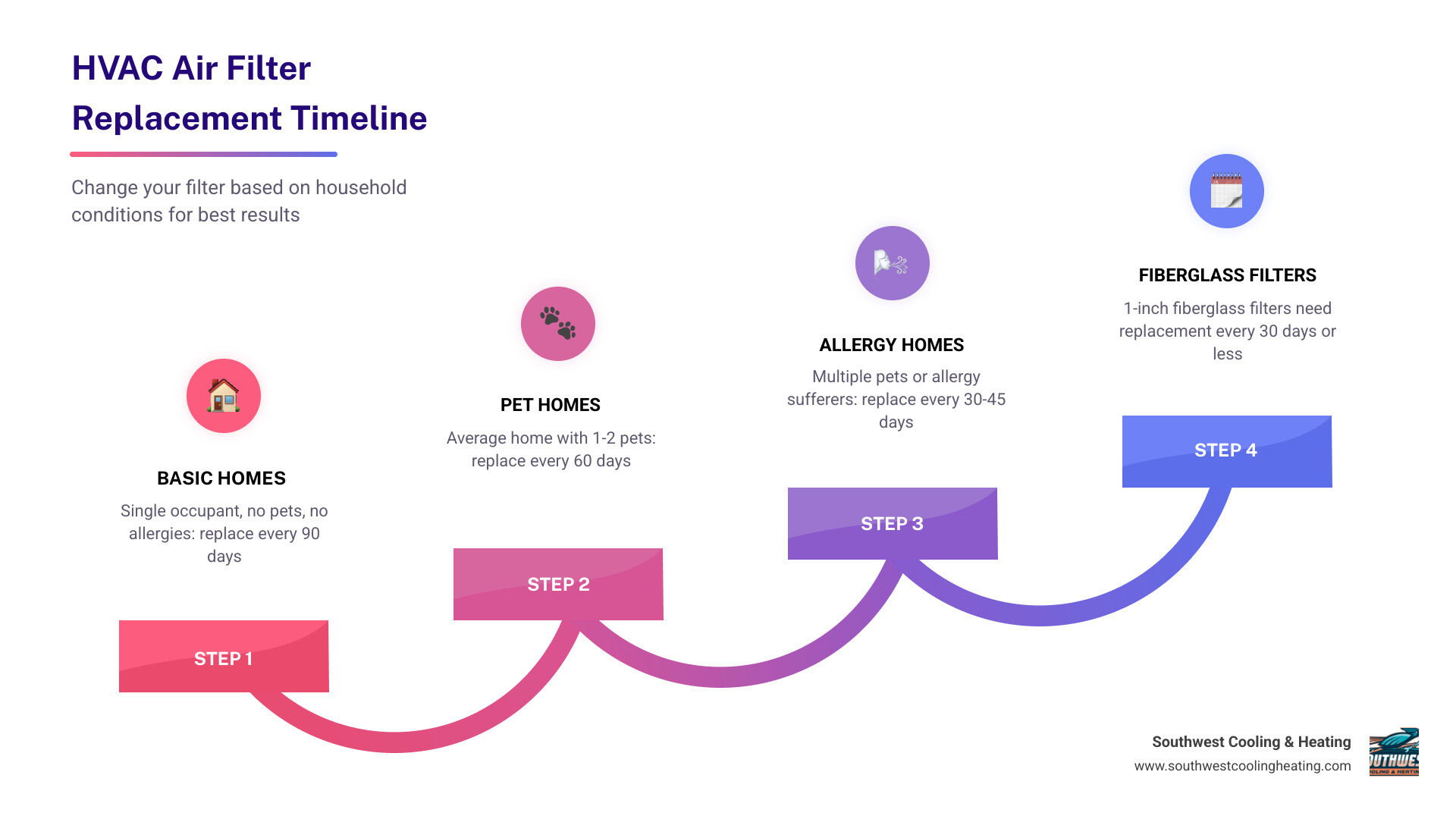
How often should you change your HVAC air filter depends on your filter type and home conditions — but here’s a quick reference to get you started:
| Household Situation | Recommended Change Interval |
|---|---|
| Vacation home or rarely occupied | Every 6-12 months |
| Single occupant, no pets, no allergies | Every 90 days |
| Average home with 1-2 pets | Every 60 days |
| Multiple pets or allergy sufferers | Every 30-45 days |
| Fiberglass (1-inch) filters | Every 30 days or less |
| Pleated (1-inch) filters | Every 60-90 days |
| Media filters (4-5 inch) | Every 6-12 months |
Most homeowners should aim to change their filter at least every 90 days — but your home’s specific conditions may mean you need to do it more often.
It’s one of the simplest things you can do to protect your HVAC system, keep your energy bills in check, and breathe cleaner air inside your home. Yet it’s also one of the most overlooked. A clogged filter doesn’t just hurt your air quality — it forces your system to work harder, which shortens its lifespan and drives up your monthly energy costs. According to the U.S. Department of Energy, replacing a dirty filter can improve your system’s efficiency by 5 to 15%.
I’m Bruce Hymas, owner of Southwest Cooling and Heating, and with over four decades of HVAC experience serving St. George, Utah homeowners behind me, I’ve seen how something as simple as knowing how often should you change your HVAC air filter can be the difference between a system that runs smoothly for years and one that breaks down at the worst possible time. Let’s walk through everything you need to know to get this right for your home.
How Often Should You Change Your HVAC Air Filter?
When we talk to homeowners in Santa Clara, Hurricane, and Ivins, the most common question we get is, “Is there a single baseline rule I can follow?”
While the general industry baseline is to inspect your filter every 30 days and replace it at least every 90 days, the absolute biggest factor in determining your actual replacement frequency is the type of filter you use. Let’s break down the main options you will find at the store and how long they truly last under normal operating conditions.
Fiberglass Filters (Disposable)
Fiberglass filters are the basic, semi-transparent filters you can often buy in bulk. They are designed with a very thin layer of spun glass fibers reinforced by a metal grate.
- Lifespan: 30 days or less.
- The Verdict: While these are highly affordable up front, they provide only minimal protection. They are designed to stop large debris, like hair and giant dust bunnies, from entering your heating and cooling equipment. They do very little to improve indoor air quality and clog incredibly fast. If you use these, you must commit to changing them every single month.
Pleated Filters (Disposable)
Pleated filters are made from folded sheets of polyester or cotton paper. The folds (pleats) create a significantly larger surface area than a flat fiberglass filter, allowing them to trap much smaller particles without immediately choking your system’s airflow.
- Lifespan: 60 to 90 days.
- The Verdict: This is the sweet spot for the majority of homes in Southern Utah. Because of the increased surface area, they can hold a substantial amount of dust and allergens before they begin to restrict airflow. For a standard household in places like Bloomington or Coral Canyon, replacing these every two to three months keeps the system happy and healthy. To explore which specific brands and designs work best for your setup, check out our guide on Top Rated Air Filters to Keep Your Home Fresh.
Media Filters (High-Capacity)
Media filters are deep, pleated filters that are typically 4 to 5 inches thick instead of the standard 1-inch varieties. They require a special media cabinet installed next to your furnace or air handler.
- Lifespan: 6 to 12 months.
- The Verdict: Because of their massive physical depth and surface area, media filters can hold a tremendous amount of dust. They are highly efficient and only need to be replaced once or twice a year, making them incredibly convenient for busy households.
To help you visualize how these different options stack up, here is a quick comparison table:
| Filter Type | Thickness | Average Lifespan | Primary Benefit | Best Suited For |
|---|---|---|---|---|
| Fiberglass | 1-inch | 30 days or less | Low initial cost | Basic system protection only |
| Pleated | 1-inch | 60–90 days | Great balance of filtration & airflow | Standard residential homes |
| Media | 4–5 inches | 6–12 months | High dust capacity, low maintenance | Homes with media cabinets, busy families |
Why You Need to Know How Often Should You Change Your HVAC Air Filter
It is easy to view the air filter as just a cardboard-bound square tucked away in a dark slot. However, understanding how often should you change your HVAC air filter is vital because that simple square controls the lifeblood of your heating and cooling system: airflow.
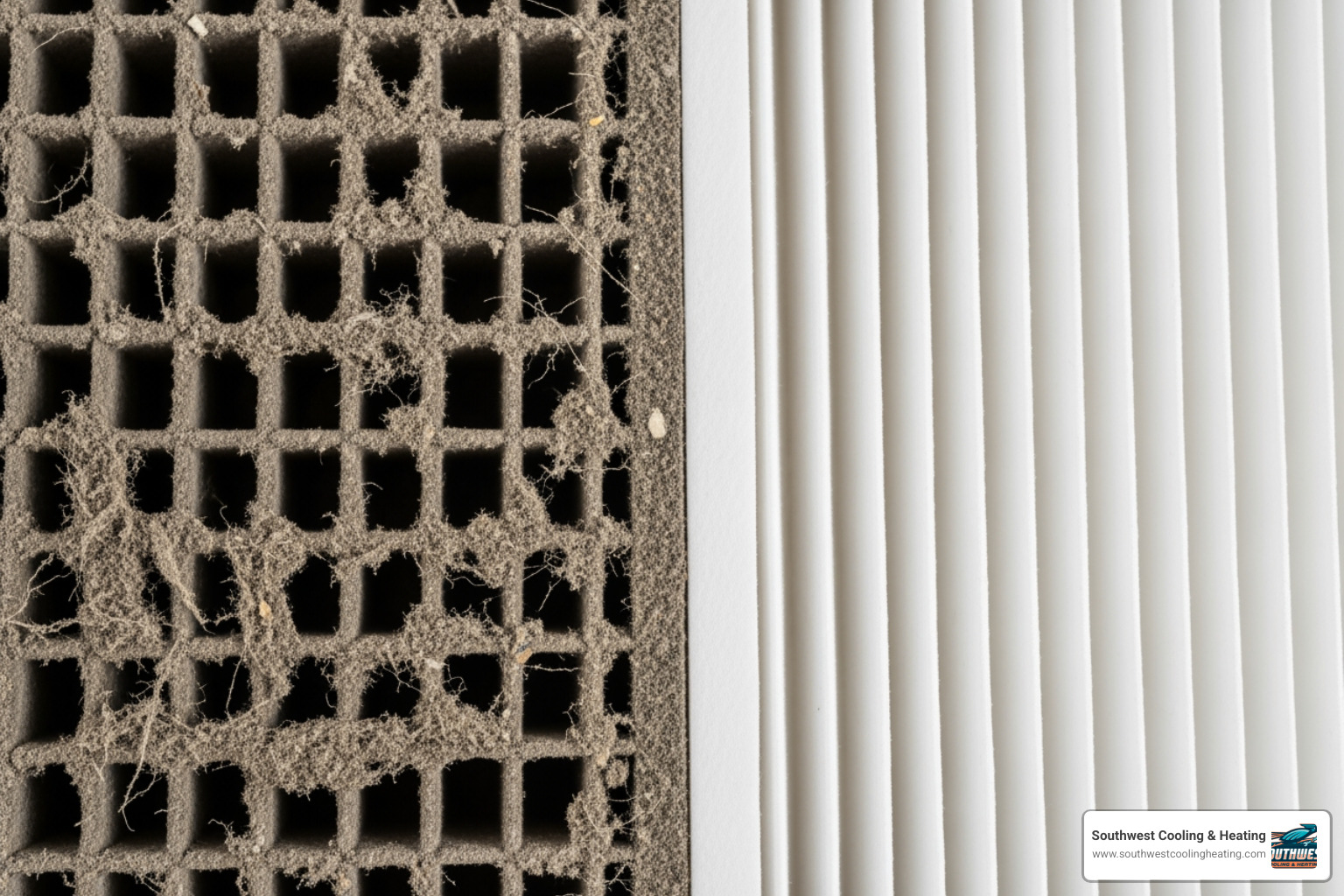
When an air filter becomes choked with dust, pet hair, and airborne particles, it creates a massive pressure drop across the system. This severe airflow restriction triggers a chain reaction of expensive headaches:
- Blower Motor Strain: The fan motor inside your air handler has to work twice as hard to pull air through a clogged filter. This extra work causes the motor to overheat, accelerates wear and tear, and can lead to a premature blower motor failure.
- Skyrocketing Energy Bills: When airflow is restricted, your system has to run for much longer cycles to reach the temperature set on your thermostat. Longer run times directly translate to higher utility bills.
- System Lifespan Reduction: Just like driving a car with a completely clogged engine air filter, running an HVAC system under constant strain dramatically shortens its overall lifespan.
Taking a few minutes to replace your filter on time is the ultimate low-cost preventive measure. If you want to keep your system out of the “emergency room” this year, read our helpful guide on An Ounce of Prevention: Keeping Your HVAC Out of the ER.
Key Factors That Affect Your Filter Replacement Schedule
No two homes in Southern Utah are exactly alike. A retired couple living in a pristine, pet-free home in Bloomington Hills will have completely different air filtration needs than a family of six with three golden retrievers living in Hurricane.
When determining your custom schedule, you must adjust your baseline based on several key environmental and household factors.
1. Pets and Dander
Pets are wonderful companions, but they are also absolute dust and hair factories. Dog and cat hair, along with microscopic dander, are among the heaviest physical loads a residential HVAC system will ever face.
- The adjustment: If you have one pet, you should plan to change your 1-inch pleated filter every 60 days. If you have multiple pets, that timeline drops to every 30 to 45 days. Neglecting this task means your return vents will quickly look like they are growing fur coats, choking off vital system airflow.
2. Allergies and Asthma
If anyone in your household suffers from chronic allergies, asthma, or other respiratory sensitivities, the air filter is your first line of defense.
- The adjustment: To keep airborne irritants like pollen, mold spores, and fine dust to an absolute minimum, you should replace your filter every 30 to 45 days, regardless of whether it looks completely dirty. Keeping a fresh, highly efficient filter in place ensures your indoor air remains clean and breathable. For more tips on optimizing your indoor air, check out our resource on Simple Ways to Scrub Your Home’s Air Clean.
3. Household Size and Occupancy
More people means more movement, which kicks up settled dust, fabric fibers, and skin cells into the air.
- The adjustment: High-occupancy homes should treat 60 days as their absolute ceiling for a standard 1-inch filter. On the flip side, if you own a vacation home in Coral Canyon or Diamond Valley that sits empty for months at a time, your filters will experience very light loads and can easily last 6 to 12 months between changes.
4. Seasonal Usage and Climate
Our local climate in St. George, Utah, demands a lot from our air conditioners. During the scorching summer months, your AC system might run continuously for 12 to 18 hours a day.
- The adjustment: The more air that passes through your filter, the faster it will clog. We highly recommend checking your filter monthly during the peak summer cooling season and the dead of winter. Conversely, during the mild “shoulder” seasons of spring and autumn, you can often let your filters run a bit longer.
5. Outdoor Air Quality and Construction
Are you living near a new housing development in Washington County? Drywall dust, fine desert sand, and construction debris can travel through the air and find their way into your home. High winds and seasonal wildfire smoke can also rapidly overload your air filter.
- The adjustment: If there is construction nearby or we have experienced a period of high winds and heavy dust, inspect your filter immediately. It can clog in a matter of days under extreme conditions.
How MERV Ratings Impact How Often Should You Change Your HVAC Air Filter
When shopping for a new filter, you will see a number labeled “MERV.” MERV stands for Minimum Efficiency Reporting Value, and the scale ranges from 1 to 16 for residential and light commercial systems. The higher the MERV rating, the smaller the particles the filter can trap.
However, a higher MERV rating is not always better for your home.
[Low MERV: 1-4] ----> Allows small particles to pass; low airflow resistance.
[Medium MERV: 8-11] --> Traps dust, pollen, and dander; ideal balance for homes.
[High MERV: 13-16] --> Traps microscopic particles; high airflow resistance (can strain residential systems).
- MERV 1 to 4: These are typically basic fiberglass filters. They offer low airflow resistance but only capture very large particles. They must be changed every 30 days.
- MERV 8 to 11: This is the ideal range for the vast majority of residential HVAC systems in St. George and surrounding areas. They provide excellent filtration—trapping dust, pollen, pet dander, and mold spores—without creating excessive airflow resistance. Under normal use, these pleated filters last 60 to 90 days.
- MERV 13 to 16: These filters are incredibly efficient at trapping bacteria, smoke, and microscopic allergens. However, they are also highly restrictive. If your residential system’s blower motor was not designed to handle a MERV 13+ filter, it can restrict airflow so severely that it mimics a dirty, clogged filter from day one. This can cause system strain, frozen coils, and high energy bills.
Always consult with an HVAC professional before upgrading to a high-MERV filter to ensure your system can handle the increased airflow resistance.
Signs It Is Time to Replace Your Filter Immediately
While keeping a calendar reminder is a great habit, your eyes and your home will tell you when a filter has reached its limit. Here are the five telltale signs that you need to swap out your filter immediately:
- The Visual “Light Test”: Pull your filter out and hold it up to a bright light source or the sun. Can you see light passing through it? If the filter has a gray, matted appearance and completely blocks the light, it is fully loaded and restricting your system’s airflow.
- Excessive Dust Around the Home: If you find yourself dusting your furniture in Winchester Hills or Toquerville far more often than usual, or if you notice a layer of fine dust settling on surfaces near your supply vents, your filter is likely full and can no longer trap incoming particles.
- Longer System Cycles: If your air conditioner or heat pump is running much longer than usual to reach your thermostat’s set temperature, check the filter. Restricted airflow slows down heat exchange, forcing the system to run extended cycles.
- Musty Odors: When a dirty filter is exposed to high humidity or condensation, it can harbor mold or mildew. If you notice a musty, dusty, or “dirty sock” smell when your system kicks on, it is time for a fresh filter.
- Reduced Airflow: Hold your hand up to one of your supply registers. If the airflow feels weak or lukewarm, a clogged filter is the most common culprit.
If you notice these signs and can’t remember the last time your system was professionally checked, it might be time for a comprehensive tune-up. Learn how to tell if your system needs professional attention by reading Is Your HVAC Crying for Help? Here Is How Often You Should Service It.
Frequently Asked Questions About HVAC Filters
Can a dirty filter cause my AC to freeze up?
Yes, absolutely. This is one of the most common service calls we receive during the hot St. George summers. Your air conditioner relies on a steady stream of warm indoor air passing over the cold evaporator coil to transfer heat. If a clogged filter restricts that airflow, the temperature of the evaporator coil will rapidly drop below freezing. Any moisture in the air will instantly freeze on the coil, turning it into a solid block of ice. This completely stops the cooling process and can cause serious water damage when the ice eventually melts.
Do I need to change my filter more often in summer?
Yes. During peak cooling season, your system runs almost continuously to combat the intense outdoor heat. Because of this high volume of air movement, the filter accumulates dust, pollen, and debris at a much faster rate than it would during the mild spring or fall months. We recommend checking your filter every 30 days during the summer and replacing it as soon as it shows signs of gray buildup.
What happens if I run my HVAC without a filter?
Running your system without a filter—even for a few days—is highly risky. The air filter’s primary job is to protect the delicate internal components of your HVAC system. Without a filter, airborne dust, pet hair, and debris will build up directly on your evaporator coil, blower motor, and ductwork. This leads to restricted airflow, severe system strain, poor indoor air quality, and incredibly expensive repair bills. It is always better to wait and run your system only after you have installed a clean, properly sized filter.
Conclusion
Taking control of how often should you change your HVAC air filter is one of the easiest, most cost-effective ways to protect your home’s comfort, keep your utility bills low, and safeguard your indoor air quality. Whether you are living in Santa Clara, Hurricane, La Verkin, or right here in St. George, keeping a close eye on your filter is key to a long-lasting, efficient system.
At Southwest Cooling & Heating, we have been helping our neighbors throughout the region stay comfortable since 1980. We combine modern HVAC technology with old-school values, offering reliable maintenance and expert service backed by our performance and satisfaction guarantees.
If you want to ensure your system is running at peak efficiency, or if you need professional help setting up a high-capacity media filter system, we are here to help. Contact us today to schedule your next seasonal tune-up and experience the difference of working with local experts who care: Southwest Cooling & Heating HVAC Services.