


Why New HVAC Benefits Beyond Comfort Matter More Than Most Homeowners Realize
The new HVAC benefits beyond comfort that today’s systems deliver go far beyond just keeping your home warm in winter and cool in summer. Here’s a quick look at what a modern HVAC upgrade can actually do for you:
Key benefits of a new HVAC system beyond comfort:
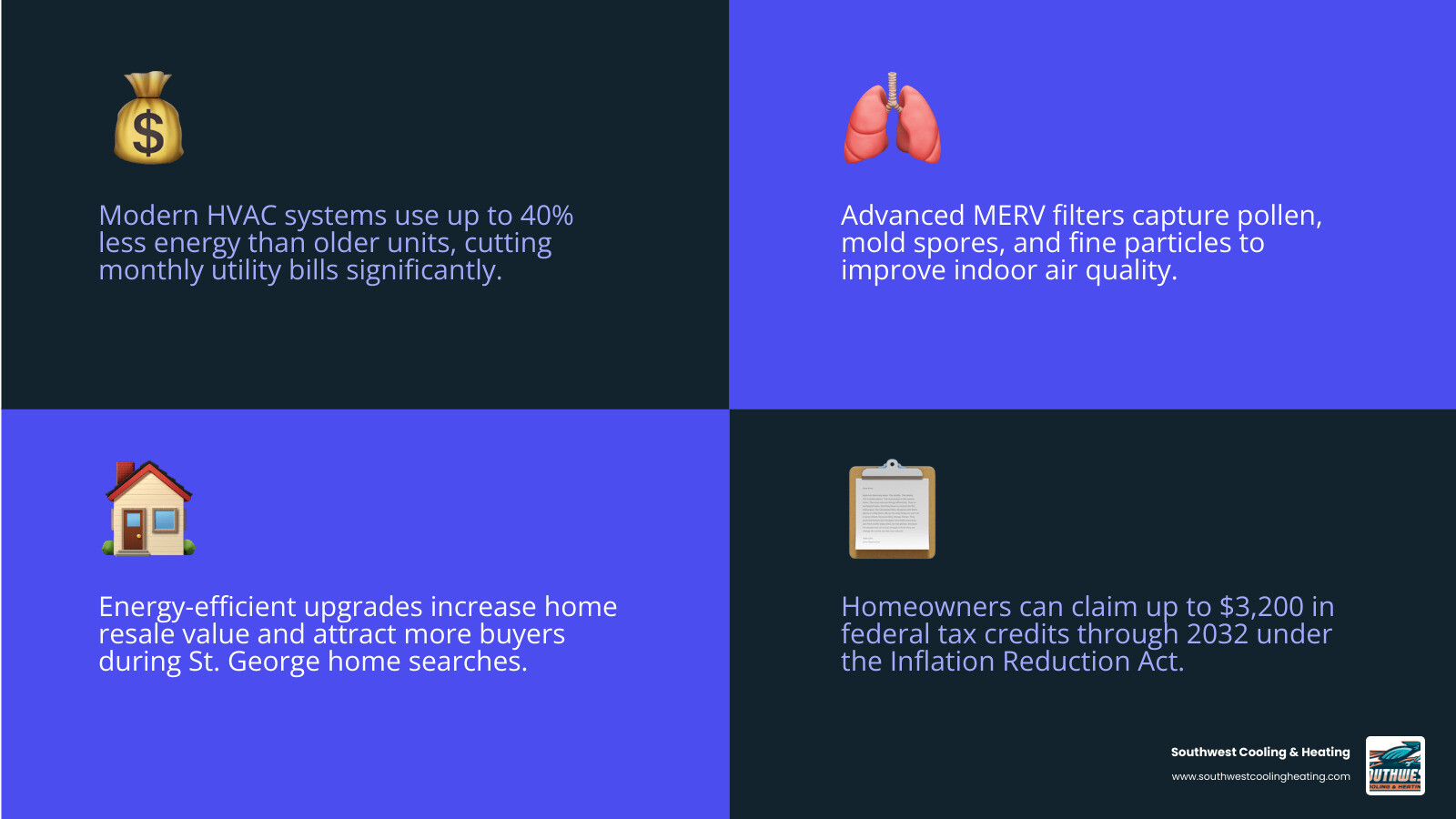
- Lower energy bills – Modern systems use up to 40% less energy than older equipment
- Better indoor air quality – Advanced filtration captures dust, pollen, mold spores, and fine particles
- Increased home value – Buyers actively look for energy-efficient, low-maintenance homes
- Federal tax credits – Up to $3,200 per year through 2032 under the Inflation Reduction Act
- Fewer repairs – Newer systems with warranties mean fewer surprise service calls
- Smart controls – Thermostats that learn your schedule and cut waste automatically
- Humidity control – Balanced indoor humidity protects both your health and your home
- Quieter operation – Variable-speed technology runs nearly silently compared to older units
- Reduced environmental impact – Heat pumps and lower-GWP refrigerants shrink your carbon footprint
Most St. George homeowners think about their HVAC system only when something breaks. That’s understandable — it’s one of those things you rely on every day without thinking much about it. But if your system is aging, running hard through Utah’s intense summer heat, and racking up repair bills, the real cost of keeping it going may surprise you. A modern upgrade isn’t just about staying comfortable. It’s a home improvement decision that touches your monthly budget, your family’s health, your home’s resale appeal, and your long-term peace of mind.
I’m Bruce Hymas, owner of Southwest Cooling and Heating, and with decades of hands-on experience helping St. George families navigate the real costs and new HVAC benefits beyond comfort, I’ve seen how the right upgrade can transform a home in ways most people never expect. Let’s walk through exactly what those benefits look like — and how to know if now is the right time for your home.
1. New HVAC Benefits Beyond Comfort Start With Lower Operating Costs
When homeowners ask us about upgrading, the first question is usually simple: will it save money over time? In many cases, yes.
Older HVAC systems waste energy in ways most people never see. They cycle on and off too often, lose efficiency as parts wear down, and struggle to keep up during long St. George cooling seasons. Modern systems are built to use energy more precisely, especially when they include variable-speed technology, better efficiency ratings, and smart controls.
If you want a deeper look at the money side, read Will a New HVAC System Actually Save You Money?.
How modern equipment cuts waste and monthly energy use
New equipment is designed to do more with less. High-efficiency air conditioners, furnaces, and heat pumps use improved compressors, fans, and heat exchangers to reduce wasted energy. Instead of blasting at full power every time, many newer systems can ramp up and down based on what your home actually needs.
That matters because your house rarely needs “maximum everything” all day long. Early morning, late evening, and mild weather days all place different demands on the system. Variable-speed and inverter-driven equipment can respond to those changing conditions with much better precision.

Some modern systems can reduce energy consumption dramatically compared to conventional older equipment. In advanced applications, newer heat pump designs have shown energy reductions of up to 40%. While actual savings vary by home, installation quality, and system type, the general trend is clear: newer high-efficiency HVAC systems waste less energy and can lower monthly utility bills.
Features that often drive those savings include:
- Higher SEER2 ratings for cooling efficiency
- Higher AFUE ratings for gas heating efficiency
- Better HSPF2 performance for heat pumps
- Variable-speed blowers and compressors
- Zoning options for different parts of the home
- Smart thermostat scheduling based on occupancy patterns
Why fewer breakdowns can save more over time
An aging HVAC system doesn’t just cost more to run. It usually costs more to keep alive.
As systems get older, major components face more wear. Capacitors, motors, contactors, igniters, blower assemblies, and compressors all become more failure-prone with age. That means more service calls, more inconvenience, and more “great, of course this happened on the hottest day of the week” moments.
A useful rule of thumb is this: if a major repair starts getting close to half the value of replacement, it may be time to seriously evaluate upgrading instead of repairing again. That isn’t a hard law, but it is a practical checkpoint.
A new system also gives you:
- Manufacturer warranty protection
- Newer, more durable components
- Better diagnostic capabilities
- Fewer emergency breakdown risks
- More predictable ownership costs
With routine maintenance, many modern HVAC systems last around 15 to 25 years. That long lifespan helps spread the value of the upgrade over many seasons, especially when paired with lower repair frequency.
How smart thermostats improve efficiency without extra effort
Smart thermostats are one of the easiest-to-appreciate new HVAC benefits beyond comfort because they save energy without asking you to babysit the system.
Instead of manually changing the temperature all day, smart thermostats can:
- Follow your normal schedule
- Adjust when you’re away from home
- Reduce unnecessary runtime at night
- Allow remote control from your phone
- Alert you to issues or maintenance reminders
- Integrate with other smart home features
That means less waste and more convenience. If you leave for work, run errands in Hurricane, or head out for the weekend from Ivins or Santa Clara, you can adjust settings without walking back into the house muttering at the thermostat like it’s personally offended you.
2. Health, Air Quality, and Everyday Wellness Are Major Upgrade Benefits
A modern HVAC system doesn’t just move hot and cold air. It also affects what you’re breathing every day.
That is a big deal in Southern Utah, where dust, seasonal allergens, and dry conditions can all impact indoor air quality. For many families, one of the most important new HVAC benefits beyond comfort is cleaner, healthier air.
Better filtration can reduce allergens and airborne irritants
Newer systems often support better filtration than older equipment. Advanced filters can capture dust, pollen, pet dander, mold spores, and other airborne particles that would otherwise keep circulating through your home.
Depending on system compatibility, homeowners may benefit from:
- Higher-efficiency media filters
- MERV-rated filtration options
- Air purification add-ons
- Improved ventilation support
- Better airflow through cleaner, correctly sized equipment
This matters for everyday comfort, but it can also matter for wellness. Cleaner indoor air may help reduce irritation for people dealing with allergies, asthma triggers, or general respiratory sensitivity. In areas affected by smoke or elevated outdoor particulates, upgraded filtration can be especially valuable.
Humidity control helps protect both people and the home
Humidity is often overlooked because most homeowners think only about temperature. But humidity affects how air feels, how your home smells, and how likely mold or mildew problems are to develop.
A good HVAC system helps maintain balanced indoor humidity rather than simply over-cooling the house to make it feel drier. That more precise moisture control can help:
- Reduce clammy indoor conditions
- Lower mold and mildew risk
- Improve comfort at moderate thermostat settings
- Protect some building materials and furnishings
- Support healthier indoor air
Emerging HVAC technologies are getting even better at separating moisture control from temperature control. Newer dehumidification approaches, including advanced moisture-removal systems, reduce the need to over-cool air just to pull out humidity. While not every home needs cutting-edge dehumidification, the broader trend is important: modern systems are getting smarter about air quality, not just temperature.
Quieter operation improves sleep, focus, and daily life
Let’s give a little respect to the humble benefit of peace and quiet.
Older systems often make themselves known. They bang, buzz, roar, click, and sometimes sound like they’re preparing for liftoff. Newer equipment, especially variable-speed systems, usually runs much more quietly because it doesn’t have to slam on at full capacity every cycle.
That can improve daily life in ways homeowners notice fast:
- Better sleep in nearby bedrooms
- Less disruption during remote work
- More peaceful conversations and TV time
- Reduced stress from loud startup cycles
Quiet operation may not be the headline benefit people shop for, but once they experience it, they rarely want to go back.
3. Rebates, Tax Credits, and Financing Can Improve the Value of an Upgrade
A new HVAC system is a major home improvement, so it makes sense to look at every available financial advantage. In 2026, homeowners may have access to incentives that make energy-efficient upgrades more attractive.
For local guidance, visit Heat Pump Conversion Utah HVAC Credits.
Federal incentives homeowners should know about in 2026
Under current federal rules, qualifying energy-efficient HVAC improvements may be eligible for tax credits through 2032. In some cases, homeowners can claim up to $3,200 per year for eligible upgrades under the Inflation Reduction Act framework.
Eligibility depends on factors like:
- The type of equipment installed
- Efficiency ratings
- Whether the product meets applicable ENERGY STAR requirements
- The year the system is placed into service
Heat pumps are often one of the biggest categories for credits, but some furnaces and other qualifying improvements may also be eligible. Since tax rules can change and household situations differ, we always recommend confirming current requirements before you file.
How rebates and financing options support better system choices
Incentives can do more than reduce out-of-pocket burden. They can also help homeowners choose a better long-term system instead of defaulting to the shortest-term fix.
Depending on available programs, homeowners may have access to:
- Manufacturer promotions
- Utility-related rebates where applicable
- Flexible financing options
- Payment structures that make upgrades easier to plan
That can make it easier to choose features with stronger long-term value, like better efficiency, smart controls, upgraded filtration, or heat pump technology.
What paperwork to keep for credits and rebate claims
This part is not exciting, but it is important. If you’re claiming a credit or rebate, documentation matters.
Keep copies of:
- Your installation invoice
- Product model information
- Manufacturer certification statements, if applicable
- Proof of payment
- Proof of installation date
- Any submitted rebate forms
For federal tax credits, homeowners commonly use IRS Form 5695 when applicable. It is also smart to keep records for at least three years in case you need them later. If you want to be extra organized, think of it as giving your future self a small gift instead of a paperwork scavenger hunt.
4. A New HVAC System Can Make Your Home More Attractive to Buyers
An HVAC upgrade can matter even if you’re not planning to move tomorrow. Buyers pay attention to mechanical systems, especially when they are comparing homes with similar layouts and finishes.
If you’re thinking about resale, see Will a New HVAC Help Sell Your Home Faster?.
Why buyers notice newer HVAC systems during home searches
Homebuyers love anything that feels like “one less thing to worry about.” A newer HVAC system signals that the home has been maintained and that a major replacement may not be around the corner.
That can improve:
- Buyer confidence
- Listing appeal
- Inspection-day peace of mind
- Perception of overall home upkeep
- Interest from efficiency-minded buyers
A recent HVAC replacement may not always be the flashiest home feature, but it is one buyers appreciate because it affects everyday living and future maintenance expectations.
How energy efficiency and IAQ features strengthen resale appeal
Today’s buyers are increasingly focused on long-term operating costs, wellness, and practical value. Many care less about raw square footage and more about what the home will actually cost to own and maintain.
Features that can strengthen resale appeal include:
- High-efficiency heating and cooling equipment
- Smart thermostats
- Heat pumps
- Better filtration
- Humidity management
- Quiet operation
- Lower expected repair needs
These features help support the idea of a healthier, lower-maintenance, more efficient home, which is exactly what many buyers want.
When an HVAC upgrade adds more value than another repair
Sometimes the best resale move is not another repair. If the system is older, inefficient, and increasingly unreliable, replacing it before listing may create a stronger impression than patching it again.
That is especially true when the existing system has:
- Frequent service history
- Outdated efficiency
- Visible wear
- Uneven performance
- Poor indoor air quality support
Even if you’re staying put, replacing before the system becomes a constant problem can protect your enjoyment of the home now and its marketability later.
5. New Technology and Proper Installation Maximize Performance
Great equipment still needs great installation. This is where a lot of homeowners get tripped up. The system itself matters, but sizing, airflow, refrigerant charge, and controls setup all play a huge role in whether you actually get the benefits you paid for.
For more on this, read Why Correct System Sizing Matters for Your Home.
Why correct sizing matters as much as the equipment itself
Bigger is not always better in HVAC. An oversized system can short cycle, waste energy, and struggle with humidity control. An undersized system may run too long, wear out faster, and still fail to keep up.
Proper sizing is based on a load calculation, not a guess.
A professionally sized system helps deliver:
- More consistent temperatures
- Better humidity control
- Improved efficiency
- Less wear and tear
- Better comfort in different parts of the home
In a climate like St. George, where long cooling demands are common, correct sizing is especially important.
Eco-friendly HVAC options that reduce environmental impact
If sustainability matters to you, modern HVAC technology offers meaningful improvements.
Heat pumps are one of the biggest examples. They can provide highly efficient heating and cooling in one all-electric system, reducing energy use and lowering emissions compared to older, less efficient equipment. Many newer systems also use lower-GWP refrigerants as the industry continues moving toward options with less environmental impact.
Other environmentally friendly advances include:
- Variable-speed operation that uses less electricity
- Smarter controls that reduce unnecessary runtime
- Zoning that avoids conditioning unused spaces
- Improved dehumidification technology
- Better compatibility with electrification goals
Advanced moisture-control technologies, including MOF-based dehumidification in emerging applications, also show how the industry is improving efficiency by handling humidity more intelligently rather than over-cooling and reheating air.
Professional setup helps protect efficiency, safety, and lifespan
Professional installation helps make sure every part of the system works the way it should from day one.
That includes:
- Verifying manufacturer specifications
- Setting proper airflow
- Charging refrigerant correctly
- Checking electrical connections
- Confirming safe venting where applicable
- Balancing the system for the home
- Testing thermostat and control communication
Poor installation can reduce efficiency, shorten system life, and increase breakdown risk. Proper setup helps protect performance, safety, and warranty support.
| Feature | Older or poorly performing HVAC | Properly installed modern HVAC |
|---|---|---|
| Energy use | Higher and less controlled | Lower and more optimized |
| Airflow | Uneven or restricted | Balanced for better performance |
| Humidity control | Often inconsistent | More precise and stable |
| Noise | Louder startup and operation | Quieter, smoother operation |
| Repairs | More frequent surprises | Fewer issues with maintenance |
| Smart features | Limited or none | Scheduling, remote access, alerts |
6. How to Decide If Upgrading Your HVAC Is Worth It
Not every home needs a full replacement today. Sometimes a repair is still the right move. The key is stepping back and looking at the big picture instead of just the latest symptom.
Questions to ask before replacing an older system
Ask yourself:
- How old is the system?
- Have repair calls become more frequent?
- Are energy bills rising without another clear explanation?
- Do some rooms stay too hot or too cold?
- Is indoor air quality getting worse?
- Is the system loud, dusty, or unreliable?
- Are you planning to stay in the home for years?
- Would a newer system support your goals better?
If the answer to several of those is yes, an upgrade may deserve serious consideration.
Best-home-fit features to compare before you choose
The best system is not just the most efficient model on paper. It is the one that fits your home and your priorities.
Compare options based on:
- SEER2, AFUE, and HSPF2 ratings
- Heat pump versus furnace and AC configurations
- Smart thermostat compatibility
- Filtration and indoor air quality options
- Humidity-control performance
- Zoning availability
- Warranty terms
- Compatibility with your ductwork and home layout
A thoughtful evaluation helps you avoid buying too little system or too much system. Yes, both are possible.
When to schedule a professional evaluation in St. George, UT
If your system is aging, struggling in summer, or showing signs like uneven temperatures, poor air quality, rising utility use, or repeated repairs, this is a good time to schedule a professional evaluation.
Here are common signs it may be time to upgrade:
- System age is in the later stage of its life
- Monthly utility bills keep creeping upward
- You are scheduling repairs too often
- Airflow feels weak or inconsistent
- Your home feels dusty or stuffy
- Humidity or hot spots are becoming more noticeable
- The system is getting unusually noisy
- You want better efficiency, cleaner air, or smart-home features
At Southwest Cooling & Heating, we help homeowners in St. George and nearby communities like Santa Clara, Bloomington Hills, Bloomington, Hidden Valley, Coral Canyon, Diamond Valley, Winchester Hills, Hurricane, Ivins, Toquerville, and La Verkin evaluate whether repair or replacement makes the most sense. Since 1980, we have focused on reliable service, modern solutions, and old-school values backed by performance and satisfaction guarantees.
Conclusion
The biggest new HVAC benefits beyond comfort are the ones homeowners feel in everyday life: lower operating costs, cleaner air, quieter performance, fewer repairs, stronger resale appeal, and smarter control over the home.
A modern system is not just a temperature machine. It is a whole-home upgrade that can improve efficiency, wellness, convenience, and long-term value all at once. Add in available tax incentives, better environmental performance, and the importance of professional installation, and the case for upgrading becomes much clearer.
If you’re wondering whether your current system is still serving your home well, we’re here to help. Learn more about HVAC services and let us help you find the right fit for your home in St. George or the surrounding area.