


How Southern Utah Desert Heat Affects Your HVAC System
#
How southern utah desert heat affects your hvac system is something every homeowner in St. George, Hurricane, and Cedar City needs to understand before summer arrives. Here is a quick breakdown:
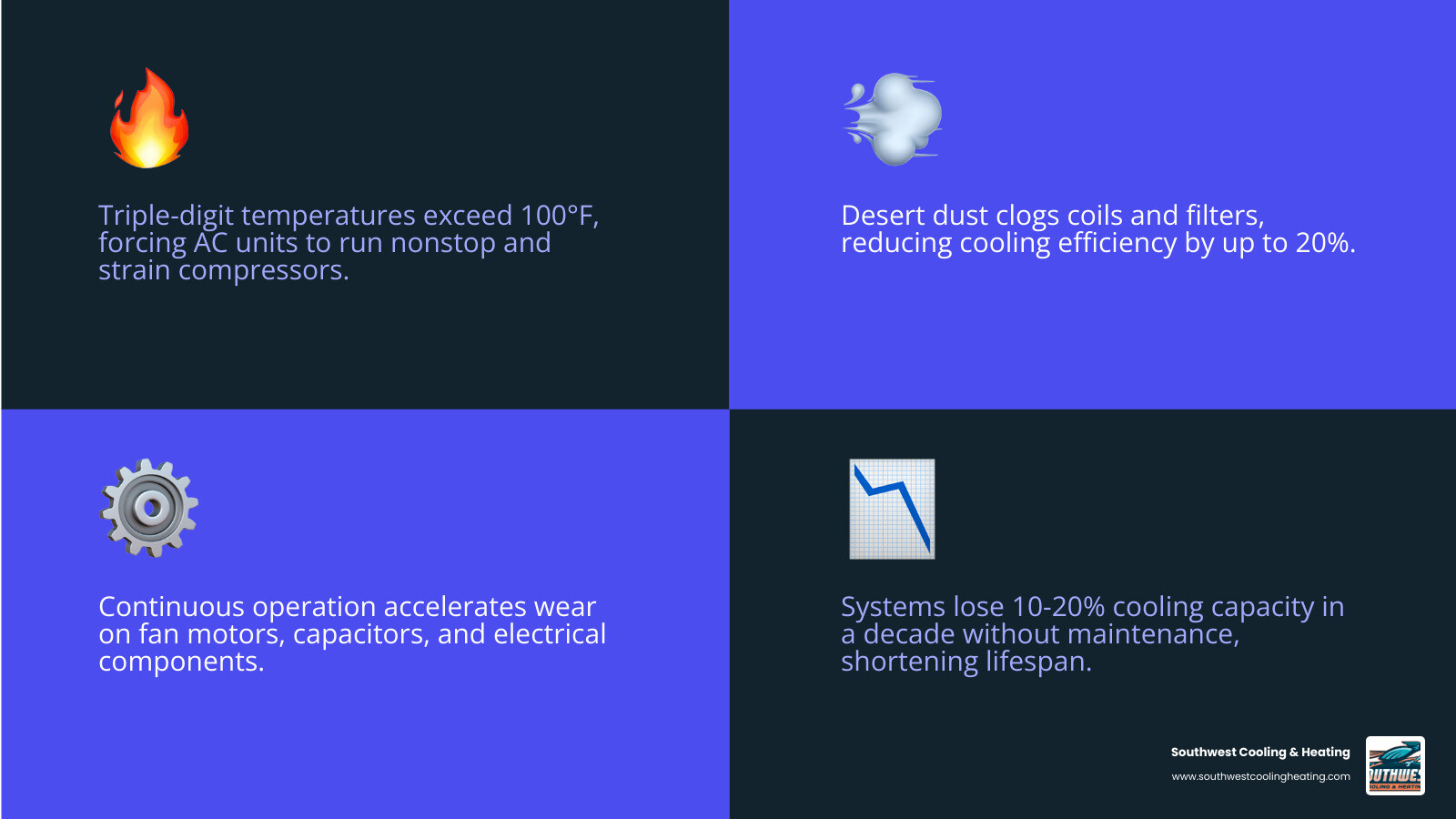
- Relentless heat: Temperatures regularly exceed 100°F, forcing your AC to run almost nonstop, which strains compressors, capacitors, and fan motors
- Desert dust: Fine red sand particles coat your coils and clog filters, cutting cooling efficiency by up to 20%
- Year-round demand: Southern Utah’s extreme summers followed by cold winters mean your system rarely gets a true rest
- Accelerated wear: Without regular maintenance, systems lose 10-20% of their cooling capacity within a decade, and 25% or more after 15 years
- Warranty risk: Most manufacturer warranties require documented annual professional maintenance to remain valid
Southern Utah is not an average climate. Daytime temperatures can climb past 110°F and stay elevated well into the night, meaning your air conditioner never gets a break during the peak summer months. That kind of sustained, punishing heat does not just make your home uncomfortable — it quietly shortens the life of your equipment, inflates your energy bills, and sets the stage for an inconvenient breakdown at the worst possible moment.
I’m Bruce Hymas, owner of Southwest Cooling and Heating, and with over four decades of family history serving St. George-area homeowners, I’ve seen how southern utah desert heat affects your hvac system in ways that catch even prepared homeowners off guard. Understanding what this climate does to your equipment is the first step toward protecting your investment and keeping your home comfortable all year long.
When we talk about the Mojave Desert climate, we aren’t just talking about “hot weather.” We are talking about an environment that is fundamentally hostile to mechanical equipment. In cities like St. George and Ivins, the triple-digit temperatures of July and August create a massive “heat load” on your home. Your HVAC system’s job is to move that heat from inside your house to the outside. However, when the outside air is already 105°F or higher, that transfer becomes incredibly difficult.
This leads to what we call “continuous operation.” In a milder climate, an AC unit might run for 15 or 20 minutes, reach the desired temperature, and then shut off to rest. In Southern Utah, your system might run for six, eight, or even twelve hours straight without a single break. This puts a massive amount of thermal stress on the internal components.
One of the most common issues we see during a St. George heat wave is a sudden AC Repair call for a failed capacitor or a seized compressor. The compressor is the “heart” of your system, and the capacitor is the “battery” that gives it the jolt it needs to start and stay running. Under the punishing desert sun, these electrical components can literally cook. When the ambient temperature is 110°F, the temperature inside the metal cabinet of your AC unit can be much higher, leading to premature failure of the very parts that keep you cool.
The Impact of Relentless Heat on System Components
The heat doesn’t just affect the big parts; it wears down every single moving piece. Fan motors, which are responsible for blowing heat away from the outdoor coils, have to work harder when the air is thin and hot. Higher outdoor temperatures also lead to higher refrigerant pressure. This means the compressor isn’t just running longer—it’s running under much higher physical pressure, drawing more electrical current and generating even more internal heat.
If you’ve ever noticed that your AC seems to struggle more in the late afternoon, you’re seeing the effects of this strain. For more on what to watch for, check out our guide on What to Expect When Your AC Expects the Unexpected. Often, the system is simply fighting the laws of physics as it tries to dump heat into a desert that is already saturated with it.
Long-Term Reliability: How Southern Utah Desert Heat Affects Your HVAC System
We often tell our neighbors in Toquerville and La Verkin that an HVAC system is like a car. If you drive a car through the desert at 100 mph all day, every day, it’s going to wear out faster than a car driven casually on Sunday mornings. In our region, systems face significant mechanical degradation.
Statistics show that while a well-maintained system should last 15 to 20 years, the constant strain of the desert can shorten that significantly if maintenance is ignored. In fact, a system can lose 1% to 3% of its cooling capacity every single year just from normal desert wear. By the time a unit is 10 years old, it might be 20% less efficient than the day it was installed. This is why Finding the Best AC Maintenance in Toquerville UT Without Breaking a Sweat is so critical for local homeowners.
Why Desert Dust is the Silent Enemy of Efficiency
If heat is the opponent you can feel, desert dust is the silent saboteur you might not notice until it’s too late. Southern Utah is famous for its beautiful red rocks, but that red rock eventually turns into fine, powdery sand that gets into everything.
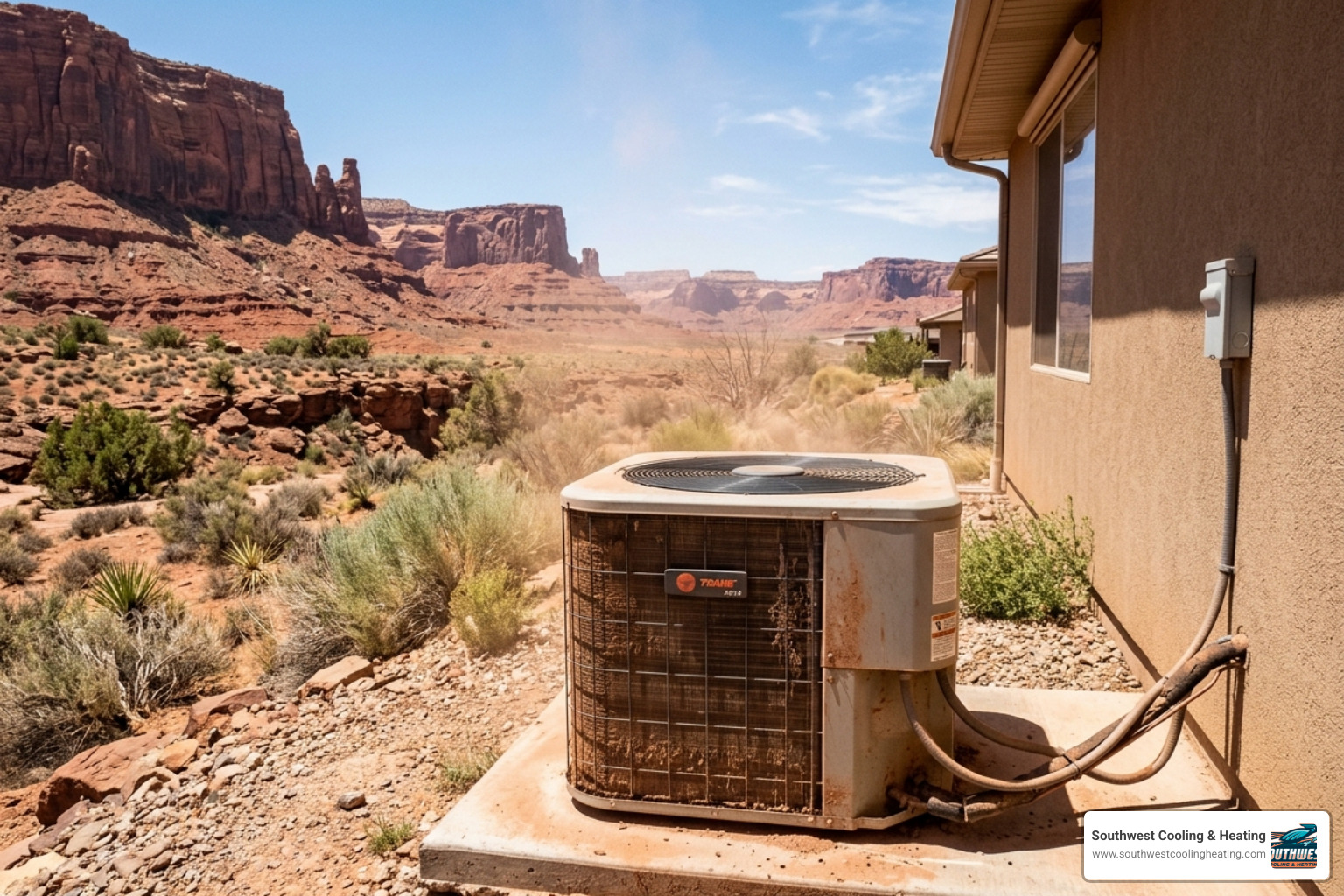
Your outdoor unit (the condenser) works by pulling air through metal fins to cool down the refrigerant inside. When those fins get coated in a layer of red desert dust, it acts like an insulating blanket. Instead of the heat escaping into the air, it stays trapped in the system. This can lead to a 20% loss in efficiency almost overnight after a particularly windy spring week. Regular AC Maintenance is the only way to ensure these coils stay clean enough to do their job.
How Southern Utah Desert Heat Affects Your HVAC System Through Clogged Filters
The dust doesn’t stay outside, either. It finds its way into your home through the smallest cracks, eventually ending up in your air filters. In a dusty environment like Hidden Valley or Diamond Valley, a standard air filter can become completely clogged in as little as 30 days during peak season.
When a filter is clogged, it increases “static pressure.” This means your indoor blower motor has to fight much harder to pull air through the filter. This doesn’t just hurt your indoor air quality; it can actually cause the motor to overheat and burn out. We’ve put together The Ultimate Hidden Valley Guide to Keeping Your AC Happy to help residents manage this constant battle against the red sand.
Essential Maintenance to Combat Arid Conditions
To keep your system running in these conditions, a “quick check” isn’t enough. A professional tune-up in Southern Utah needs to be comprehensive. We recommend a multi-step process that includes:
- Deep Coil Cleaning: Using specialized, biodegradable cleaners to melt away the red sand and grime from both indoor and outdoor coils.
- Diagnostic Inspection: Testing the “amperage draw” of motors to see if they are working harder than they should be.
- Refrigerant Check: Ensuring levels are exact; in extreme heat, being slightly “off” can cause the system to freeze up or overheat.
- Electrical Tightening: Heat causes metal to expand and contract, which can loosen electrical connections over time.
- Safety Switch Verification: Ensuring that if the system does overheat, it will shut down safely before a fire starts or the compressor is destroyed.
For those living in the outskirts, Keep Your Cool with Expert AC Maintenance in Diamond Valley is a great resource for understanding these specific needs.
Maximizing Reliability in Extreme Arid Conditions
Because of how southern utah desert heat affects your hvac system, many homeowners in Santa Clara and Bloomington are moving toward high-efficiency replacements. When your system has to run for thousands of hours a year, the efficiency rating (SEER) makes a massive difference in your monthly budget.
A new AC Installation today is lightyears ahead of what was available even ten years ago. Modern systems are built with materials that resist the corrosive nature of desert dust and the intense UV radiation of the St. George sun.
Choosing the Right System for the St. George Climate
When selecting a new system, bigger isn’t always better. In fact, an Oversized AC St. George AC Service can lead to “short-cycling,” where the system turns on and off too quickly, never removing the humidity from the air and wearing out the starter components.
The “gold standard” for our climate is variable-speed technology. Unlike older systems that are either “100% on” or “100% off,” variable-speed systems can dial their output up or down. On a 90°F day in May, it might run at 30% capacity, saving you a fortune. On a 115°F day in July, it can ramp up to 100% to keep you safe. You can learn more about this in our comparison of Variable Speed vs Single Stage AC Installation St. George.
| SEER Rating | Estimated Energy Savings (Over SEER 10) | Ideal For |
|---|---|---|
| 14 SEER | 20-30% | Standard Budget |
| 16 SEER | 40-50% | High-Use Desert Homes |
| 20+ SEER | 60%+ | Maximum Efficiency & Comfort |
Protecting Your Warranty and Performance
One thing many people don’t realize is that your HVAC warranty is a two-way street. Almost every major manufacturer (like Carrier or Trane) requires proof of annual professional maintenance to honor their 10-year parts warranty. If your compressor fails in year seven because of the heat, but you haven’t had a pro look at it in five years, the manufacturer may deny the claim.
Whether you are in Winchester Hills or Bloomington Hills, keeping a paper trail of your maintenance is vital. For advice on finding the right pro to handle this, see How to Find the Best AC Maintenance in Winchester Hills Without Losing Your Cool.
Frequently Asked Questions about Desert HVAC Care
When is the best time to schedule HVAC maintenance in Southern Utah?
The best time is during the “shoulder seasons”—early spring (March/April) and late fall (October/November). You want your cooling system checked before the first 100-degree day hits in St. George, and your heating system checked before the freezing nights arrive in Cedar City. Scheduling during these times ensures you aren’t stuck waiting for a technician during an emergency mid-summer heat wave.
How does low humidity affect my cooling system?
While low humidity actually helps the “evaporative” part of the cooling process, it can be tough on your home and your health. Extremely dry air can cause wood furniture to crack and increase static electricity, which can occasionally interfere with sensitive digital thermostats. Some homeowners choose to add whole-home humidification to balance the indoor environment, especially during the driest months of June and July.
Why is my AC running constantly during July and August?
When it is 110°F outside, your home is constantly absorbing heat through the roof, windows, and walls. This is called “heat gain.” Most AC systems are designed to maintain a 20-degree difference between the outside air and the inside air. If it’s 110°F out, your system is working overtime just to keep the house at 75°F. If you’re curious about the impact on your wallet, we have a detailed breakdown on How Much Does It Really Cost to Cool Your Home?.
Conclusion
Living in Southern Utah means accepting that the desert is always trying to reclaim your home’s comfort. From the relentless triple-digit sun to the fine red dust that clogs every vent, the environment is a constant challenge for your HVAC system. But with the right care, a high-efficiency system, and a dedicated team of local experts, you can win the battle.
At Southwest Cooling & Heating, we’ve been the St. George HVAC experts for over 40 years. We understand the unique ways how southern utah desert heat affects your hvac system, and we have the modern tools and old-school values to keep your home a sanctuary. Whether you need a quick tune-up or a full system upgrade, we are here to help. Schedule service in Hurricane or any of our surrounding service areas today and let us help you beat the heat!