


Understanding Federal Tax Credits for Heat Pump Upgrades
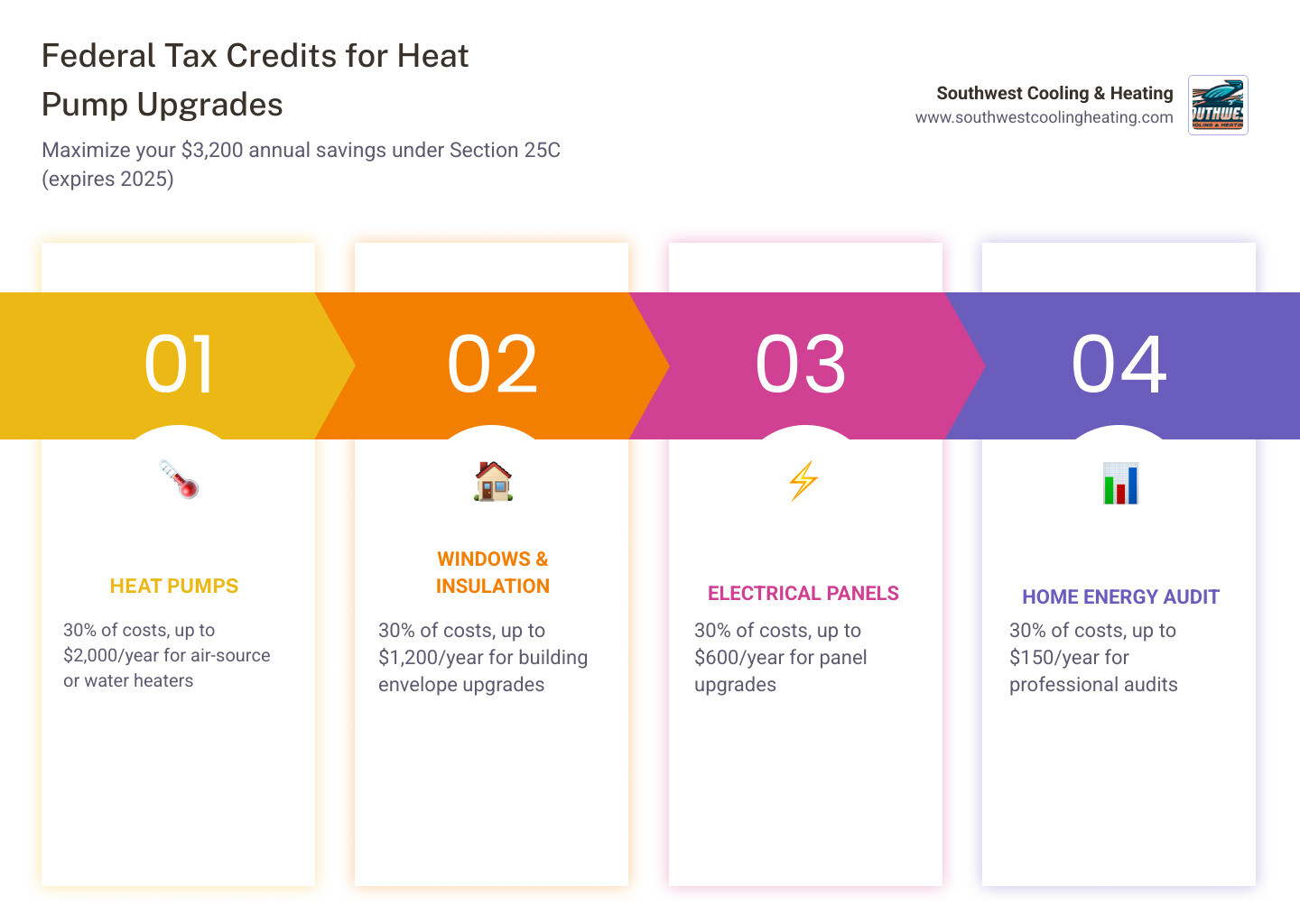
Federal tax credits for heat pump upgrades allow eligible homeowners to claim 30% of their total project costs, up to $2,000 per year, through December 31, 2025, under Section 25C of the tax code.
Here is a quick summary of what is available:
| Improvement Type | Credit Rate | Annual Cap |
|---|---|---|
| Air-source heat pump | 30% of cost | $2,000 |
| Heat pump water heater | 30% of cost | $2,000 (combined with above) |
| Windows, doors, insulation | 30% of cost | $1,200 |
| Electrical panel upgrade | 30% of cost | $600 |
| Home energy audit | 30% of cost | $150 |
| Total annual maximum | $3,200 |
Key facts to know before you read further:
- The credit is non-refundable — it can reduce your tax bill to zero, but you will not receive a refund for any unused portion
- There is no lifetime dollar limit, so you can claim the maximum each year through 2025
- Installations must be completed by December 31, 2025 to qualify under the current law
- You claim the credit using IRS Form 5695 when you file your federal taxes
- Starting in 2025, your heat pump must be from a qualified manufacturer, and you must include a four-digit QM code on your tax return
For St. George homeowners, this is one of the most significant opportunities in decades to reduce the upfront cost of upgrading to a more efficient home comfort system. Heating and cooling account for the largest share of energy expenses in most American homes, and modern heat pumps are three to five times more energy-efficient than traditional fossil fuel heating systems. With Southern Utah summers pushing temperatures well above 100°F, the ability to offset installation costs with a substantial federal tax credit makes now an especially smart time to act.
I’m Bruce Hymas, owner of Southwest Cooling and Heating, and my background in business operations — combined with decades of hands-on HVAC experience serving the St. George area — gives me a practical, homeowner-focused perspective on navigating federal tax credits for heat pump upgrades. Let me walk you through everything you need to know to make the most of these incentives before the 2025 deadline.
When we talk about the Inflation Reduction Act (IRA), we are really talking about a massive shift in how the government encourages us to think about our homes. For those of us living in the heat of the Washington County valley, the most important part of this law is the Energy Efficient Home Improvement Credit, also known as Section 25C.

This isn’t just a small “thank you” from the IRS; it’s a substantial 30% credit on the total cost of your project. If you decide to install a Heat Pump, the federal government will essentially cover nearly a third of the investment, capped at a generous $2,000 per year.
It is important to understand the “non-refundable” status of this credit. In plain English, this means the credit can only cancel out the taxes you actually owe. If you owe $1,500 in federal income tax and you have a $2,000 credit, your tax bill drops to zero, but Uncle Sam won’t send you a check for the remaining $500. Furthermore, unlike some other credits, the 25C credit does not allow you to “carry forward” the leftover amount to next year. It’s a “use it or lose it” situation for that specific tax year.
As we move through May 2026, we are looking back at the final window for these specific incentives. The 25C credit is currently set to expire for any systems not “placed in service” by December 31, 2025. There is, however, a separate credit called Section 25D (the Residential Clean Energy Credit) which applies to geothermal heat pumps. That one is even more robust—covering 30% with no dollar limit and allowing for a carry-forward—but for the standard air-source units most common in St. George and Hurricane, 25C is the primary pathway.
Qualifying Equipment for Federal Tax Credits for Heat Pump Upgrades
Not every unit you find at a big-box store is going to qualify for these savings. The IRS has strict standards to ensure that the money is going toward truly high-efficiency technology. To qualify for the maximum $2,000 annual credit, the equipment must meet specific criteria:
- Air-Source Heat Pumps: These provide both heating and cooling. For a Heat Pump Installation to qualify in 2025, the unit must meet the “ENERGY STAR Most Efficient” requirements.
- Heat Pump Water Heaters: These are incredibly efficient at keeping your showers hot while using a fraction of the electricity of a standard tank. They share the same $2,000 annual cap as the HVAC heat pump.
- Biomass Stoves: While less common in our desert climate, these also qualify under the same category.
For 2025 installations, the IRS looks to the Consortium for Energy Efficiency (CEE) and their highest efficiency tiers. This ensures that the system we install in your Ivins or Santa Clara home isn’t just “good enough,” but is actually at the top of its class for energy conservation.
Eligibility and Efficiency Standards for Utah Homeowners
One of the most common questions we get at Southwest Cooling & Heating is: “Does my house qualify?” The rules are actually quite friendly for most residents in our service area, from Bloomington to Toquerville.
First, the 25C credit is designed for existing homes. If you are building a brand-new home in Coral Canyon, you generally cannot claim the 25C credit for your HVAC system (though the builder might receive separate incentives). However, if you are upgrading the system in the home you’ve lived in for years, you are right in the target zone.
Second, the home must be used as a residence. While it is usually your primary residence, there is some flexibility. Interestingly, Heat Pump Conversion Utah HVAC Credits can also apply to second homes that you use as a residence, though you cannot claim “building envelope” improvements (like windows or insulation) on a second home.
What about renters? Believe it or not, if you are renting a home in La Verkin and you pay for a qualifying heat pump upgrade yourself, you may be eligible for the credit. On the flip side, landlords generally cannot claim these credits for properties they do not live in.
Technical Efficiency Requirements (The “Alphabet Soup”)
To make sure you get your tax break, the equipment must hit specific performance marks. In our “Southern Tier” climate zone (which includes St. George), the standards are slightly different than in the snowy north:
- Split Ducted Systems: Must meet a SEER2 rating of 15.2 or higher.
- Packaged Systems: Also require a 15.2 SEER2.
- Ductless (Mini-Split) Systems: These are popular for garages or additions and must meet a SEER2 of 16 or higher.
We always provide our customers with the manufacturer’s certification statement to prove the unit meets these HSPF2 and SEER2 requirements, so you aren’t left guessing when tax season rolls around.
Strategic Multi-Year Planning for Energy Savings
If you’re planning a total home overhaul, timing is everything. Because the $3,200 total annual cap resets every January 1st, you can maximize your savings by spreading projects out.
| Credit Category | Annual Limit | Best Strategy |
|---|---|---|
| Heat Pump / HP Water Heater | $2,000 | Install the main HVAC system in Year 1. |
| Building Envelope (Windows/Doors) | $600 – $1,200 | Upgrade windows or insulation in Year 2. |
| Electrical Panel | $600 | Upgrade the panel in the same year as the heat pump if needed. |
| Home Energy Audit | $150 | Do this first to find where you’re losing air! |
For example, a homeowner in Winchester Hills might perform a home energy audit and add attic insulation this year to claim up to $1,350 ($150 for the audit + $1,200 for insulation). Then, next year, they could install a high-efficiency heat pump to claim another $2,000. By splitting the work, they receive $3,350 in total credits rather than being capped at $3,200 in a single year.
Don’t forget that these federal credits can often be “stacked” with local utility rebates. While we can’t speak for every utility, many providers in the St. George area offer their own incentives for energy-efficient upgrades. Just remember: the IRS requires you to subtract any utility subsidies or rebates from the total project cost before you calculate your 30% tax credit.
Required Documentation and the 2025 QM Code
As of 2025, the IRS has tightened the screws on how these credits are reported. It’s no longer enough to just tell them you bought a heat pump; they want proof that the manufacturer is “qualified.”
The most critical piece of information for your tax return is the Qualified Manufacturer (QM) code. This is a four-digit identification number (sometimes called a QMID or PIN) provided by the manufacturer. When we finish an installation in Diamond Valley or Hidden Valley, we ensure you have the specific code for your unit. Without this code on IRS Form 5695, your claim will likely be rejected.
Strategic Filing for Federal Tax Credits for Heat Pump Upgrades
When it comes time to file, keep a “tax folder” specifically for your HVAC project. You should have:
- The Invoice: Showing the total cost, including labor. (Yes, labor costs for installing the heat pump qualify for the 30% credit!)
- Manufacturer Certification: A document from the brand (like Mitsubishi or Bosch) stating the unit meets the CEE efficiency tiers.
- The QM Code: That essential four-digit number.
- Rebate Records: Documentation of any money you received back from your utility company.
Because the credit is non-refundable, you want to ensure you have enough tax liability to actually use it. If you’re retired or have a lower income, it’s worth a quick chat with a tax professional to see how much of the $2,000 you can actually benefit from.
Frequently Asked Questions about Federal Tax Credits for Heat Pump Upgrades
When does the heat pump tax credit expire?
Under current legislation, the 25C Energy Efficient Home Improvement Credit is available for equipment installed through December 31, 2025. Any systems placed in service on January 1, 2026, or later, are currently ineligible for this specific tax credit unless Congress extends the law. If you’ve been on the fence, the clock is definitely ticking.
Can I claim the credit for a second home in Utah?
Yes, but with caveats. You can claim the credit for “energy property” like air-source heat pumps and heat pump water heaters on a second home, provided you use it as a residence. However, you cannot claim the credit for “building envelope” improvements—like windows, doors, or insulation—on any home other than your primary residence. So, if you have a vacation spot in Hurricane, the heat pump is covered, but the new windows are not.
Is the heat pump tax credit refundable?
No, it is non-refundable. It can reduce the amount of tax you owe to zero, but it won’t result in a check for the difference. If you only owe $1,000 in federal taxes, your maximum benefit for that year is $1,000, even if you spent enough to qualify for the full $2,000. There is also no carry-forward provision for the 25C credit, so any unused portion is lost.
Conclusion
Upgrading your home’s comfort system is a big decision, but the federal tax credits for heat pump upgrades make it a much easier pill to swallow. By taking advantage of the 30% credit and the $2,000 annual cap, you’re not just saving money on the installation—you’re setting yourself up for years of lower utility bills in our demanding Utah climate.
At Southwest Cooling & Heating, we’ve been serving the St. George community since 1980. We’ve seen tax incentives come and go, but the current Inflation Reduction Act benefits are some of the most robust we’ve ever seen. Whether you’re in Ivins, Santa Clara, or Bloomington Hills, our team is ready to provide the high-quality, reliable service we’re known for. We combine modern technology with old-school values to ensure your home stays comfortable, no matter how high the mercury climbs.
Don’t let the 2025 deadline pass you by. Schedule your expert heat pump installation today and let us help you maximize your tax savings while upgrading your home’s efficiency.