


Understanding Utah’s Primary Energy Rebate Programs in 2026
How to apply for energy rebates in Utah is something many St. George homeowners want to know — but most never follow through because the process feels complicated before it even begins. Here is the short answer:
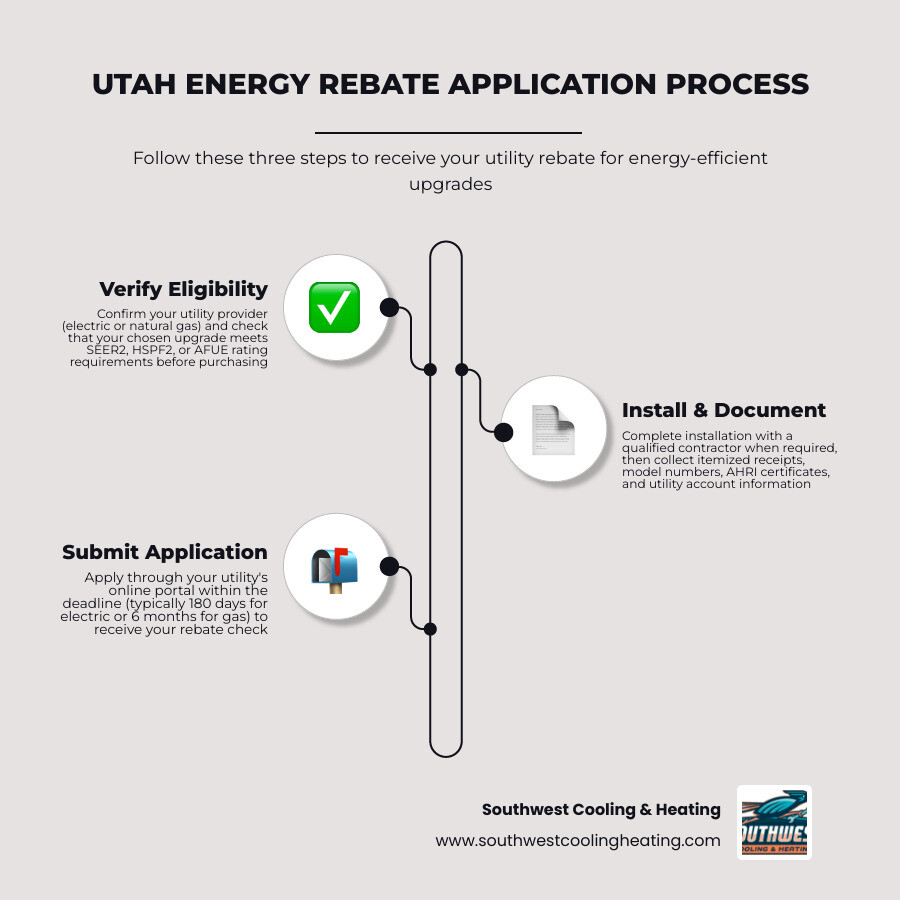
- Identify your utility provider — Rocky Mountain Power (electric) or Enbridge Gas (natural gas).
- Choose a qualifying upgrade — such as a heat pump, smart thermostat, high-efficiency furnace, or insulation.
- Verify product specifications meet program requirements before you buy (check SEER2, HSPF2, or AFUE ratings).
- Complete installation using a qualified contractor when the program requires one.
- Gather your documents — utility account number, itemized receipt, model numbers, and efficiency certificates.
- Submit your application through the utility’s online portal within the deadline — typically 180 days for Rocky Mountain Power’s Wattsmart program or six months for Enbridge Gas ThermWise.
- Receive your rebate — usually within 14 business days after approval for electric rebates, or approximately six weeks for gas program checks.
Utah homeowners have real money available through utility rebate programs, and the savings go beyond the rebate check itself. Research shows that households participating in weatherization programs average about 35% in annual energy savings — roughly $583 per year. Yet many homeowners either don’t know these programs exist or start the process too late to qualify. With multiple programs running at the same time — covering electric upgrades, natural gas appliances, weatherization improvements, and low-income assistance — knowing where to start makes all the difference.
I’m Bruce Hymas, owner of Southwest Cooling and Heating in St. George, and my team works with homeowners every day who want to understand how to apply for energy rebates in Utah before committing to an HVAC upgrade. With decades of hands-on experience in energy-efficient heating and cooling systems across Southern Utah, I want to make this process clear and straightforward so you can capture every dollar available to you.
When you begin looking into energy efficiency upgrades, it is easy to get lost in a sea of acronyms. In Utah, the rebate landscape is primarily divided between your electric utility and your natural gas utility. If you live in St. George, Washington, Santa Clara, Hurricane, or Ivins, you are likely served by Rocky Mountain Power for your electricity, while Enbridge Gas (formerly Dominion Energy) provides your natural gas.
Each utility manages its own separate rebate program. This means you do not apply to a single state office for everything; instead, you apply directly to the utility that charges you for the energy used by that specific appliance.
Upgrading to high-efficiency systems can dramatically lower your monthly bills. If you are wondering about the long-term financial impact of upgrading your comfort systems, you can learn more about whether Will a New HVAC System Actually Save You Money? to understand how these savings stack up over time.
How to Apply for Energy Rebates in Utah for Electric Upgrades
Rocky Mountain Power runs the Wattsmart Home program. This program is designed to incentivize residential electric customers to install energy-efficient equipment that reduces electricity consumption.
The most substantial electric rebates in 2026 are centered around heat pump technology. Because heat pumps transfer heat rather than generating it, they can deliver up to three times more heat energy than the electricity they consume. The Wattsmart program offers robust incentives for:
- Ducted Heat Pumps: Transitioning from electric baseboard heating or a standard central air conditioner to a high-efficiency heat pump.
- Dual-Fuel Heat Pumps: Combining an electric heat pump with a high-efficiency natural gas furnace. This smart pairing switches between electric heating on milder winter days and gas heating when temperatures drop, optimizing efficiency year-round.
- Smart Thermostats: Upgrading to a qualified smart thermostat that manages your heating and cooling schedules automatically.
For homeowners in Southern Utah, making this switch can yield significant financial returns. If you want to dive deeper into the specific credits and rebates associated with these systems, check out our guide on Heat Pump Conversion Utah HVAC Credits.
How to Apply for Energy Rebates in Utah for Natural Gas Upgrades
For natural gas appliances, the program you need is ThermWise, managed by Enbridge Gas. The ThermWise program is designed to help homeowners reduce their natural gas consumption through high-efficiency heating systems, water heaters, and thermal envelope upgrades.
Key residential rebate categories under the ThermWise program include:
- High-Efficiency Gas Furnaces: Upgrading older, standard-efficiency furnaces (which often run at around 70% AFUE) to modern, high-efficiency models. In one Utah dataset, furnace efficiency improved from an average of 69.59% AFUE to 94.95% AFUE after qualifying upgrades.
- Gas Water Heaters: Upgrades to high-efficiency condensing gas storage water heaters or ENERGY STAR certified tankless gas water heaters.
- Weatherization Improvements: Adding attic insulation, wall insulation, floor insulation, or upgrading to high-performance windows with a U-Factor of 0.22 or lower.
Step-by-Step: How to Apply for Energy Rebates in Utah
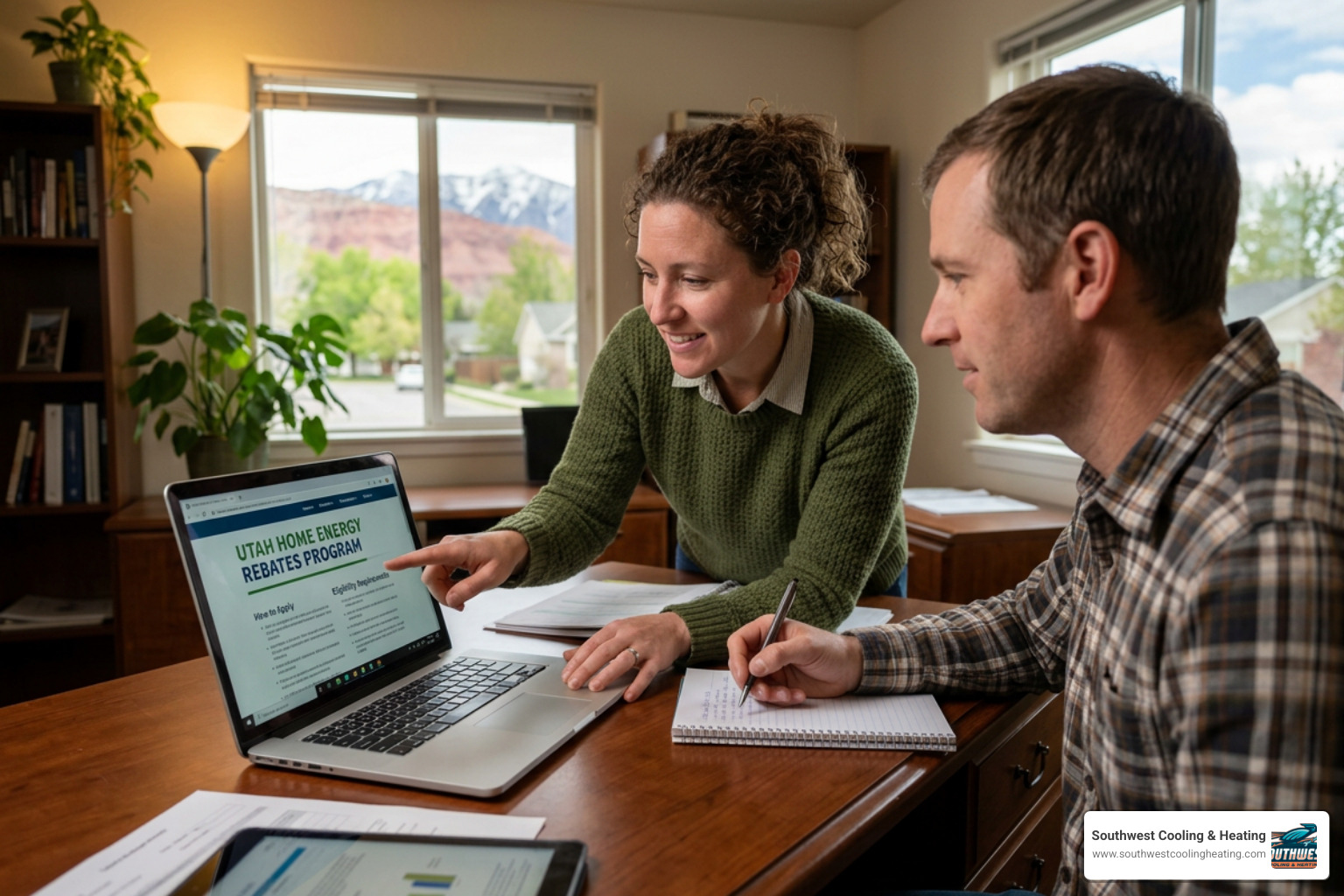
Applying for rebates does not have to be a headache. If you follow a structured process, you can ensure your application is processed quickly and without delay. Here is our step-by-step roadmap to securing your cash back:
Step 1: Confirm Your Utility Providers
Make sure you have active accounts with Rocky Mountain Power or Enbridge Gas. Your home’s physical service address must match the address on your utility bills.
Step 2: Choose an Eligible Upgrade
Before you buy any equipment, review the current program guidelines on the Wattsmart or ThermWise websites. Do not assume that because a box says “ENERGY STAR” it automatically qualifies for every local rebate. Equipment must meet specific efficiency thresholds (such as SEER2, HSPF2, or AFUE) defined by the utility’s tariff rules.
Step 3: Hire a Qualified, Program-Participating Contractor
For major installations like heat pumps, dual-fuel systems, and central air conditioners, the utilities require the work to be completed by an approved trade ally or program-participating contractor. If you install the system yourself or hire an unapproved contractor, your rebate application will be denied.
Step 4: Keep All Documentation from the Installation
Collect the physical itemized invoice, the manufacturer’s specification sheets showing model numbers for both indoor and outdoor units, the AHRI (Air-Conditioning, Heating, and Refrigeration Institute) certificate, and any energy performance stickers (like NFRC labels on windows).
Step 5: Submit the Application Online
While paper forms are still accepted by mail, submitting online is much faster and reduces the risk of lost paperwork. Use the official online portals:
- For electric rebates: Visit the Wattsmart Home portal.
- For gas rebates: Visit the ThermWise portal.
| Rebate Program Feature | Rocky Mountain Power (Wattsmart) | Enbridge Gas (ThermWise) |
|---|---|---|
| Primary Focus | Electricity reduction (Heat pumps, AC, Smart Thermostats) | Natural gas conservation (Furnaces, Water Heaters, Insulation) |
| Application Deadline | Within 180 days of installation | Within 6 months of installation |
| Contractor Requirement | Must use a program-participating contractor for HVAC | Must use a qualified installer for specific measures |
| Typical Processing Time | Within 14 business days after final approval | Approximately 6 weeks from submission |
| Rebate Payment Method | Direct check or utility bill credit | Direct check |
Eligibility Requirements and Verifying Product Specifications
To qualify for residential energy rebates in Utah, you must meet specific customer and equipment criteria. Understanding these technical specifications beforehand prevents the frustration of buying an expensive system only to find out it is ineligible.
Customer and Property Eligibility
To apply, you must be a residential customer on an active residential rate schedule. The property must be an existing home (retrofits) or, in the case of specialized builder programs, a newly constructed single-family or multifamily residence.
For income-qualified households, additional support is available. Programs like the HEAT (Home Energy Assistance Target) program and the HELP (Utah Home Electric Lifeline Program) offer direct bill discounts and heating assistance for households earning up to 150% of the federal poverty level. Furthermore, the Utah Weatherization Assistance Program helps households earning up to 200% of the federal poverty level make energy-efficient home improvements at no cost, leading to average annual savings of roughly $583 per home.
Verifying Technical Equipment Standards
When purchasing heating and cooling equipment, you must verify the certified efficiency ratings. Your contractor should provide an AHRI Certificate of Product Performance, which certifies that the specific combination of outdoor condenser, indoor evaporator coil, and furnace/blower motor works together to achieve the rated efficiency.
- SEER2 (Seasonal Energy Efficiency Ratio 2): Measures cooling efficiency.
- HSPF2 (Heating Seasonal Performance Factor 2): Measures heat pump heating efficiency.
- AFUE (Annual Fuel Utilization Efficiency): Measures gas furnace combustion efficiency. High-efficiency systems generally require 95% to 98% AFUE to qualify for gas rebates.
Investing in these high-efficiency standards does more than qualify you for cash back; it fundamentally improves how your home feels and operates. You can read more about these structural advantages in The Ultimate Guide to New HVAC Benefits Beyond Comfort.
Maximizing Savings: Combining Utility Rebates with Federal Tax Credits
One of the best strategies for Utah homeowners in 2026 is “incentive stacking.” While you cannot combine two different federal rebates for the exact same upgrade, you can combine your local utility rebates with federal tax credits.
Under the Inflation Reduction Act (IRA), the Section 25C Energy Efficient Home Improvement Credit allows homeowners to claim a tax credit of up to 30% of the installation cost for qualifying high-efficiency upgrades.
Here is how these federal caps work alongside your local utility programs:
- Heat Pumps: You can claim up to a $2,000 federal tax credit per year for a qualifying ducted heat pump. This tax credit can be claimed on your annual tax return, while you simultaneously collect up to $1,450 in direct cash back from Rocky Mountain Power’s Wattsmart program for an AHRI-rated dual-fuel heat pump.
- Gas Furnaces and Air Conditioners: You can claim up to a $600 federal tax credit for a gas furnace (minimum 97% AFUE) or a highly efficient central air conditioner (SEER2 $ge$ 16), while also receiving $300 to $350 back from ThermWise.
- Smart Thermostats and Insulation: These upgrades qualify for a 30% federal tax credit (up to separate caps) and can be combined with local utility cash incentives.
Taking advantage of these stacked incentives dramatically lowers the net cost of your home comfort project. If you are planning an upgrade and want to explore flexible payment options to cover the remaining balance, we invite you to look at our Financing options to find a plan that fits your household budget.
Frequently Asked Questions About Utah Energy Rebates
Navigating the application process often brings up a few common questions. Here are the answers to the questions we hear most frequently from homeowners in St. George and the surrounding communities.
What documentation is required when applying for Utah energy rebates?
To submit a successful rebate application, you will need to gather several specific documents. Missing even one of these can cause your application to be delayed or denied:
- Your Utility Account Number: This must match the service address where the equipment was installed.
- Itemized Contractor Invoice: This invoice must show the installation date, the contractor’s license number, the brand name, and the complete model and serial numbers for all installed indoor and outdoor equipment.
- AHRI Certificate: For heat pumps and air conditioners, this document certifies the matched system’s efficiency rating.
- NFRC Stickers: If you are applying for window rebates, you must keep and submit photos of the National Fenestration Rating Council stickers showing a U-Factor of 0.22 or lower.
- W-9 Form: This is sometimes required for rebates exceeding certain thresholds for tax reporting purposes.
What are the application deadlines and processing times for Utah rebates?
Application deadlines are strict and non-negotiable.
- For Rocky Mountain Power (Wattsmart), you must submit your completed application and documentation within 180 days of the installation date. Once approved, rebates are typically processed and paid out within 14 business days.
- For Enbridge Gas (ThermWise), applications must be postmarked or submitted online within six months of the installation date. The typical processing time for ThermWise checks is approximately six weeks.
How do I find approved contractors or trade allies in Southern Utah?
Many utility rebate programs require you to work with an approved trade ally or a program-participating contractor to qualify for HVAC incentives. These contractors are trained to understand the specific efficiency specifications, perform correct load calculations, and provide you with the exact documentation (like AHRI certificates) needed for a successful application.
When choosing a contractor, verify that they serve your specific local area — whether you are in Santa Clara, Bloomington, Hurricane, Ivins, Toquerville, or La Verkin — and ensure they have a proven track record of installing rebate-eligible equipment. Beyond the immediate cash back, upgrading your HVAC system is a smart long-term investment. If you are wondering how these improvements affect your property value, read our article on Will a New HVAC Help Sell Your Home Faster? to see how modern, efficient systems appeal to future buyers.
Conclusion
Applying for energy rebates in Utah is one of the smartest moves you can make as a homeowner. By combining Rocky Mountain Power’s Wattsmart incentives, Enbridge Gas’s ThermWise rebates, and federal tax credits, you can offset a substantial portion of your upfront investment while securing lower utility bills for years to come.
The secret to a successful rebate is simple: plan ahead, verify your equipment specs before purchasing, and work with a qualified professional who understands the paperwork.
At Southwest Cooling & Heating, we have been helping families across St. George, Santa Clara, Hurricane, Ivins, and the surrounding areas stay comfortable since 1980. We combine modern technical expertise with old-school customer service values, and we are always here to help you select, install, and document the perfect energy-efficient system for your home.
Ready to maximize your home comfort and your savings? Upgrade to an energy-efficient heat pump today and let our expert team guide you through every step of the process.