


Is a Mini Split Better Than Central Air? A Clear Central AC vs Ductless Mini Split Comparison
When it comes to keeping your St. George home cool, the central ac vs ductless mini split comparison comes down to a few key factors: whether you have existing ductwork, how many rooms you need to cool, and how much control you want over your energy use.
Here is a quick breakdown to help you decide:
| Factor | Central AC | Ductless Mini Split |
|---|---|---|
| Best for | Homes with existing ductwork | Homes without ducts or with additions |
| Efficiency | Up to 21+ SEER2 | Up to 33-38+ SEER2 |
| Zoning | Requires add-ons | Built-in, room by room |
| Installation disruption | Moderate to high | Minimal (3-inch wall hole) |
| Whole-home coverage | Yes | Yes (with multiple heads) |
| Lifespan | ~15 years | 20-30 years |
| Duct energy loss | 10-30% possible | None |
Neither system is universally better. The right choice depends on your home’s layout, your existing infrastructure, and how you actually use your space day to day.
If you already have well-sealed ductwork, central AC is often the most straightforward and cost-effective path. If your home lacks ducts — or you want room-by-room temperature control without cooling empty spaces — a ductless mini split is worth a serious look.
St. George summers are no joke. With temperatures regularly climbing well above 100°F, choosing the wrong cooling system can mean higher energy bills, uneven comfort, and a system that struggles to keep up when you need it most. That is why getting this decision right matters.
I’m Bruce Hymas, owner of Southwest Cooling and Heating, and I have spent years helping Southern Utah homeowners navigate exactly this kind of decision — including how to apply the central ac vs ductless mini split comparison to real homes with real constraints. Let me walk you through what actually matters when making this choice for your home.
Understanding the Central AC vs Ductless Mini Split Comparison
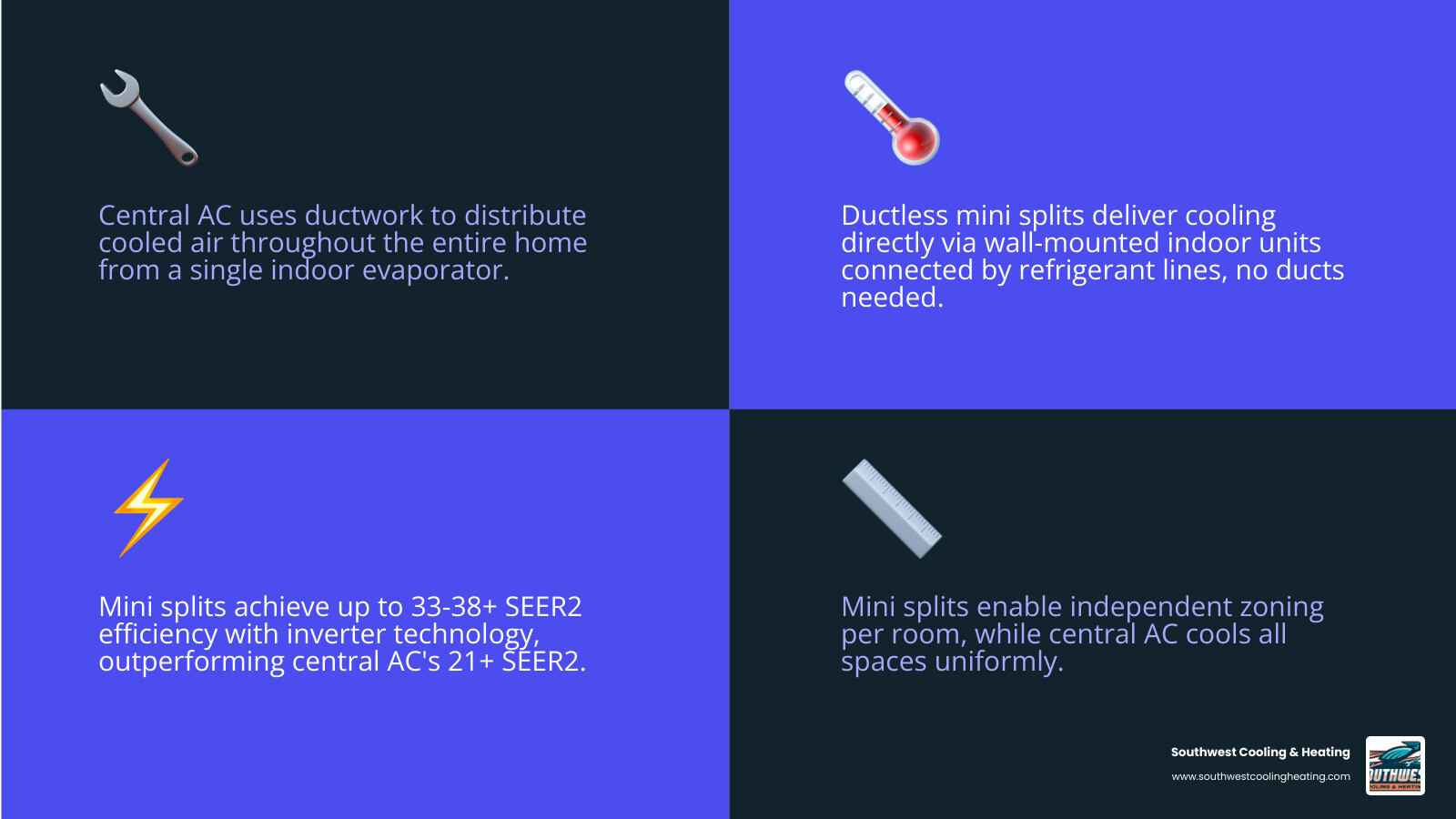
To really get a handle on the central ac vs ductless mini split comparison, we first need to look at what’s happening under the hood. While both systems use the same basic physics — using refrigerant to pull heat out of your home and dump it outside — the way they deliver that cool air is completely different.
In a central system, you have one large outdoor condenser and one indoor evaporator coil (usually tucked away in a closet or attic). That indoor unit is connected to a network of ducts that snake through your walls and ceilings, pushing air into every room simultaneously.
A ductless mini split, on the other hand, skips the “middleman” of ductwork. It still has an outdoor unit, but it connects directly to one or more indoor “heads” mounted on the wall or ceiling of specific rooms. These are linked by small refrigerant lines and electrical cables that only require a tiny three-inch hole in your exterior wall.
| Component | Central AC | Ductless Mini Split |
|---|---|---|
| Outdoor Unit | Large Condenser | Compact Compressor |
| Indoor Unit | Single Air Handler/Coil | Multiple Wall/Ceiling Heads |
| Air Distribution | Ductwork and Vents | Direct Airflow from Head |
| Control | Single Thermostat (usually) | Individual Remote/Thermostat per Zone |
Whether you are looking for a full AC Installation or a targeted Mini Split Installation, understanding these mechanical differences is the first step toward a comfortable home in Hurricane or Ivins.
How Central Air Works in Southern Utah Homes
Central air has been the standard for Southern Utah homes built since the late 1970s. In communities like Hidden Valley and Coral Canyon, most homes were designed from the ground up to support a massive air handler and the necessary ductwork.
The primary advantage here is invisibility. You don’t see the equipment; you just feel the cool air coming through the floor or ceiling vents. Central systems are also excellent at maintaining a uniform temperature across a large, open-concept floor plan. However, they rely heavily on the health of your ducts. If your ductwork is leaky or poorly insulated — which is common in older homes in Bloomington — you could be losing up to 30% of your cooling power before it ever reaches your living room. This is why regular AC Maintenance is so critical for central systems.
The Mechanics of a Ductless Mini Split Comparison
The central ac vs ductless mini split comparison takes a high-tech turn when we look at mini splits. These systems use “inverter technology,” which allows the compressor to speed up or slow down based on the exact cooling demand. Think of it like a dimmer switch for your lights versus a standard on/off switch.
Because each indoor head has its own thermostat, you can keep your bedroom at a crisp 68°F while leaving the guest room at 78°F. This is a game-changer for residents in Santa Clara or Diamond Valley who have rooms that always seem to stay hotter than the rest of the house. If you are interested in a system that can also provide efficient heat during our chilly desert winters, an HVAC Ductless Heat Pump is a versatile choice. For those researching the best models, we have compiled a list of Top Rated Ductless Heat Pumps for St. George Residents to help guide your search.
Energy Efficiency and Performance Factors
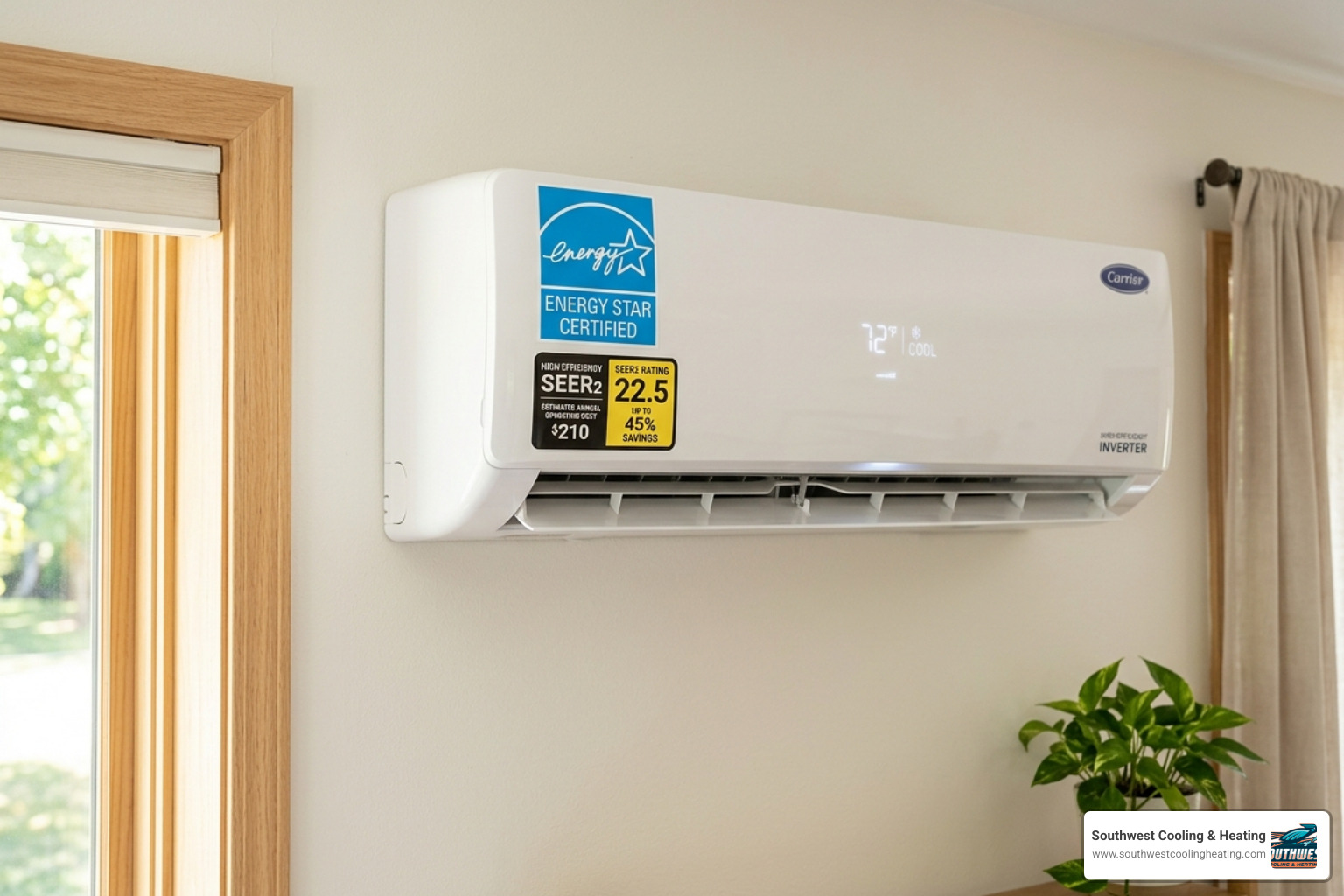
As of April 2026, energy standards have become even more stringent, making efficiency a top priority for our neighbors in Toquerville and La Verkin. When we talk about the central ac vs ductless mini split comparison, efficiency is where mini splits often pull ahead.
Efficiency is measured by the SEER2 (Seasonal Energy Efficiency Ratio 2) rating. While high-end central AC systems can reach 18 to 21+ SEER2, premium ductless mini splits can achieve staggering ratings of 33 to 38+ SEER2.
Why the big difference? It comes down to two main factors:
- Duct Loss: The Department of Energy estimates that leaky or uninsulated ductwork can waste more than 30% of a system’s energy consumption. Since mini splits don’t use ducts, they have zero duct loss.
- Variable-Speed Compressors: Most mini splits use inverter-driven compressors that run at the lowest possible speed to maintain comfort, whereas many standard central units still use older on/off or two-stage technology that consumes more power.
Replacing an old SEER 10 system with a modern ENERGY STAR model can save you significantly on your monthly cooling costs. We’ve seen many families discover Why Bloomington Hills Homes Are Going Ductless This Season — it often comes down to the sheer math of energy savings.
Choosing the Right System for Your Home Layout
Your home’s layout is perhaps the biggest “deciding factor” in the central ac vs ductless mini split comparison.
If you live in a large, 3,000-square-foot home in Winchester Hills with existing, high-quality ductwork, a central AC system is likely your best bet. It provides powerful, whole-home cooling through a single, manageable system. However, if your existing ducts are failing or were poorly designed, you might face a choice: spend thousands to replace the ductwork or switch to a ductless setup.
Ductless systems are the heroes of historic home preservation and modern additions. If you are converting a garage in Ivins into a home office or adding a sunroom to your home in Bloomington, extending ductwork can be a nightmare. It often involves cutting into walls and losing ceiling height. A mini split avoids all of that.
If your current system is struggling to keep up with a new layout or an aging structure, you might first need an AC Repair to diagnose the issue, but often, a layout change is the perfect time to reconsider your system type.
When to Choose a Central AC vs Ductless Mini Split Comparison
We often tell our customers that there is no one-size-fits-all answer. However, certain scenarios make the choice much clearer.
Choose Central AC if:
- You have existing, functional ductwork in good condition.
- You prefer the “invisible” look of vents over wall-mounted units.
- You want a single, centralized air filtration system.
- You need to cool a very large home (over 2,500 sq. ft.) uniformly.
Choose a Ductless Mini Split if:
- Your home has no existing ductwork (common in older St. George homes).
- You are adding a new room, garage workshop, or “mother-in-law” suite.
- Different family members have wildly different temperature preferences.
- You have “problem rooms” that never stay cool enough with your current central system.
- You want the absolute highest energy efficiency possible to combat Southern Utah heat.
For those ready to make the switch to targeted cooling, a professional Mini Split Installation ensures the unit is sized perfectly for the square footage of your specific room.
Maintenance and Long-Term Reliability in 2026
In 2026, we are seeing that both systems are more reliable than ever, provided they are cared for correctly. However, the maintenance routines for the central ac vs ductless mini split comparison differ quite a bit.
Central AC systems require you to change a large pleated filter every 1 to 3 months. You also need to keep an eye on your ductwork to ensure dust and debris aren’t building up. If you have pets or allergies, this filtration is excellent because it cleans the air for the whole house at once.
Ductless mini splits have smaller, reusable filters inside each indoor head. These need to be popped out and washed under a tap every 2 to 4 weeks during heavy use. Because these units are in your living space, they can collect dust more quickly. Neglecting these filters is the number one reason mini splits lose efficiency.
In terms of lifespan, central AC units typically last about 15 years in our harsh desert climate. Mini splits, because they often run at lower stress levels thanks to inverter technology, can last 20 to 30 years with proper care. Regardless of which you choose, annual AC Maintenance by a professional is the only way to ensure you get the full life out of your investment.
Frequently Asked Questions about Home Cooling
Can I use both systems together in a hybrid setup?
Absolutely! This is actually one of the smartest ways to handle the central ac vs ductless mini split comparison. Many homeowners in St. George use a central AC for the main living areas but add a single-zone HVAC Ductless Heat Pump for a master bedroom or a converted garage. This allows you to keep the central system at a higher temperature at night while only cooling the room you are actually sleeping in.
Which system provides better indoor air quality?
Central AC generally wins on raw filtration power. Because it uses a large, high-MERV filter, it can catch more pollen and dust from the entire home’s air volume. However, this only works if your ducts are clean. Ductless systems offer multi-stage filtration in each head, which is great for localized air cleaning, but they don’t move as much total air volume as a central system. Proper AC Installation of either system should always consider your specific IAQ needs.
How do rebates and incentives factor into the decision?
In 2026, the Inflation Reduction Act (IRA) continues to offer significant federal tax credits for high-efficiency HVAC upgrades. Qualifying ductless heat pumps can often net you a tax credit of up to $2,000, making them much more competitive. Many local utility companies in Southern Utah also offer rebates for moving to higher SEER2 systems. You can learn more about how these financial perks apply to our area by reading about Why Bloomington Hills Homes Are Going Ductless This Season.
Conclusion
The central ac vs ductless mini split comparison isn’t about finding a “winner” — it is about finding the right fit for your specific Southern Utah lifestyle. Whether you are looking for the whole-home consistency of central air or the precision efficiency of a ductless system, the goal is always the same: a cool, inviting home where you can escape the desert sun.
At Southwest Cooling & Heating, we have been serving the St. George community since 1980. From the historic streets of Santa Clara to the growing neighborhoods of Hurricane and La Verkin, we bring modern technology and old-school values to every job. We stand behind our work with performance and satisfaction guarantees, ensuring your comfort is never in question.
Are you ready to stop guessing which system is right for you? Schedule your professional HVAC Ductless Heat Pump consultation today and let our expert team help you design the perfect cooling solution for your home.