


Is It Normal for the Breaker to Trip During the First Fall Heating Startup?
Are you searching for reliable home maintenance tips and troubleshooting advice because your heat pump just shut down your entire electrical circuit on the first cold night of the year? You are not alone. When the November first-freeze arrives, many homeowners turn their thermostats to “heat” for the first time in months, only to be met with a sudden loss of power to the unit and, occasionally, a faint burning odor. This sudden failure creates an immediate decision point: is this just normal seasonal dust burning off the heating elements, or is it a sign of a severe mechanical failure that requires immediate professional attention?
The short answer is that a tripped circuit breaker is never a normal part of your system’s seasonal transition. The breaker in your electrical panel is a critical safety mechanism designed to cut power when a device pulls a dangerous amount of electrical current. While a brief burning smell can sometimes just be settled dust clearing out of the heat exchanger or auxiliary heat strips, a tripped breaker indicates a severe electrical overload. When you are faced with this situation, you will eventually need to decide whether it makes more sense to repair or replace your AC and heating components. Because high-voltage electrical diagnostics carry significant safety risks, it is always recommended to call a professional for AC problems rather than attempting risky electrical do-it-yourself repairs.
How Extreme Summer Heat Sets the Stage for Fall Electrical Failures
To understand why your heat pump or compressor fails in the late fall, you have to look at what the equipment endured over the previous six months. In the St. George region, extreme triple-digit summer heat forces HVAC systems to run nearly continuously. This grueling cooling season accelerates wear and tear on every internal electrical component long before the winter season even begins. By the time November arrives, the system is already deeply fatigued.
The transition from a heavy summer cooling load to a sudden November heating load is mechanically jarring. During the summer, the continuous operation masks dormant issues. A wire that is slowly degrading or a capacitor that is losing its ability to hold a charge might still manage to keep the system limping along during the summer because the unit rarely cycles completely off. However, when the system sits idle during the mild weeks of early fall and is then suddenly asked to start up against cold, dense refrigerant during the first freeze, those hidden weaknesses are immediately exposed.
The Invisible Wear and Tear on Your HVAC System
Prolonged high temperatures bake the electrical components inside your outdoor condenser. This continuous heat exposure causes several specific types of invisible degradation:
- Electrical insulation breakdown: The protective coating on internal wiring becomes brittle and cracks after months of high-heat operation, increasing the risk of short circuits.
- Thermal expansion and contraction: As the system heats up during the day and cools at night, metal electrical connections expand and contract. Over time, this loosens the spade connectors on contactors and capacitors.
- Contactor pitting: The high-voltage switch that turns the compressor on and off arcs slightly every time it engages. Over a long summer, this creates carbon buildup and pitting, which causes resistance and forces the system to pull more amperage.
The Hidden Dangers of Repeatedly Resetting a Tripped Breaker
If your HVAC system trips the breaker, the most dangerous thing you can do is continuously flip the switch back to the “on” position. A continuously tripping breaker is definitively signaling a severe electrical overload, a grounded circuit, or a mechanical lockup. According to National Fire Protection Association (NFPA) electrical safety guidelines, drawing excess amperage through a compromised circuit poses a significant fire risk. The breaker is doing exactly what it was engineered to do: protecting your home’s wiring from overheating and melting.
Repeatedly resetting the breaker forces high voltage into a failing component. If the compressor is struggling to start, forcing power into it over and over again can cause permanent, catastrophic damage to the motor windings, effectively destroying the compressor entirely. Furthermore, opening the outdoor cabinet to inspect high-voltage electrical components is strictly for licensed professionals. These systems utilize 240 volts of electricity and contain capacitors that store lethal amounts of energy even when the breaker is turned off.

Failed Capacitors: The Leading Cause of Hard-Starting Compressors
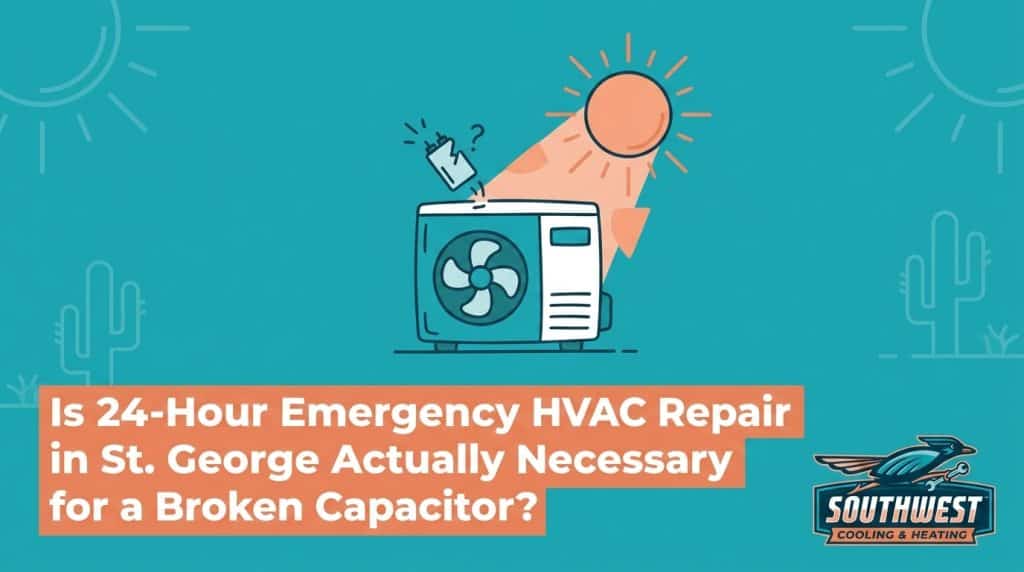
One of the most frequent culprits behind a tripped breaker during the fall transition is a failed dual-run capacitor. The capacitor acts like a powerful battery that provides the massive initial jolt of electricity required to start the compressor and the condenser fan motor. Compressors require significantly more energy to start than they do to continue running. If the capacitor is weak or dead, the compressor will try to pull that required starting energy directly from your home’s electrical panel. This massive power draw, known as Locked Rotor Amps (LRA), will instantly trip the breaker.
Before a capacitor completely fails, it often exhibits warning signs. You might notice a humming or buzzing noise coming from the outdoor unit, or the system might hesitate for several seconds before the fan finally spins. If you observe these symptoms, it is critical to seek emergency HVAC repair for a broken capacitor before the compressor sustains permanent damage.
Why Capacitors Fail in Late Fall
Capacitors are highly sensitive to heat. The cumulative heat damage from summer operation causes the dielectric fluid inside the capacitor to break down. By the time the November first-freeze hits, the capacitor is severely compromised. When the thermostat calls for heat, the cold, dense refrigerant in the system requires even more torque to move. The combination of a heat-damaged capacitor and the increased electrical demand required to start a cold system forces the compressor to overwork, resulting in an immediate breaker trip.
Grounded Compressors and Electrical Shorts in the System
If the breaker trips the absolute millisecond the system tries to turn on, you may be dealing with a grounded compressor. The compressor motor is housed inside a sealed, hermetic steel shell. Inside that shell, copper wire windings generate the magnetic fields needed to spin the motor. If the protective insulation on those copper windings burns off or wears away, the bare wire can touch the internal steel casing of the compressor. This is known as a “grounded” compressor.
When a compressor is grounded, the electrical current bypasses its normal path and flows directly into the metal casing and down to the earth ground. This creates a massive, instantaneous short circuit that will trip the breaker every single time. Beyond the compressor itself, other electrical shorts can occur in the system. High-frequency vibrations over the summer can chafe wire insulation against copper tubing, or pests seeking warmth in the early fall can chew through wiring harnesses. Understanding what a tripped breaker tells you about your AC compressor is essential for diagnosing the severity of the fault.
Diagnosing a Grounded Compressor (Professionals Only)
Confirming a grounded compressor requires specialized tools and training. With decades of local experience diagnosing complex electrical shorts safely, professional technicians utilize advanced multimeters to test the resistance (measured in ohms) between the compressor terminals and the copper lines. If continuity is detected between the electrical terminals and the ground, the compressor has suffered a fatal internal failure. Because the hermetic shell cannot be opened and repaired, this condition usually necessitates a full compressor replacement or an entirely new condensing unit.
Stuck Reversing Valves: The Heat Pump Switchover Problem
If your home uses a heat pump rather than a traditional furnace, the breaker tripping during the first cold snap might be tied to a mechanical component called the reversing valve. The reversing valve is the defining feature of a heat pump; it is a four-way directional valve that physically reverses the flow of refrigerant. In the summer, it directs heat out of your home. In the winter, it reverses the process to pull ambient heat from the outside air and move it indoors.
After sitting in the “cooling” position for six straight months, the internal slide mechanism of the reversing valve can become stuck due to internal wear, debris, or a failing solenoid coil. When the thermostat signals the valve to shift into heating mode for the November first-freeze, a stuck valve creates extreme refrigerant pressure imbalances. The compressor tries to pump high-pressure gas against a blockage, causing the motor to strain, overheat, and pull enough excess amperage to trip the safety breaker. This is a highly technical, high-pressure refrigerant issue that requires certified professional repair.
Signs Your Reversing Valve is Failing
- Incorrect air temperatures: The system blows cold air out of the vents even when the thermostat is firmly set to heat.
- Unusual transition noises: Loud hissing, whooshing, or clicking noises occurring continuously during the transition cycle.
- Mode-specific electrical failures: The breaker trips specifically when changing the thermostat mode from cooling to heating, but operates normally otherwise.
Airflow Restrictions and Overheating Condenser Coils
Not all breaker trips are caused by direct electrical component failures; severe maintenance neglect can also force the system to over-amp. Airflow is the lifeblood of any HVAC system. When return air filters become heavily clogged with dust, pet dander, and debris, the indoor blower motor has to work exponentially harder to pull air through the restriction. This lack of indoor airflow also means the refrigerant is not absorbing or releasing heat properly, which alters the pressure levels and forces the outdoor compressor to work harder to compensate.
Similarly, the outdoor condenser coils must remain clean to transfer heat effectively. While routine cleaning is important for efficiency, it is crucial to understand the truth about hosing down your AC condenser. Spraying water on the outside of the unit is a good preventative maintenance step during the summer, but it will not fix a system that is already tripping the breaker. If the breaker is tripping, the internal damage or strain has already exceeded safe operational limits. Professional pre-winter maintenance is the only reliable way to clear deep airflow restrictions and verify electrical safety.
The Chain Reaction of Poor Airflow
| Maintenance Issue | Mechanical Impact | Electrical Result |
|---|---|---|
| Clogged Indoor Air Filter | Blower motor strains; refrigerant pressures drop | Blower motor over-amps and overheats |
| Dirty Outdoor Condenser Coils | System cannot release or absorb heat efficiently | Compressor runs longer, internal temperatures spike |
| Blocked Supply Vents | Static pressure increases inside ductwork | System works against resistance, drawing excess power |
Frequently Asked Questions About Tripped Compressors and Fall Startups
Why does my AC trip the breaker after a few minutes?
If the breaker trips after running for a few minutes rather than immediately upon startup, it usually points to an overheating issue rather than a direct short circuit. A weak capacitor, low refrigerant levels, or a failing condenser fan motor can cause the compressor to slowly overheat as it runs. Once the internal temperature or the amperage draw exceeds the safety limits, the breaker cuts the power to prevent a fire. This delayed trip requires a professional to measure the running amperage and diagnose the root cause.
Is it safe to reset a tripped AC breaker?
It is generally acceptable to reset a tripped AC breaker exactly one time, as power surges or temporary grid fluctuations can occasionally cause a nuisance trip. However, if the breaker trips a second time immediately, or trips again later that same day, it is no longer safe to reset it. Repeatedly forcing power into a failing system can cause catastrophic damage to the compressor and poses a serious electrical fire hazard. Leave the breaker off and schedule a professional diagnostic.
Can a bad capacitor cause the breaker to trip?
Yes, a bad capacitor is one of the most common reasons for a tripped breaker. The capacitor provides the necessary electrical boost to start the compressor motor. When it fails, the compressor attempts to draw that massive starting energy directly from your electrical panel. This sudden spike in electrical demand exceeds the breaker’s rated capacity, causing it to trip instantly to protect your home’s wiring.
Why does my heat pump trip the breaker when switching to heat?
When a heat pump transitions to heating mode, the reversing valve must shift to redirect the flow of refrigerant. If the valve is stuck or failing, it creates a severe pressure restriction within the system. The compressor is then forced to pump refrigerant against this blockage, causing it to overwork, overheat, and draw excessive electrical current. This spike in amperage triggers the breaker to trip during the switchover.
How do I know if my AC compressor is grounded?
The most obvious symptom of a grounded compressor is a breaker that trips the exact millisecond the thermostat calls for cooling or heating. Unlike an overheating issue that takes a few minutes to trip, a grounded compressor represents a direct electrical short to the metal casing. Confirming this diagnosis requires a licensed professional using a multimeter to test the resistance of the internal motor windings against the copper lines.
What are the signs of a stuck reversing valve?
A stuck reversing valve will often cause your heat pump to blow cold air when it is set to heat, or warm air when it is set to cool. You may also hear unusual hissing, groaning, or clicking noises coming from the outdoor unit as the valve struggles to shift position. In severe cases, the restriction caused by the stuck valve will cause the compressor to pull too much power, resulting in a tripped breaker specifically when the system tries to change modes during the November first-freeze.
Making the Right Call for Your Fall HVAC Transition
Transitioning your HVAC system from a long, grueling cooling season to its first heating cycle is a critical moment for your equipment. The mechanical toll of the St. George region summer leaves components vulnerable, and the sudden demand of heating against cold refrigerant can push weakened parts past their breaking point. Whether the issue stems from a heat-damaged capacitor, a stuck reversing valve, or a severe internal short circuit like a grounded compressor, the underlying rule remains the same: a tripped breaker is a serious safety warning.
While replacing a dirty air filter is a simple homeowner task, investigating high-voltage electrical failures is not. Repeatedly resetting the breaker will only invite permanent damage to your compressor. If your system is struggling to transition, making unusual noises, or tripping electrical circuits, the safest path forward is to schedule a comprehensive professional inspection. Talk to a licensed expert to ensure your heating system is safe, reliable, and ready to perform efficiently throughout the winter months.