


The Reality of 90 Days of Triple-Digit Heat on Your AC
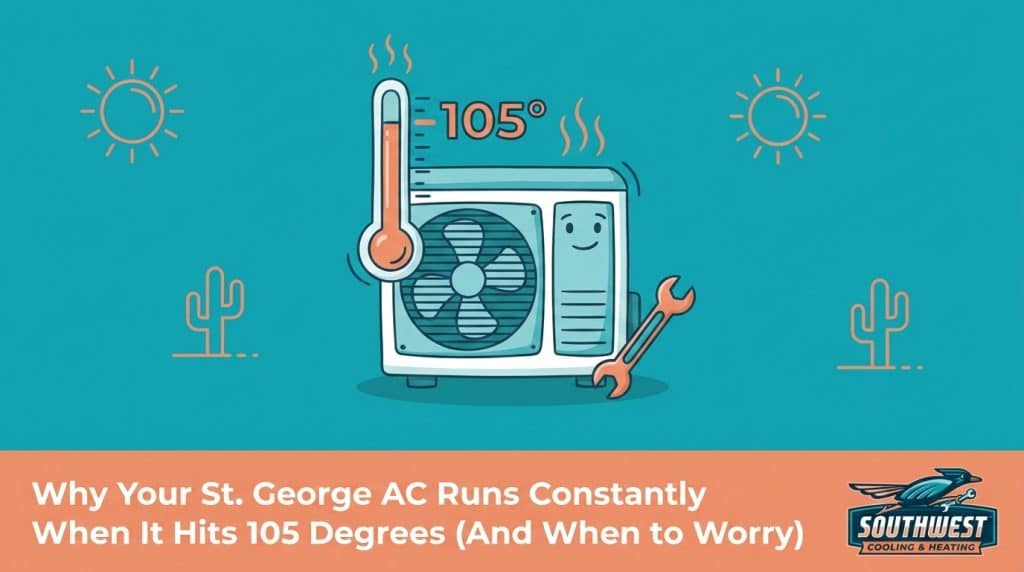
By the time late August rolls around, the average air conditioner in Southern Utah has endured a staggering 90 days of triple-digit heat. When we look at the most common AC failures we see in Washington County after 90 days of triple-digit heat, one thing becomes incredibly clear: these late-season breakdowns are rarely random. They are the highly predictable result of extreme, cumulative mechanical fatigue. Your cooling system may have survived the initial spikes of June and the grueling marathon of July, but August is typically the breaking point where high-stress electrical and moving parts finally give out.
With decades of first-hand experience diagnosing these exact end-of-summer failures in Southern Utah, our team at Southwest Cooling & Heating knows exactly how this local climate alters standard HVAC lifecycles. A system that might last fifteen years in a mild coastal town often faces a much harsher reality here. The parts that were merely stressed in early summer become critically compromised after months of continuous operation under maximum thermal load.
Right now, homeowners face a distinct decision point. You can either schedule a proactive end-of-season check to identify and replace these fatigued components while the system is still running, or you can risk a total, sudden breakdown during the final, sweltering weeks of the season. Understanding what is happening inside your outdoor unit is the first step in preventing a catastrophic failure.
The Cumulative Toll of St. George Summers on HVAC Systems
Air conditioning systems are designed to handle hot weather, but the continuous, relentless nature of a St. George summer creates a completely different category of wear and tear. In moderate climates, an air conditioner cycles on, cools the house, and then shuts off for an extended period, allowing internal components to cool down. In our region, those resting periods practically disappear from late May through September.
Because the system runs three to four times longer during extreme heat waves compared to moderate climates, a single summer in Washington County often equals a full year’s worth of mechanical wear elsewhere. By late August, your system has likely operated under maximum load for thousands of hours. This relentless friction and electrical heat degrade the system in highly specific ways. If you are wondering what typically breaks first, here are the top cumulative heat failures we diagnose late in the season:
- Pitted Contactors: The high-voltage switches that send power to your compressor become scarred and burnt from thousands of electrical arcs, eventually failing to close properly.
- Overheated Fan Motors: The outdoor condenser fan runs continuously in extremely hot air, causing the internal bearings to degrade and the motor to burn out.
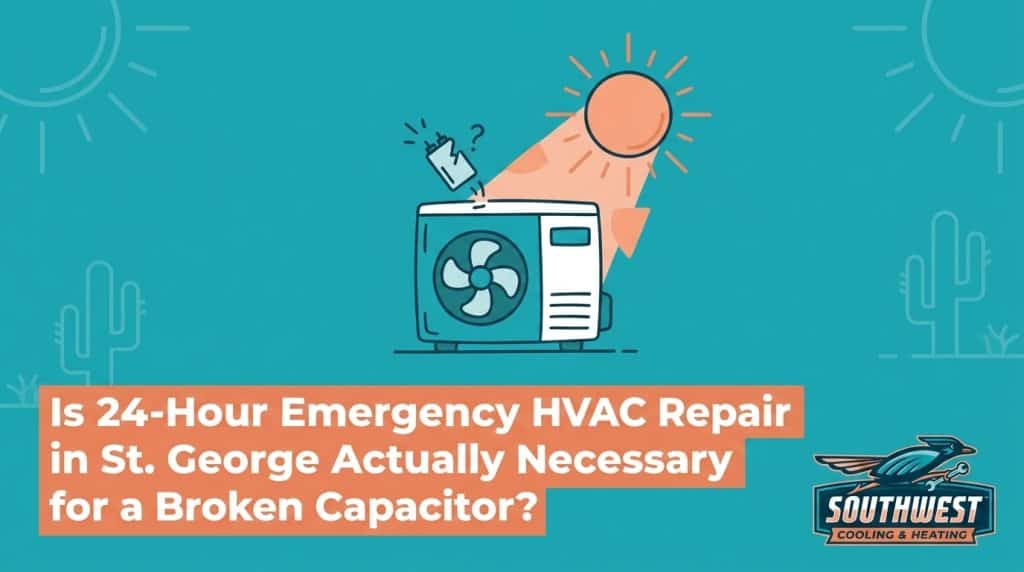
- Stressed Capacitors: These electrical energy storage devices lose their ability to hold a charge after prolonged exposure to internal and external heat, leaving the compressor unable to start.
Hours of Operation vs. Normal Climates
To truly understand the strain on your system, it helps to look at the raw numbers. The operating hours of a local unit far exceed national averages. While a typical American home might run its AC for 800 to 1,000 hours a year, a St. George system can easily surpass 2,500 to 3,000 hours in a single cooling season.
| Climate Factor | Moderate National Average | Washington County / St. George UT |
|---|---|---|
| Days Over 100°F | 10 – 15 days | 90+ days |
| Average Daily Run Time | 4 – 6 hours | 12 – 16+ hours |
| System Rest Periods | Frequent, with complete overnight cooldowns | Rare, with short cycling even at night |
| Component Lifespan Impact | Standard manufacturer expectations | Accelerated thermal and mechanical fatigue |
Every extra hour of operation generates mechanical friction in the moving parts and immense electrical heat in the wiring and switches. This dual threat of internal heat generation and external climate heat creates a compounding effect that accelerates the degradation of your system.
The August Tipping Point
You might wonder why a part that worked flawlessly on July 4th suddenly snaps in late August. The answer comes down to thermal fatigue. Materials expand when they get hot and contract when they cool. When this happens thousands of times without a sufficient cooling-off period, metal components become brittle, lubricants break down, and electrical insulation melts away. The system does not fail because August is hotter than July; it fails because August is the tipping point where the cumulative stress finally exceeds the component’s physical limits.

Pitted Contactors: The Hidden Electrical Threat
One of the most common and immediate dangers to your air conditioning system in late summer is a failing contactor. The contactor is essentially a heavy-duty mechanical switch located inside your outdoor condensing unit. When your thermostat calls for cooling, a low-voltage signal is sent to the contactor, pulling a metal bridge down to close the circuit. This action sends high-voltage electrical power directly to the heavy-lifting components: the compressor and the condenser fan motor.
Under normal conditions, this is a smooth, instantaneous process. However, the relentless cycling required during an August heatwave changes the dynamic. Every time the contactor closes and opens, a tiny electrical arc jumps between the metal plates. In extreme heat, with the system cycling on and off dozens of times a day, this arcing becomes highly destructive.
How Continuous Heat Causes Pitting
The electrical arcing phenomenon during high-load summer days generates intense, localized heat on the surface of the metal contacts. Over 90 days of triple-digit heat, this constant sparking literally burns away the smooth metal surface. This process is known as “pitting.” What started as a perfectly flat, highly conductive surface becomes jagged, charred, and covered in a black, carbon-like buildup.
A professional technician looks for these visual signs during a late-summer inspection. If the contacts are blackened or deeply pitted, the component is severely compromised. A failing contactor is a massive threat to your system because it can fail in two disastrous ways. First, the jagged edges can prevent the switch from making a solid connection, starving the compressor of the voltage it needs and causing it to overheat. Second, the intense heat can actually cause the pitted metal to weld itself shut. If the contactor welds closed, the outdoor unit will run continuously, even when the thermostat tells it to stop, quickly leading to catastrophic compressor damage.
Overheated Fan Motors and Continuous Strain
While electrical switches take a beating from high voltage, the moving parts in your system suffer from relentless mechanical friction. The condenser fan motor, located at the top of your outdoor unit, has one of the hardest jobs in your entire HVAC system. Its role is to pull massive volumes of air through the metal fins of the condenser coil, exhausting the heat that the refrigerant absorbed from inside your home.
The Problem: In late summer, the condenser fan motor is forced to operate in an incredibly hostile environment. In 100+ degree weather, the ambient air attempting to cool the motor is already extremely hot. This drastically reduces the motor’s cooling efficiency, causing its internal operating temperature to skyrocket.
The Cause: Thousands of hours of high-speed rotation eventually degrade the internal components. The sealed bearings inside the motor rely on a specific lubricant to spin freely. Continuous, extreme heat causes this lubricant to break down, dry out, or leak. Once the lubrication is gone, metal grinds on metal. The motor has to work much harder to spin the heavy fan blades, drawing more electrical current and generating even more heat. Eventually, this heat melts the protective insulation surrounding the copper windings inside the motor, causing an electrical short that kills the motor entirely.
The Solution: Professional intervention is required to test the motor’s amp draw and check the condition of the bearings. Interestingly, a failing fan motor often masquerades as a refrigerant issue to the homeowner. When the fan slows down or stops, the unit can no longer exhaust heat. The compressor continues to run, but the system stops cooling the house effectively, blowing lukewarm air indoors. Catching a struggling fan motor before it completely seizes can save your compressor from a fatal overheating event.
Why Nighttime Heat Retention Accelerates Wear
When discussing AC failures, most people focus on the blazing afternoon sun. However, one of the most critical factors driving late-summer breakdowns is what happens after the sun goes down. Washington County’s sustained triple-digit heat does not simply vanish at sunset; the heat extends deep into the evening.
The local geography, combined with the thermal mass of asphalt roads, concrete driveways, and masonry homes, absorbs solar radiation all day and slowly releases it at night. This means that even at 10:00 PM, the ambient temperature around your outdoor unit can remain uncomfortably high. These elevated overnight lows prevent the compressor and fan motors from properly cooling down.
In climates with moderate summers, cool nights give the HVAC system a vital rest period. The metal components contract, the oil inside the compressor settles and cools, and the electrical components shed their retained heat. In St. George UT, that thermal recovery simply does not happen during a severe heatwave. The system is forced to start its next cooling cycle the following morning while it is still internally hot from the day before.
This lack of thermal recovery drastically accelerates the degradation of electrical components. Capacitors, which are highly sensitive to temperature, lose their ability to store and release energy efficiently when they are never allowed to cool. Wiring insulation becomes permanently brittle. The cumulative effect of this nighttime heat retention is a major reason why August is the peak month for total system failures in our area.
Warning Signs Your System is Nearing Late-Summer Failure
Because these late-season failures are the result of cumulative wear, your air conditioner will often give you subtle warning signs before it completely shuts down. Knowing what to listen and look for can be the difference between a simple part replacement and a massive repair bill. If you notice any of these symptoms in late August, it is a strong indicator that your system is struggling under the weight of the season.
- Loud Buzzing or Humming: A distinct, loud electrical buzz coming from the outdoor unit is a classic sign of a failing or pitted contactor struggling to engage.
- Screeching or Grinding Noises: High-pitched squeals or metal-on-metal grinding sounds indicate that the bearings in your condenser fan motor or indoor blower motor are failing.
- Hard Starting: If you hear the outdoor unit click on, but it hesitates, groans, or dims the lights in your house before the fan starts spinning, your capacitor is likely failing and struggling to provide the necessary startup jolt.
- Constant Running without Cooling: If the system is running constantly but the house is slowly warming up in the afternoon, the compressor may be overheating, or the outdoor coil may be failing to reject heat due to a slow fan motor.
- Unusual Heat from the Top of the Unit: While the air blowing out of the top of the condenser should be warm, the metal casing of the fan motor itself should not be blistering hot to the touch.
If these symptoms appear during a heatwave, the most important thing you can do is avoid ignoring them. Pushing a struggling system to keep running will only cause a cascading failure, where a small electrical issue destroys the expensive compressor. Knowing what to do when your AC breaks in extreme heat starts with turning the system off at the thermostat to prevent further damage.
Always emphasize the importance of calling a licensed professional for electrical diagnostics. The high-voltage components inside an air conditioner carry enough stored energy to cause severe injury, even when the power is turned off. A trained technician has the proper meters to safely test capacitors, contactors, and motors, ensuring an accurate diagnosis without the risk of DIY electrical work.
FAQ
Why did my AC stop working in the extreme heat?
Your AC likely stopped working because a specific component reached its physical limit after months of continuous strain. In extreme heat, parts like capacitors, contactors, and fan motors endure massive thermal and electrical stress. Once one of these parts fails, the entire system shuts down to protect the compressor from fatal damage.
What happens to an AC unit when it is over 100 degrees for months?
When an AC unit operates in 100-degree weather for months, it suffers from severe cumulative mechanical fatigue. The system runs three to four times longer than normal, causing lubricants to dry out, metal contacts to burn, and electrical insulation to degrade. Without adequate overnight cooling, this continuous heat retention drastically shortens the lifespan of high-stress parts.
How do I know if my AC contactor is bad?
A bad AC contactor often produces a loud, continuous buzzing or chattering noise from the outdoor unit when the system tries to turn on. You might also notice that the outdoor unit fails to start entirely, or conversely, that the outdoor unit continues running even after you turn the thermostat off. A professional inspection will reveal blackened, pitted, or welded metal contacts.
Why is my AC fan motor overheating in late summer?
Your AC fan motor overheats in late summer because the internal bearings have likely lost their lubrication after thousands of hours of continuous rotation. As the metal grinds, the motor works harder and draws more electricity, generating intense internal heat. Combined with the already hot outdoor air, this friction quickly pushes the motor past its thermal limits.
Should I get my AC checked at the end of summer even if it’s still running?
Yes, scheduling an end-of-summer check is highly recommended because many components are on the verge of failure by late August. A system that is still running may be operating with a severely pitted contactor or a weak capacitor. Catching these issues proactively prevents a sudden, complete breakdown during the final heatwaves of the year.
Can prolonged heat cause permanent damage to an AC compressor?
Prolonged heat itself does not immediately ruin a compressor, but the failure of supporting components due to heat certainly will. If a fan motor stops cooling the unit, or a contactor welds shut and forces the system to run continuously, the compressor will overheat. Repeated overheating events will eventually cause the compressor’s internal windings to short out, requiring a total replacement.
Schedule Your End-of-Season AC Evaluation
Don’t wait for your system to give out completely during the final stretch of summer. If your air conditioner has been running non-stop and is starting to show signs of fatigue, now is the time to act. Schedule your end-of-season check today to understand exactly why your system is stressed and replace failing components before they cause a total breakdown. Our team is ready to ensure your home stays cool and comfortable through the rest of the season.