


Why Finding the best air filter for your home Matters More Than You Think
The best air filter for your home depends on your specific needs, but here are the top options to consider based on filtration type and use case:
Quick Answer: Best Air Filters by Category
| Category | Best Pick | Why It Stands Out |
|---|---|---|
| Best overall HVAC filter | MERV 13 pleated media filter | Balances filtration and airflow for most homes |
| Best for allergies and particles | HEPA-grade portable purifier | Captures 99.97% of particles 0.3 microns and larger |
| Best for large spaces | Whole-home media filter (MERV 11-16) | Consistent filtration throughout the entire home |
| Best for odors and VOCs | Activated carbon filter | Absorbs gases, smoke, and chemical vapors |
| Best for small rooms | Portable HEPA unit sized by CADR | Flexible, targeted room-by-room coverage |
You probably don’t spend much time thinking about the air inside your home — but you should. According to the EPA, indoor air pollutants can run two to five times higher than outdoor concentrations. And in St. George, Utah, where desert dust, seasonal pollen, and wildfire smoke are part of life, that number can climb even higher. More than one-third of Americans already live in areas with unhealthy air quality — and the air inside their homes may be making things worse.
The good news is that choosing the right air filter can make a meaningful difference. The challenge is knowing where to start. Walk into any home improvement store and you’ll find dozens of options — different sizes, ratings, technologies, and price points — with no clear guide on which one actually works best for your situation.
I’m Bruce Hymas, owner of Southwest Cooling and Heating, and after decades of helping St. George-area homeowners maintain their HVAC systems, I’ve seen how the right air filter can protect both your indoor air quality and your equipment. Finding the best air filter for your home is one of the most impactful and overlooked decisions a homeowner can make, and this guide will help you cut through the confusion.
Which Ratings Should I Look for to Find the best air filter for your home?
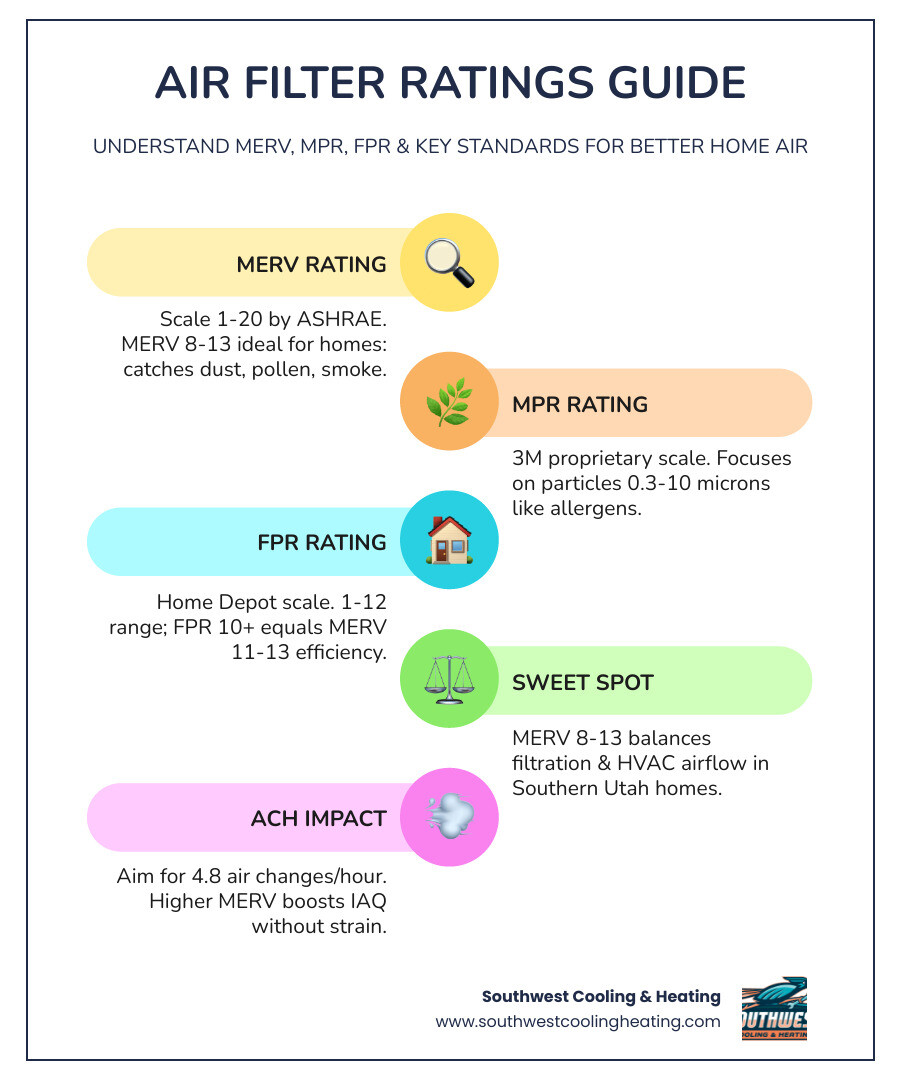
When you go shopping for a filter in Santa Clara or Hurricane, the first thing you’ll notice is a jumble of letters and numbers on the packaging. These are rating systems designed to tell you how effective a filter is at catching microscopic gunk. However, because different manufacturers use different systems, it can feel like you need a secret decoder ring.
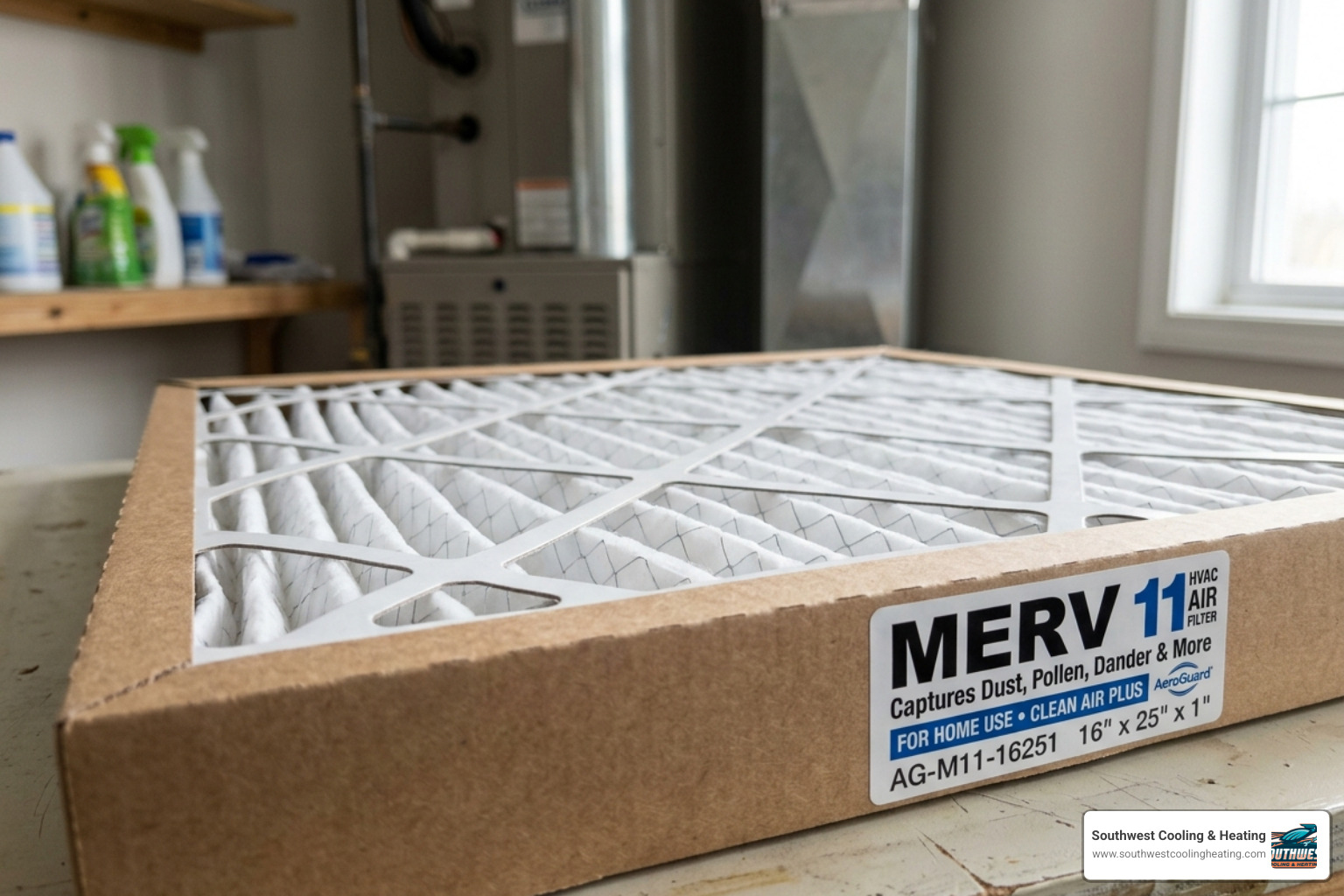
The most common standard is the MERV (Minimum Efficiency Reporting Value). Developed by ASHRAE, this scale runs from 1 to 20. For most residential settings in Southern Utah, a MERV rating between 8 and 13 is the “sweet spot.” A MERV 8 filter is great for catching dust and pollen, while a MERV 13 is much more efficient at trapping fine particles like smoke and bacteria.
You might also see MPR (Microparticle Performance Rating), used by 3M, or FPR (Filter Performance Rating), used by The Home Depot. While they all aim to measure the same thing—how many particles the filter stops—the scales are different. For example, a high-end FPR 10 or MPR 1900-2200 is roughly equivalent to a MERV 13.
To keep your system running smoothly, balance filtration with airflow. If you choose a filter that is too restrictive for your specific unit, you might find yourself needing AC Maintenance Services sooner than expected due to system strain.
| Rating System | Entry Level (Good) | Mid-Range (Better) | High-Efficiency (Best) |
|---|---|---|---|
| MERV | 5 – 8 | 9 – 12 | 13 – 16 |
| MPR (3M) | 300 – 600 | 1000 – 1200 | 1500 – 2800 |
| FPR (Home Depot) | 4 – 5 | 6 – 7 | 8 – 10 |
| What it catches | Large dust, lint, pollen | Dust mites, mold spores | Smoke, smog, bacteria |
Choosing the best air filter for your home Based on Pollutants
Not all “fresh air” is created equal. Depending on whether you live in Hidden Valley and deal with construction dust or in Bloomington Hills with heavy seasonal pollen, your needs will vary.
HEPA (High-Efficiency Particulate Air) filters are the gold standard. By definition, a true HEPA filter must capture at least 99.97% of particles as small as 0.3 microns. To put that in perspective, a human hair is about 45 microns wide. HEPA filters are incredible for removing allergens, pet dander, and even some bacteria and viruses. However, most standard home HVAC systems aren’t powerful enough to pull air through a thick HEPA filter without help.
If your concern is smells—like cooking odors, “wet dog” scent, or Volatile Organic Compounds (VOCs) from new furniture—you need Activated Carbon. Standard filters catch particles; carbon filters absorb gases. For the best air filter for your home regarding odors, look for “pelleted” carbon rather than just carbon-impregnated fabric. Some high-end units, like the Austin Air HealthMate, contain up to 15 lbs of carbon to scrub the air of chemicals. Keeping your heating system clean with Furnace Maintenance Services also ensures these pollutants don’t settle deep within your vents.
Sizing and Capacity for the best air filter for your home
Size matters—and we don’t just mean the dimensions of the cardboard frame. When looking at portable units or whole-home systems, you need to understand CADR (Clean Air Delivery Rate) and ACH (Air Changes per Hour).
- CADR: This measures how much clean air the unit puts out in cubic feet per minute (cfm). The higher the number, the faster it cleans the room.
- ACH: The EPA recommends about 4.8 to 5 air changes per hour for effective purification. This means all the air in your room should pass through the filter every 12 minutes.
If you have a 400-square-foot living room in Ivins, a tiny “desktop” purifier won’t cut it. You’d need a unit with a CADR of at least 250 to 300 to achieve those 5 air changes. For those looking to integrate this into their existing setup, our HVAC Services can help determine if your current ductwork can handle higher-capacity media filters.
Is a Whole-Home System or a Portable Purifier Better for My Space?
This is the most common question we get in Diamond Valley and Toquerville. The answer depends on your goals and your home’s layout.
Portable Purifiers are fantastic for targeted “problem areas.” If you have a bedroom where you sleep or a home office where you spend 8 hours a day, a portable unit like a Levoit Vital 200S or a Coway Airmega can provide 5 ACH in spaces up to 360–500 square feet. They are “plug-and-play” and often come with smart features like air quality sensors and app connectivity.
Whole-Home Systems, on the other hand, are integrated directly into your HVAC ductwork. Instead of a 1-inch thick filter, these systems often use 4-inch or 5-inch Media Filters. Because they have more surface area (imagine an accordion folded up), they can catch more pollutants without choking your airflow. A high-efficiency whole-home system, like the Bryant Evolution Air Purifier, can reduce airborne pet dander by 89% and pollen by 82% across a 2,000 sq. ft. home in just 24 hours.
If you want the best air filter for your home that requires the least amount of daily thought, whole-home is the way to go. You only change the filter once or twice a year, and every room with a vent gets cleaned. We often tell clients that to Keep Your Cool with Expert AC Maintenance in Diamond Valley, upgrading to a media filter cabinet is one of the best long-term investments they can make.
What Maintenance Does My Air Filtration System Need to Stay Efficient?
Even the best air filter for your home will eventually become a wall of dirt if you don’t maintain it. In the dusty environment of St. George and Washington, UT, maintenance is non-negotiable.
- Replacement Schedule: Standard 1-inch pleated filters should be checked every 30 days and replaced at least every 90 days. If you have pets or live near a construction site in Coral Canyon, you might need to change them every month.
- Energy Consumption: A clogged filter makes your motor work harder, which spikes your energy bills. Using “Smart” features or app connectivity can help by alerting you when the filter is actually dirty, rather than just guessing.
- Noise Levels: If you’re using portable units in bedrooms, look for units that stay under 30–35 dB on low settings. Whole-home systems are generally quieter because the filtration happens at the equipment level, away from your sleeping area.
- DIY Options: For those on a budget, a Corsi-Rosenthal Box (a DIY cube made of four MERV 13 filters and a box fan) is a surprisingly effective and scientifically proven way to clean large amounts of air quickly.
- Safety First: Always avoid air purifiers that produce Ozone. While some older “ionizers” claimed to clean the air, ozone is a lung irritant and is generally considered unsafe for indoor use.
If you notice your system struggling or making strange noises, it might be time for AC Repair Services to ensure a dirty filter hasn’t caused deeper mechanical issues.
Frequently Asked Questions about Home Air Filtration
Can a high-efficiency filter damage my HVAC system?
Yes, it can if it’s the wrong type of filter for your specific blower motor. This is a concept called Static Pressure. Think of it like trying to breathe through a straw versus a thick wool blanket. A very high-MERV 1-inch filter can be so restrictive that it causes the system to overheat or even leads to a frozen evaporator coil.
This is why we often recommend upgrading to a Media Filter Cabinet. These allow for high-efficiency filtration (MERV 11–16) because the filter is much thicker, providing more surface area for air to pass through easily. If you’re Finding the Best AC Maintenance in Toquerville, UT Without Breaking a Sweat, ask your technician to check your system’s static pressure before you jump to a higher MERV rating.
How often should I replace my air filters in St. George?
In Southern Utah, our “dust season” is basically year-round. Between the red sand blowing in from the desert and the heavy pollen in the spring, your filters work overtime. We recommend checking your filter every 30 days. If it looks gray or fuzzy, swap it out. At a minimum, change it every 90 days. If you’re running your heat in the winter, don’t forget to check those vents, as Furnace Repair Services are often caused by restricted airflow from a forgotten filter.
Do air purifiers remove mold and viruses?
The best air filter for your home can certainly help, but it’s not a magic wand. High-efficiency filters like MERV 13 or HEPA are capable of trapping mold spores and microscopic virus carriers. However, the filter only works on what is airborne. If you have mold growing on a wall or a virus on a countertop, the air purifier won’t touch it. Some systems also use UV-C light to “deactivate” biological growth on the coils, which is a great secondary defense. Regular AC Maintenance Services can help identify if mold is a concern within your actual HVAC equipment.
Conclusion
Finding the best air filter for your home doesn’t have to be an overwhelming chore. Whether you decide on a high-tech portable unit for your Santa Clara bedroom or a robust whole-home media system for your Hurricane family home, the goal is the same: cleaner, healthier air for your family to breathe.
At Southwest Cooling & Heating, we’ve been serving the St. George area since 1980. We know the unique challenges our climate poses to indoor air quality. From Ivins to La Verkin, we are committed to helping our neighbors stay comfortable and healthy. If you’re ready to upgrade your home’s air filtration or just need a professional to ensure your current system is performing at its peak, we’re here to help.
Don’t let poor air quality linger in your home. Take the first step toward a fresher living space today by checking your filter—and if you need an expert’s touch, give us a call!