


Why Desert Homeowners in St. George Are Switching to Ductless Systems
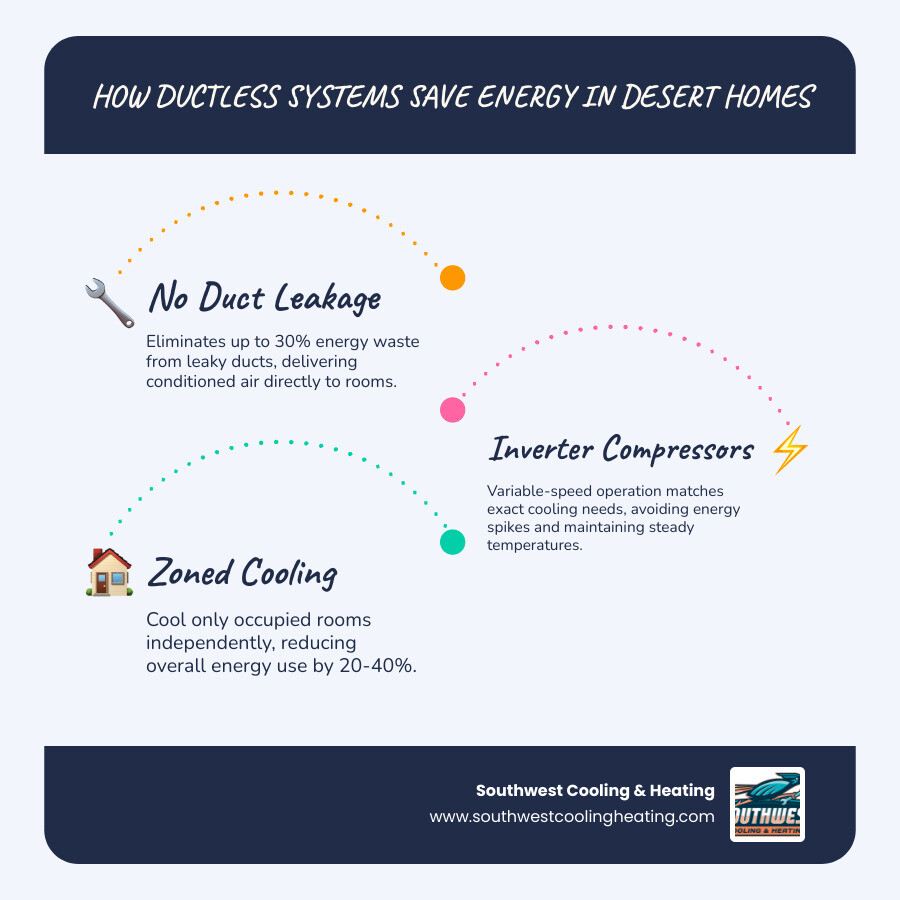
How ductless systems save energy in desert homes comes down to a few key advantages over traditional central AC:
- No duct leakage – Traditional ducted systems lose up to 30% of conditioned air through leaky or poorly insulated ductwork. Ductless systems deliver air directly to each room, eliminating that waste entirely.
- Inverter-driven compressors – Instead of cycling on and off, ductless systems run at variable speeds to match the exact cooling demand, avoiding energy spikes.
- Zoned cooling – You only cool the rooms you’re actually using, not the whole house.
- Higher efficiency ratings – Most ductless mini-splits carry SEER ratings of 20 or higher, compared to 14-18 SEER for typical central AC units.
- No hot attic ductwork – In desert climates, attics can exceed 140°F. Ducts running through that space lose enormous amounts of cooling energy before it ever reaches your living areas.
If you live in St. George or anywhere in Southern Utah’s high desert, you already know what relentless summer heat feels like. Your AC runs for 12 or more hours a day for months on end — and if your system is losing nearly a third of its cooling capacity through leaky ducts baking in a superheated attic, you’re paying for air that never actually cools your home. That’s not a minor inefficiency. It’s a significant drain on your energy bill, month after month, season after season. As April 2026 energy costs continue to climb, more desert homeowners are asking whether there’s a smarter way to stay cool — and the answer increasingly points to ductless systems.
I’m Bruce Hymas, owner of Southwest Cooling & Heating, and with decades of hands-on HVAC experience serving St. George’s unique desert climate, I’ve seen how understanding how ductless systems save energy in desert homes can transform both comfort and monthly costs for local homeowners. Let’s walk through exactly how these systems work and why they’re such a strong fit for our region.
How Ductless Systems Save Energy in Desert Homes: The Efficiency Breakdown
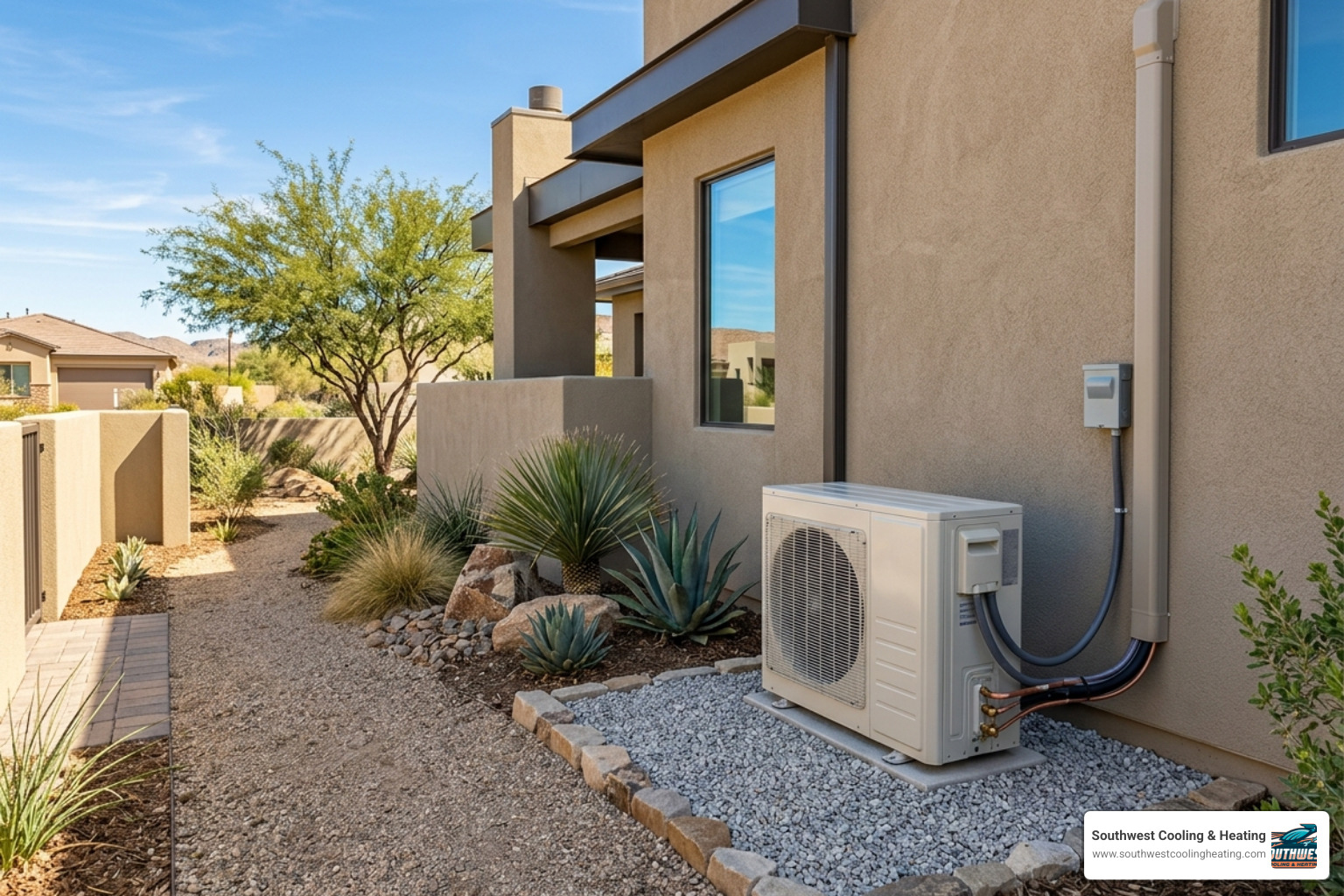
To understand why so many families in areas like Bloomington Hills and Hidden Valley are making the switch, we first have to look at what makes a ductless mini-split different. A traditional central AC system relies on a single, large indoor unit that pushes air through a complex network of branching ducts. In contrast, a ductless system consists of a small outdoor compressor unit connected to one or more indoor air handlers via thin refrigerant lines.
These systems utilize advanced heat pump technology. Despite the name, a heat pump doesn’t just “pump heat” into a home; in the summer, it works in reverse, extracting heat from your indoor air and moving it outside. Because they move heat rather than generate cooling through massive energy consumption, they are incredibly efficient. In fact, Energy Star certified mini-split units can use up to 60% less energy than conventional electric heating and cooling systems.
One of the biggest metrics we look at in April 2026 is the SEER (Seasonal Energy Efficiency Ratio). While many older central units in our service area might only be rated at 14 or 16 SEER, modern ductless systems often boast ratings of 20, 25, or even higher. When you are dealing with the sustained 100°F+ days common in Southern Utah, that jump in SEER translates directly into lower utility bills. If you are considering a transition, our team at Southwest Cooling & Heating specializes in Mini-Split Installation tailored specifically for the high-heat demands of our local geography.
Eliminating Duct Leakage: How Ductless Systems Save Energy in Desert Homes
The most significant “hidden” cost of a traditional HVAC system is the ductwork itself. Research shows that ductwork can lose 20% to 30% of conditioned air due to leaks, holes, and poorly connected joints. In a desert environment, this problem is amplified. When your ducts leak, you aren’t just losing air; you are forcing your system to work harder to compensate for the loss, which leads to premature wear and tear.
Furthermore, there is the issue of “thermal transfer.” In places like Hurricane and Ivins, most ductwork is located in the attic. During a typical July afternoon, your attic can easily reach temperatures exceeding 140°F. Even if your ducts are insulated, the cool air inside them is fighting a losing battle against the radiant heat of the attic. By the time that air reaches your bedroom, it has already warmed up significantly.
Ductless systems eliminate this problem by removing the “middleman.” There are no ducts to leak and no attic-bound pipes to soak up heat. The conditioned air is delivered directly from the air handler into your living space. This is a primary reason why a Ductless Heat Pump St. George Upgrade has become such a popular choice for homeowners looking to modernize their properties.
Inverter Technology: How Ductless Systems Save Energy in Desert Homes
Another secret weapon in the ductless arsenal is the inverter-driven compressor. Traditional central AC units are either “on” or “off.” Think of it like a car that can only go 0 mph or 80 mph. When the thermostat calls for cooling, the system kicks on with a huge surge of energy, runs at full blast until the target temperature is hit, and then shuts off. This constant cycling creates massive energy spikes and leads to inconsistent indoor temperatures.
Ductless systems use variable-speed (inverter) technology. Instead of shutting off, the compressor slows down or speeds up to maintain a perfectly steady temperature. It’s like using cruise control on the I-15; it’s much more efficient to maintain a steady speed than to constantly slam on the gas and the brakes. This partial-load efficiency is exactly Why Bloomington Hills Homes Are Going Ductless This Season. By avoiding those high-energy “start-up” surges, the system stays in its most efficient zone for longer periods, which is vital when the outdoor temperature refuses to drop below 90°F even at night.
Overcoming Extreme Attic Temperatures and Harsh Environments
In Southern Utah, our environment presents challenges that go beyond just the heat. We have fine red sand, high winds, and incredibly low humidity. Traditional systems often struggle with these factors. Central AC units pull air from all over the house into a single return, often sucking in dust that has settled in the ductwork over years.
Ductless systems, however, are designed for direct-mount efficiency. Because the units are located inside the room they are cooling, they don’t have to fight the “attic effect.”
| Feature | Traditional Ducted System | Ductless Mini-Split |
|---|---|---|
| Energy Loss Location | Attics (up to 140°F+) | No duct loss; direct delivery |
| Air Leakage Waste | 20% – 30% of total energy | 0% (No ducts used) |
| Dust/Sand Infiltration | High (via leaky duct joints) | Low (sealed refrigerant lines) |
| Filtration | Single central filter | Multi-stage filtration per unit |
| Compressor Type | Single or Two-Stage (On/Off) | Variable-Speed Inverter |
For residents in St. George, the red sand is a real concern. It gets everywhere. In a ducted system, that sand can settle in the vents and reduce airflow. Ductless units feature advanced, multi-stage filtration systems in every indoor head. This not only keeps the unit running efficiently but also significantly improves indoor air quality by removing dust and debris before it can circulate. This level of protection is why we often recommend Top Rated Ductless Heat Pumps for St. George Residents who are concerned about allergies or respiratory health.
Maximizing Savings with Zoned Cooling Strategies
Perhaps the most practical way how ductless systems save energy in desert homes is through true zoning. In a standard home with central AC, if you want to cool your bedroom at night, you have to cool the kitchen, the living room, and the guest bathroom too. You are paying to condition thousands of cubic feet of space that no one is currently using.
Ductless systems allow you to create “zones.” Each indoor air handler has its own thermostat and remote control. If you spend your day in the home office, you can set that unit to a crisp 72°F while leaving the rest of the house at 78°F or 80°F. This precise temperature control can lead to a 20% to 40% reduction in monthly energy bills.
This is especially helpful for the diverse home layouts we see in Coral Canyon and Ivins. Many homes have sun-drenched rooms with large windows that get much hotter than the rest of the house. A ductless unit can target that specific “hot spot” without overcooling the entire residence. Whether you’re looking for Top Rated and Affordable Ductless Heat Pumps for Your Bloomington Hills Home or need a solution for a new addition, zoning is the key to balancing comfort and cost.
For those in Ivins, where many homes feature guest casitas or detached studios, ductless is the gold standard. You can find more about these specific applications in our Ivins Top Picks for Ductless Heat Pump Services: A Comprehensive Guide.
Frequently Asked Questions About Desert Ductless Efficiency
We get a lot of questions from our neighbors in Toquerville and La Verkin about whether these systems can really handle our “extreme” version of a desert climate. Here are the facts.
Are ductless systems effective when it reaches 115°F in Santa Clara?
Yes, absolutely. Modern ductless mini-splits are engineered for high-ambient cooling. While older heat pump technology used to struggle once temperatures climbed past 100°F, today’s units are designed to maintain high efficiency even in 115°F heat. Because they don’t lose 30% of their capacity in the attic, they actually have an easier time keeping a home cool during a Santa Clara heatwave than a central AC unit might. If you’re curious about local performance, check out our guide on Discovering Ductless Heat Pump Solutions for Santa Clara Homes.
Can I use a ductless system for a whole home or just additions?
While many people first discover ductless when they need to cool a garage or a new sunroom, they are perfectly suitable for whole-home retrofits. We can install multi-zone systems where one outdoor compressor powers up to eight indoor units. This allows for a completely duct-free home, which is a fantastic option for older properties in St. George that don’t have the space for traditional ductwork. For those in more rural areas, finding Ductless Heat Pumps in La Verkin UT: How to Choose the Best Local Experts is the first step toward a whole-home solution.
What maintenance ensures the best energy savings in dusty climates?
Maintenance is the key to longevity. In our dusty environment, we recommend:
- Filter Cleaning: You should check and wash your indoor unit filters every 2–4 weeks. It only takes a few minutes and ensures maximum airflow.
- Outdoor Clearances: Keep the outdoor compressor free of red sand, weeds, and debris.
- Professional Inspections: Have a technician check refrigerant levels and clean the coils annually.
For those in Santa Clara, we recommend working with Your Local Experts: Finding the Best Ductless Heat Pump Specialists in Santa Clara to set up a regular schedule.
Conclusion
Switching to a ductless system is one of the most impactful upgrades a Southern Utah homeowner can make in April 2026. By eliminating duct loss, leveraging inverter technology, and utilizing zoned cooling, you aren’t just making your home more comfortable—you’re making it significantly more sustainable. From the quiet streets of Diamond Valley to the growing communities in Winchester Hills and Hurricane, the shift toward ductless is helping families take control of their energy consumption.
At Southwest Cooling & Heating, we’ve been helping our neighbors in St. George and the surrounding areas since 1980. We understand that every home is different, which is why we offer personalized assessments to find the right HVAC Ductless Heat Pump for your specific needs. Whether you are in Toquerville, La Verkin, or Bloomington, we provide the expert sizing and professional installation required to ensure your new system delivers the maximum possible ROI.
If you are tired of “thermostat wars” or high energy bills, it might be time to look at Who to Call: Finding the Best Heat Pump Contractor in Coral Canyon or Who Are the Top Ductless Heat Pump Contractors in Bloomington Hills. We are also proud to offer Affordable Expert Ductless Heat Pump Services in Hurricane UT: A Local’s Guide to help you navigate the incentives and rebates available for Energy Star upgrades.
Don’t sweat through another record-breaking summer. Whether you need Top Rated Ductless Heat Pumps for St. George Residents or are simply Finding the Best Ductless Heat Pump Services Near St. George Without Breaking a Sweat, our team is here to help. Reach out to us today to see how we can transform your home’s efficiency.