


How Much Does It Really Cost to Cool Your Home in St. George, Utah?
The mini split vs central AC cost comparison is rarely as straightforward as a single price tag — and for homeowners in St. George, where summers push triple digits for months at a time, getting this decision wrong can mean years of overpaying on energy bills or a system that simply can’t keep up.
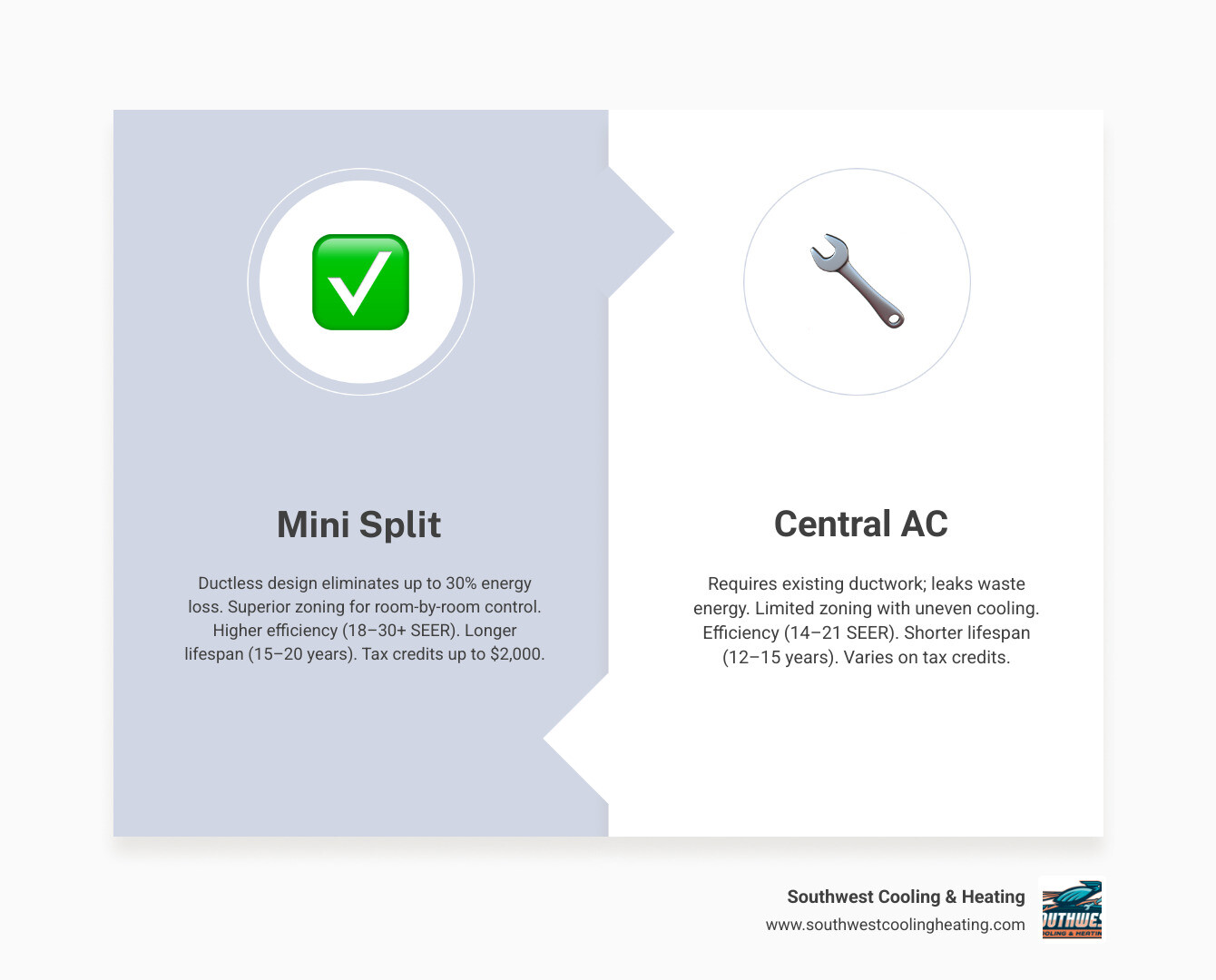
Here’s a quick breakdown of how the two systems compare:
| Factor | Mini Split | Central AC |
|---|---|---|
| Best for homes without ducts | Yes | No — adds significant cost |
| Best for homes with existing ducts | Sometimes | Usually yes |
| Energy efficiency (SEER ratings) | 18–30+ | 14–21 |
| Zoning control | Yes, by room | Limited |
| Typical lifespan | 15–20 years | 12–15 years |
| Duct energy loss | None | Up to 30% |
| Federal tax credit eligible | Yes (up to $2,000) | Varies |
The single biggest factor in this decision? Whether your home already has ductwork — and whether that ductwork is in good shape. If you’re starting from scratch, a ductless mini split often makes more financial sense. If you have modern, well-sealed ducts already in place, central AC may still come out ahead on upfront costs.
But installation price is only part of the story. Operating costs, efficiency ratings, maintenance needs, and long-term ownership value all play into which system is actually cheaper for your home.
I’m Bruce Hymas, owner of Southwest Cooling & Heating, and with decades of hands-on experience helping St. George homeowners navigate exactly this kind of mini split vs central AC cost comparison, I’ve seen how the right choice depends entirely on your home’s layout, age, and cooling goals. Let’s walk through everything you need to make a confident, informed decision.
Evaluating the mini split vs central AC cost comparison for Southern Utah homes
When we sit down with a family in Santa Clara or Hurricane to discuss their cooling options, we start by looking at the home as a complete ecosystem. In Southern Utah, our climate is unforgiving, and the way your home is built dictates which system will offer the best return on investment.
A professional system assessment is the first step in any mini split vs central AC cost comparison. We look at more than just square footage; we examine the “thermal envelope” of your home. This includes your insulation levels, the orientation of your windows toward the harsh desert sun, and the volume of air that needs to be moved to keep you comfortable.
The installation variables for these two systems are vastly different. For a central AC system, the complexity lies in the hidden infrastructure. If you are looking into AC Installation, the focus is often on the central air handler and how it connects to the existing network of vents. For a ductless system, the Mini Split Installation process is more about strategic placement of indoor units to ensure every corner of the room reaches the desired temperature without “dead spots.”
How existing ductwork influences your mini split vs central AC cost comparison
The presence and condition of ductwork is the “hidden monster” in HVAC budgeting. If your home in Bloomington or Ivins was built with a central system in mind, you already have the “highways” needed for air to travel. However, if those ducts are aging, leaky, or undersized for modern high-efficiency equipment, the cost to repair or replace them can be staggering.
Retrofitting an older home that lacks ductwork — such as a historic property in downtown St. George or a slab-on-grade home in Hidden Valley — involves significant structural disruption. You might have to sacrifice closet space, drop ceilings, or cut into thick walls just to fit the necessary trunk lines. In these scenarios, the HVAC Ductless Heat Pump becomes the clear winner. Because mini splits only require a small three-inch hole for refrigerant lines, they preserve the structural integrity of your home while avoiding the massive labor expenses associated with duct construction.
Impact of home size and zoning requirements
How do you use your home? This is a vital question for any mini split vs central AC cost comparison. If you have a 3,000-square-foot home in Coral Canyon but spend 90% of your time in the home office and the master bedroom, a central AC system is inherently “wasteful” because it tries to cool the entire house to one uniform temperature.
Multi-zone mini split systems allow for precise temperature control. You can keep the kitchen cool while you’re cooking dinner but leave the guest rooms at a higher temperature until they are actually in use. This “zoning by default” is one of the primary reasons mini splits can be more cost-effective over a 15-year period. We perform detailed load calculations to determine exactly how many “heads” or indoor units your home needs, ensuring you don’t overspend on capacity you won’t use.
Long-term efficiency and energy savings in the St. George heat
In the St. George heat, efficiency isn’t just a buzzword; it’s a survival tactic for your wallet. When comparing systems, we look at SEER2 (Seasonal Energy Efficiency Ratio) ratings. The higher the number, the less electricity the unit uses to produce the same amount of cooling.
| System Type | Typical SEER2 Range | Energy Waste Factor |
|---|---|---|
| Standard Central AC | 14 – 17 | High (Duct Loss) |
| High-Efficiency Central AC | 18 – 21 | Moderate (Duct Loss) |
| Ductless Mini Split | 18 – 30+ | Near Zero |
The secret weapon of the mini split is inverter technology. Traditional central AC units are often “single-stage,” meaning they are either 100% on or 100% off. Imagine driving your car by only flooring the gas or hitting the brakes — it’s incredibly inefficient. In contrast, variable-speed compressors in mini splits (and high-end central units) can ramp up or down to match the exact cooling demand. This prevents the energy-heavy “startup” spikes that happen every time a standard AC kicks on. For more on this, check out our guide on Variable Speed vs Single Stage AC Installation St George.
Understanding operating expenses in a mini split vs central AC cost comparison
Operating expenses go beyond just the SEER2 rating. One of the most significant drains on a Southern Utah utility bill is thermal transfer and duct leakage. Research shows that central air ducts can lose up to 30% of their cooling energy before the air even reaches your living room. This happens through tiny holes in the ductwork or simply because the ducts are running through a scorching 140-degree attic.
Mini splits deliver air directly into the room, eliminating that 30% waste entirely. When you combine this with the ability to turn off cooling in unused rooms, homeowners often see a 20% to 40% reduction in their summer electric bills. If you are considering a Ductless Heat Pump St George Upgrade, these monthly savings are the primary driver for the switch.
Environmental factors and heat pump functionality
Modern mini splits are almost always “heat pumps,” meaning they handle both cooling in the summer and heating in the winter. In our moderate St. George winters, a heat pump is exceptionally efficient. By moving heat rather than generating it (like an electric furnace or baseboard heater), these systems have a much smaller carbon footprint.
Many of these systems are Energy Star certified, which not only ensures they meet strict efficiency guidelines but also opens the door to financial incentives that we will discuss shortly. Choosing a dual-purpose system means you are maintaining one piece of equipment year-round rather than a separate AC and furnace, simplifying your home’s mechanical needs.
Maintenance, lifespan, and total ownership value
When we talk about the mini split vs central AC cost comparison, we have to look 10 to 15 years into the future. A system that is cheap to install but dies in a decade is not a bargain.
Central AC systems typically last between 12 and 15 years in the harsh desert environment. The ductwork itself also requires attention; it should be professionally inspected and cleaned every 5 to 7 years to maintain air quality. Mini splits, on the other hand, often have a lifespan of 15 to 20 years. Because they don’t rely on ducts, you avoid the costs of duct sealing and cleaning. However, mini splits do require the homeowner to be diligent about cleaning the indoor filters every few weeks to keep the air flowing freely.
Incentives and tax credits for high-efficiency upgrades
As of April 2026, the federal government continues to offer substantial support for homeowners choosing high-efficiency systems. Under the Inflation Reduction Act, you may be eligible for a tax credit of up to 30% of the project cost, capped at $2,000 per year for qualified heat pumps.
When you factor in local utility rebates from providers serving Toquerville or La Verkin, the “net cost” of a high-efficiency mini split can drop significantly, often making it more affordable than a mid-range central AC system. We always encourage our clients to explore Financing options that can help bridge the gap between the initial investment and the long-term energy savings.
Repair considerations and component durability
No system is immune to the St. George sun. Central AC units are sturdy, but they have many moving parts that can fail, from blower motors to capacitors. A common issue we see is an Oversized AC St George AC Service call where a unit was incorrectly sized, leading to “short-cycling” that wears out the compressor prematurely.
Mini splits are highly electronic. They rely on sophisticated circuit boards (PCBs) to manage the inverter technology. While these components are very durable, they require expert technicians who understand modern diagnostics. We always recommend using OEM (Original Equipment Manufacturer) parts for repairs to ensure the system continues to operate at its rated efficiency and to protect your warranty.
Choosing the right system for your specific home layout
The “best” system is the one that fits your lifestyle. In our service areas like Diamond Valley or Winchester Hills, we see a wide variety of home styles that each favor a different cooling strategy.
- Historic Homes: If you’re living in a beautiful older home in downtown St. George, you likely don’t have the space for bulky ductwork. Mini splits allow you to keep your original ceilings and crown molding intact.
- Room Additions: Did you just add a sunroom or a “mother-in-law” suite? Extending your central ductwork to a new room often requires a total system upgrade because the old unit won’t have the capacity. A single-zone mini split is almost always the more cost-effective choice here.
- Garage Conversions: For those turning a garage into a gym or workshop, a mini split provides powerful, independent cooling without connecting to the main house system.
- Slab-on-Grade: Without a crawlspace or basement, running new ducts is a nightmare. Ductless systems are the standard solution for these builds.
Performance factors beyond the initial investment
Cost isn’t just about dollars; it’s about comfort and aesthetics. Central AC is “invisible” — you only see the vents. Some homeowners find the indoor units of a mini split to be a distraction. However, modern units are sleek and can be mounted high on a wall, built into the ceiling (cassette style), or even hidden in a small soffit.
Noise is another factor. A central AC unit can be loud when it kicks on, often requiring you to turn up the TV. Mini splits are whisper-quiet, with some indoor units operating at just 19 decibels — that’s quieter than a library. To keep the exterior of your home looking sharp, we use professional “line hides.” These are decorative covers that protect the refrigerant lines and blend into your home’s siding or stucco, preventing the “industrial” look of exposed pipes.
When to consider a hybrid cooling approach
Sometimes the answer to the mini split vs central AC cost comparison is “both.” We often see homes in Hurricane or Ivins that have a perfectly functional central AC system but struggle with “nuisance rooms” — that one bedroom over the garage or the sun-drenched kitchen that never stays cool.
Instead of replacing the entire central system with a larger, more expensive one, we can install a supplemental mini split in the problem area. This “hybrid” approach gives you the best of both worlds: the whole-home coverage of central air and the precision cooling of a ductless system where you need it most. This targeted comfort often prevents you from cranking down the thermostat for the whole house just to satisfy one hot room, saving you significantly on monthly bills.
Frequently Asked Questions about cooling systems
Which system lasts longer in the Southern Utah climate?
In our experience, mini splits tend to have a slightly longer lifespan, often reaching 15 to 20 years, compared to the 12 to 15 years common for central AC units. The lack of ductwork means there is less strain on the system to push air through long, hot corridors, and the inverter technology reduces the mechanical wear and tear caused by frequent on/off cycling.
Can I use a mini split to supplement my existing central air?
Absolutely. This is one of the most common installations we perform in St. George. It’s an ideal solution for home offices, master suites, or any room that feels significantly warmer than the rest of the house. It allows you to stay comfortable in your most-used rooms without overworking your main central unit.
Are ductless systems better for indoor air quality?
They can be. Central AC ducts are notorious for collecting dust, pet dander, and allergens over time, which then get blown throughout the house. Because mini splits deliver air directly and have multi-stage filtration built into every indoor unit, they often provide cleaner air. However, this depends on the homeowner cleaning the filters regularly!
Conclusion
Choosing between these two technologies is a big decision, but you don’t have to make it alone. At Southwest Cooling & Heating, we’ve been serving the St. George community since 1980, combining modern HVAC technology with the old-school values of honesty and reliability. Whether you are in Santa Clara, Bloomington, or Hurricane, our goal is to ensure you have a system that keeps your family cool without breaking the bank.
If you are ready to see a personalized mini split vs central AC cost comparison for your own home, we are here to help. Our team can perform a detailed load calculation and walk you through the potential energy savings and tax credits available for your specific situation.
Contact our team for a ductless heat pump consultation in St. George today, and let’s make sure your home is ready for the next Southern Utah summer.